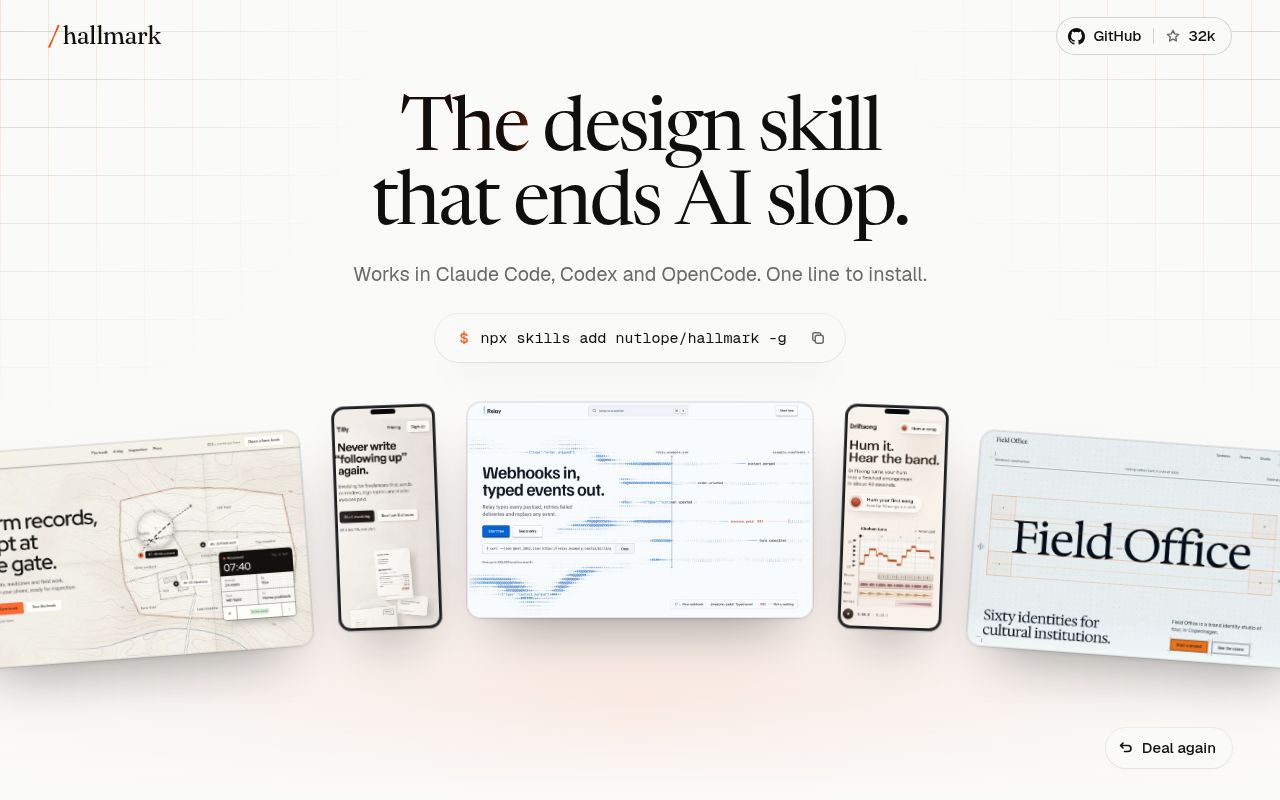
Hallmark reviews the hero before building the rest of the page
Hallmark asks its coding agent to build the hero alone, render it and get a fresh-context review before filling out the page. That is the most useful idea in its documented workflow. A weak opening can be corrected before the agent repeats the same choices across a long page. Whether this process produces better work remains outside our sandbox evidence.
The repository is a design skill for Claude Code, Codex, Cursor and OpenCode. It supplies directions and checks for an agent working on page code. You still provide the product, the intended action and real content. A team frustrated by repeated generic layouts may find that process useful, provided someone is prepared to judge the result rather than accept a clean report as proof of taste.
What happened when we ran it
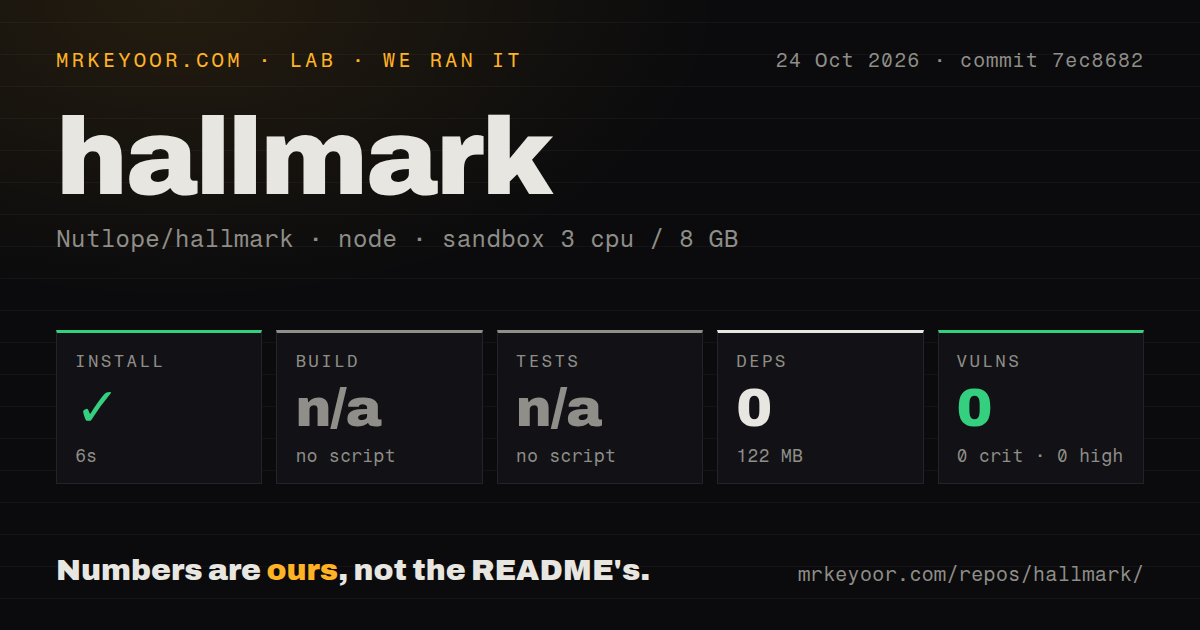
Our sandbox installed Hallmark commit 7ec8682 in 6 seconds on October 24, 2026, recording 0 dependencies and 122 MB on disk. Build was skipped because there was no build script or target. Tests were also skipped because there was no test script or target. This is a successful installation result with no build or test result to carry it further.
The checkout contained 820 files, roughly 13,293 source lines and 64.9 MB of data. The scan found 1 CI workflow file, no Dockerfile and no tests directory. Recording 0 dependencies should not be read as proof that every Hallmark feature needs no additional software: the README separately calls for browser tooling. The installed footprint is also distinct from the checkout size.
Our recorded configuration had 3 CPUs, 8 GB RAM and image lab-node:22. Actual runtime and operating-system versions require the raw logs. npm audit reported 0 known vulnerabilities, with 0 critical, high, moderate or low findings. That audit result does not evaluate generated interface behavior. We did not establish visual quality, working forms, keyboard access or responsive behavior through this run.
Chrome is required for the rendered checks
The README states that browser checks and screenshots need puppeteer-core and Chrome. Without them, static checks still run. That difference matters more than the short install: a source-level check cannot show you whether a heading fits the screen or whether a layout breaks at a particular width. Budget a working browser environment if rendered checking is why you want Hallmark.
Node 18 or later is the documented requirement. The skill can be added globally or to the current project, and the README lists separate invocation routes for the supported harnesses. Choose scope deliberately. Trying it in one project is a more contained evaluation than making its design directions available across every project you work on.
The agent’s own access and configuration remain separate. Hallmark does not establish that your coding assistant is authenticated or that it can run the required browser tools. Supply real screenshots or point it at the product so it has something specific to work from. Our installation measurement does not show that those connections were exercised.
Mandatory visual rules can conflict with a legitimate brief
Hallmark’s skill file bans eyebrow labels and purple-to-blue gradients in its mandatory Floor rules. It also requires visible keyboard focus and reduced-motion fallbacks. Some constraints protect usability, while others express a particular design preference. Read the mandatory list before adopting the process for a brand whose existing visual language depends on a forbidden treatment.
The README distinguishes mandatory Floor checks from Reflex defaults that may be overruled with a recorded reason. Finish checks address craft details without blocking handoff. Those distinctions are useful, but they do not make every style rule optional. A team should decide whether it accepts the mandatory choices before asking an agent to carry them across a product.
The default theme route deals choices from a catalog, while a custom request drops the theme recipe. Custom still follows the shared rules and checks. That is a useful escape from a preset palette, though it does not remove the mandatory restrictions. Choose it for a brief that needs its own visual direction, rather than assuming every subject should fit a catalog example.
Redesign checks preserve an inventory, while behavior needs inspection
The README documents redesign and audit as separate named operations. Redesign records links, fields, handlers and headings before changes, then checks whether they were kept. Audit only reports. This is a sensible safeguard for an existing page: a visual improvement should not casually discard a field or navigation destination.
An inventory comparison still leaves a practical acceptance question. A retained form handler may need checking against the actual service it calls, and a retained link needs the intended destination. Those are recommended checks, not failures we observed. For an evaluation, choose an existing page with a real action and verify that action before and after the redesign.
October activity supports a trial, without proving output quality
GitHub records Hallmark’s last push on October 22, 2026. The recent issue feed includes a relative-link report and pull requests, including theme-log work updated October 24. That shows ongoing reporting and contributions. It supplies no measured support response time and does not resolve the missing generated-page evidence from our run.
Impeccable provides design guidance and commands including audit, critique and polish. Consider it when a vocabulary for focused changes fits your workflow. Anthropic’s frontend-design skill gives guidance for intentional visual design. Consider it when you want to begin with a brief and written principles rather than Hallmark’s theme-dealing process. Neither alternative was compared in our sandbox.
For a Hallmark trial, use a page with real content and an action you can verify. Provide Chrome, inspect the narrow layout and use the form or link that matters. Keep the result only if the page works and the mandatory visual rules serve that particular brief.