GSD turns a five-step agent loop into durable project files
GSD Core v1.13.0 gives coding agents a fixed sequence: discuss a phase, plan it, execute the plan, verify the result, and ship it. The useful part is the record between those steps. Decisions, requirements, roadmaps, plans, and status live under .planning/ as readable files. A new agent can pick up those artifacts after the previous context is cleared. For a project that lasts longer than one chat, that is a more inspectable handoff than asking a model to reconstruct old decisions from conversation history.
The method has weight. The commit we measured contained 3,482 files and roughly 730,033 lines of source in a 55.5 MB checkout. GSD delegates research, planning, execution, and verification to fresh agents, while the main session coordinates the work. Its tutorial says executors commit each task, then the ship step opens a pull request. That opinionated path can reduce improvisation across a large build. It also means adopting GSD changes how a team plans, records decisions, and uses Git, rather than merely adding a few prompts.
What happened when we ran it
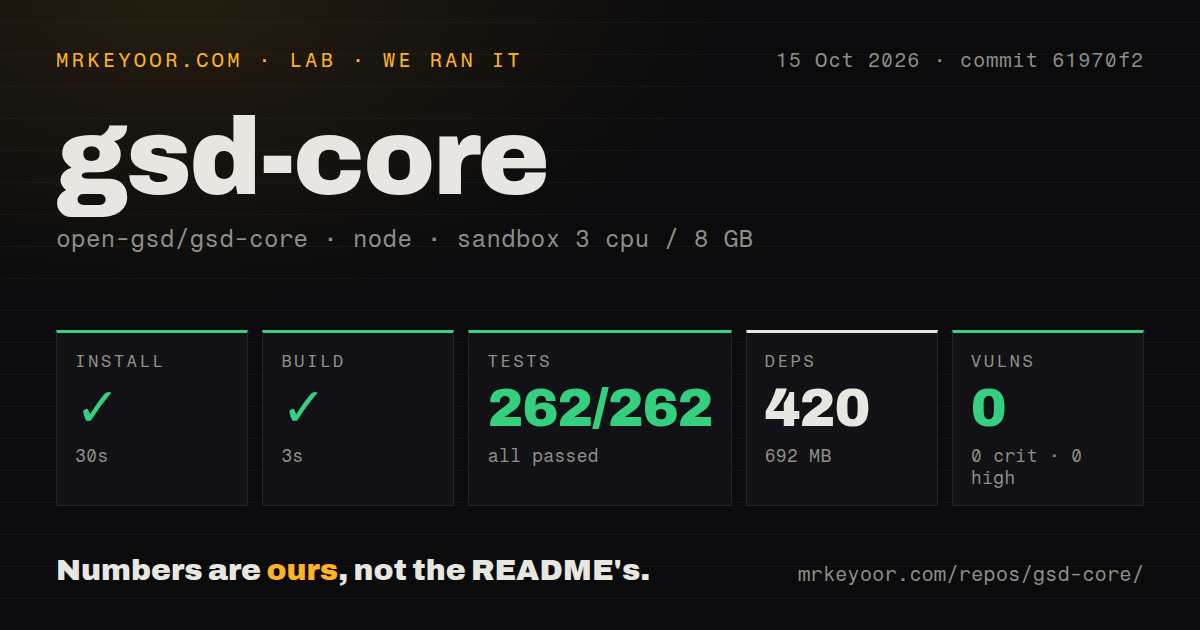
Our sandbox installed commit fd37b6a in 40 seconds, pulling 416 packages and taking 680 MB on disk. The build succeeded in 10 seconds. Npm audit reported 0 known vulnerabilities across the installed dependency tree. Those are sound results for installation and compilation, although 680 MB is a noticeable cost for a package whose user-facing entry point is an npx installer. The repository had 30 CI workflow files and a tests directory, but no Dockerfile, which fits a tool installed into an existing agent environment rather than a standalone service image.
The test command did not finish within our 900-second limit. Node's test reporter had recorded 1,733 passed and 0 failed out of 1,733 when the harness stopped waiting. The log ended after suite 197, an invalid-point contract group whose 4 subtests had passed. We cannot call the full command successful because it never exited, and the tail does not identify what kept it alive. Buyers should budget more than 15 minutes for the checked-out test path or narrow the command using the repository's documented unit, integration, install, security, and affected-test scripts.
One installer hides meaningful differences between agent runtimes
The README covers more than 10 named agent environments, including Claude Code, Codex, OpenCode, Cursor, Windsurf, and Pi. The installer translates source assets into each runtime's own command, skill, agent, and hook layout. That is useful for a team whose developers use different clients. The package also exposes a companion MCP server, which extends the integration story beyond copied prompt files. Local and global modes are documented, as are custom configuration roots and uninstall behavior.
Runtime parity remains incomplete. The Codex guide requires CLI 0.130.0, with the stable hook event schema needing 0.137.0 or newer, and says context warnings are unsupported there. Pi uses a plugin-only /gsd command instead of normal command files. Confirmed issue 4567 reports that v1.13.0 still tells Pi users to run /gsd-new-project, a command Pi never registers. A successful install therefore proves that files landed, not that every README workflow exists on the selected host.
Node requirements and state bugs need a trial project
The setup documentation disagrees with itself on a basic prerequisite. The package metadata for v1.13.0 requires Node 24.0.0 or newer and npm 10.0.0 or newer. The first-project tutorial says Node 22+ and npm 10+. Our Node 22 sandbox did complete the 40-second install and 10-second build, but that does not cancel the declared engine floor. Use Node 24 for evaluation, and treat the tutorial badge and prerequisite table as stale until the project reconciles them.
Two confirmed reports affect the files GSD uses as durable memory. Issue 4551 shows v1.12.0 deleting the word none inside existing blocker prose when another blocker is added. Issue 4564 says v1.13.0 returns empty decision and blocker arrays for the shipped STATE.md template while validation still succeeds. Both were updated on September 9, 2026. Until fixes ship, diff state files after writes and add a fixture based on your own headings before using progress summaries as a source of truth.
Same-day development is fast, with 178 issues and PRs in view
GitHub showed 9,285 stars, a September 9, 2026 last push, and 178 combined open issues and pull requests. Release v1.13.0 arrived on September 6. The recent queue includes detailed reproductions, linked fixes, regression tests, and maintainer responses within hours. That pace is evidence of active maintenance. It also exposes how quickly the workflow surface is changing: current confirmed reports cover phase numbering, state parsing, safety checks, and host-specific installation behavior. Pin the npm version instead of letting every developer run @latest unchecked.
GSD earns a trial when a codebase has enough phases that chat history and informal TODO files have stopped working. Spec Kit is the smaller choice for teams mainly seeking specifications and task breakdowns. Superpowers fits developers who want agent disciplines as selectable skills, while BMAD Method goes further into specialist roles. GSD's 416-package install and unfinished 900-second test command make little sense for a quick patch. On a long agent-led build, its inspectable project memory can repay that cost, provided humans review commits and verify the state machinery first.