Colossal-AI installed and built in our sandbox, then GPU tests reached a machine without an NVIDIA driver. That is a useful warning about the limits of a quick package check. If you're choosing a framework to spread training across accelerators, the decisive evaluation needs those accelerators. Our run exposes that boundary, along with a large environment and unresolved dependency-audit findings.
What happened when we ran it
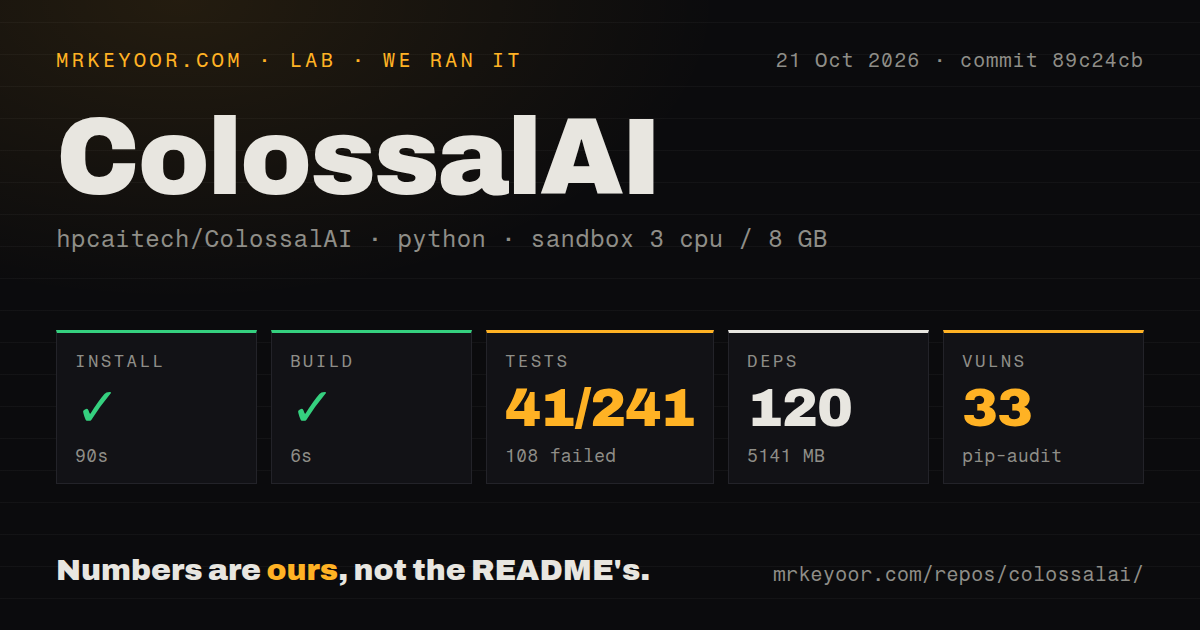
Our sandbox installed Colossal-AI commit 89c24cb in 90 seconds and completed the build in 6 seconds. Installation recorded 120 dependencies and 5,141 MB on disk. The October 21, 2026 run used 3 CPUs and 8 GB of RAM. Its recorded image was ghcr.io/astral-sh/uv:python3.12-bookworm; that label alone does not establish the actual interpreter or operating-system version.
The test command failed with exit 1 after 253 seconds. The supplied pytest summary reports 41 passed, 108 failed, 8 skipped, and 92 collection/setup errors, with a recorded total of 241. These are the supplied categories, not a basis for calculating a pass percentage. Collection and setup errors should not be silently folded into a claim about completed test cases.
The visible failures are context-attention cases under the Triton inference-kernel tests. Their RuntimeError says, "Found no NVIDIA driver on your system." That explains the displayed cases. The tail does not establish the cause of every failure or every collection error, so blaming all of them on the driver would be guesswork. Nor does this result demonstrate that the GPU kernels are broken on supported hardware.
Pip-audit reported 33 known vulnerabilities. The supplied evidence doesn't identify affected packages, severity, reachability, or available fixes. Treat that result as a requirement for inspecting the full audit before adopting the measured environment. It is not evidence of 33 exploitable defects in Colossal-AI itself. A successful build doesn't clear that separate dependency question.
Parallel components suit an existing training problem
The README lists data, pipeline, tensor, and sequence parallelism, along with ZeRO and heterogeneous memory management. These address how a training job divides computation and state across devices. That is a useful scope for an engineer who already knows which model or batch exceeds a hardware budget. It is a less helpful starting point for someone who simply wants an application to answer prompts.
Colossal-AI also contains inference work and examples for language and image models. The examples can help identify a relevant route, but their presence doesn't prove a speedup for your job. Our sandbox supplies no training throughput or model-quality result. I would choose a specific parallel component to evaluate, with a working baseline, before taking on the framework's broader collection of examples.
The checkout had 2,425 files, roughly 340,539 source lines, and occupied 17.5 MB before installation. Compare that with the 5,141 MB installed environment we measured. The repository download is a poor guide to the disk budget needed for development. Model weights and training data add their own costs, which this run does not quantify.
The documented route requires Linux and CUDA
The README specifies Linux, Python from 3.10 up to but excluding 3.13, and PyTorch from 2.2 up to but excluding 2.14. It also calls for CUDA 11.0 or newer and NVIDIA compute capability of at least 7.0. Those are upstream requirements, not toolchain versions observed in our run. They give a Windows or macOS developer a concrete reason to arrange a separate supported environment.
No hosted model-service credential is inherently part of using the local framework. You still need access to the chosen weights and data, plus whatever credentials your cluster or storage requires. The README's commercial cloud promotion is a separate service offer. Don't confuse access to a preconfigured cloud environment with evidence that your own machines satisfy the project's requirements.
Our scan found 31 CI workflow files and a tests directory, but no Dockerfile. The README separately describes published container images and a Docker workflow. That difference limits what the file scan can tell us. It neither disproves the container documentation nor verifies that a container would solve the failures in the supplied run.
An older release tag coexists with October activity
The latest release endpoint returned v0.5.0, published June 4, 2025. GitHub also reported a last push on October 22, 2026, while the recent activity feed contained issue and pull-request updates during October. The release date alone would give a misleading picture of maintenance. There is ongoing work, although this review does not establish support response times or the reliability of unreleased changes.
Keep the distinction between a release and a source commit when evaluating Colossal-AI. Our results belong to 89c24cb, not automatically to the old tag or today's main branch. Record the model and framework revisions together, and require a checkpoint save-and-restore exercise on the intended hardware before committing an expensive training job. Our sandbox did not perform that exercise.
Accelerate and DeepSpeed offer other entry points
Hugging Face Accelerate targets PyTorch users who want to retain their training loop while reducing distributed-execution boilerplate. Start there if coordinating an existing script is your main problem. DeepSpeed documents ZeRO and parallel-training approaches, making it another candidate when memory distribution is the reason you need a framework. We have no comparative performance result for these alternatives.
For Colossal-AI, proceed with a workload trial only after checking the audit details and provisioning the documented hardware environment. The failed sandbox suite gives you questions to resolve, not a verdict on supported GPU execution. Make the next evaluation prove that your chosen parallel configuration trains correctly and can resume from its checkpoint.