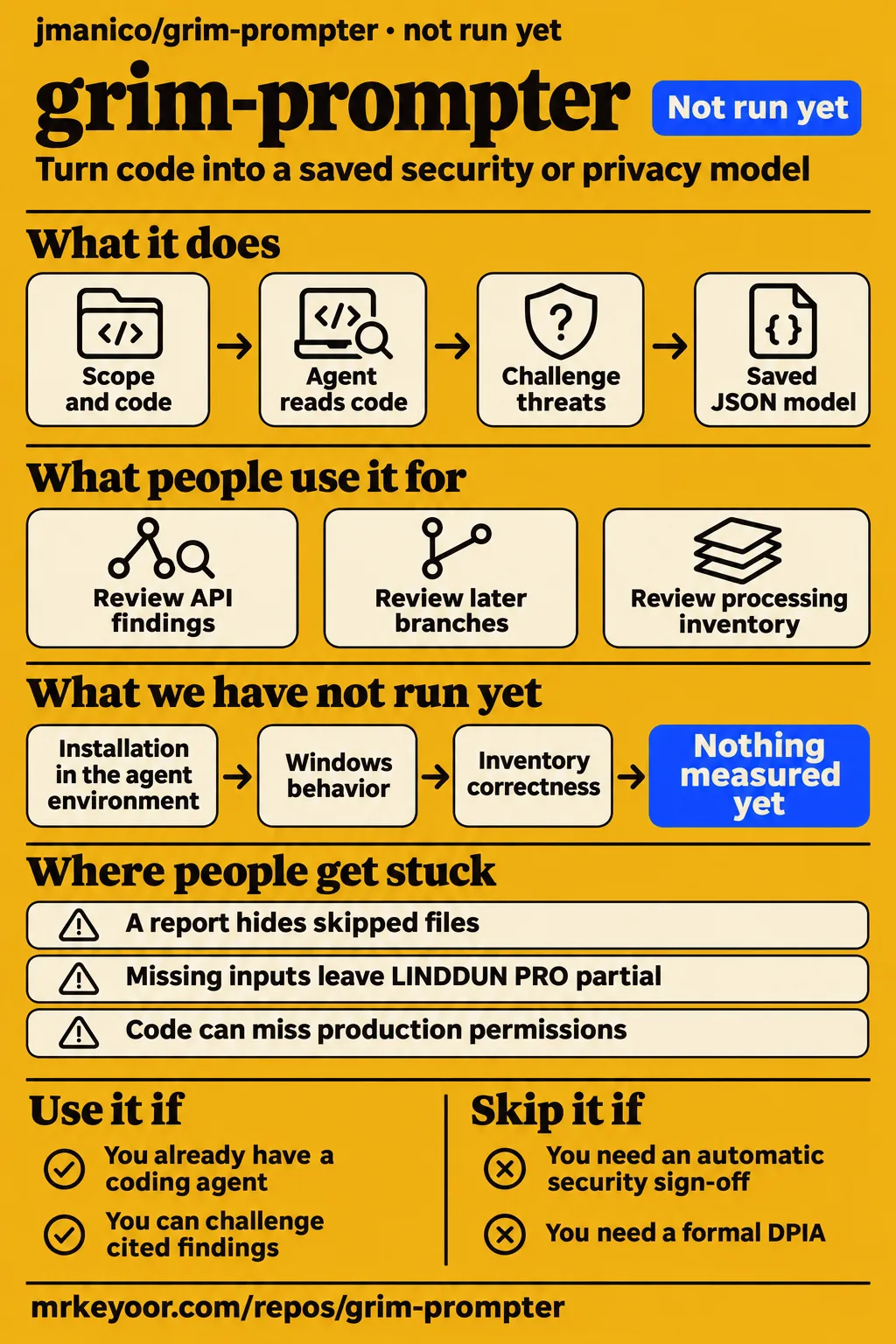
Grim Prompter documents a way to turn a coding agent's security review into a report another engineer can inspect: cited source files, recorded coverage and a saved model for later changes. Use it if you can challenge those findings and want to maintain that model. Skip it if you need an automatic security sign-off. The adoption question is whether its evidence trail fits your review process, especially when authentication, workers and external services cross different boundaries.
What you can do with Grim Prompter
Grim Prompter documents quick threat models, six-stage deep analysis and change reviews against an earlier JSON baseline. The project README asks you to name the decision, services, directories, exclusions and relevant design documents before the review begins. That gives the report a defined job: examining a shipping API, for example, rather than producing an unrestricted list of suspicious code throughout a repository. The scope is an input the reviewer supplies, alongside the code and any existing model.
Change review requires both a code diff and the earlier model. The README says the agent asks for the model when it is missing. This matters when you want to preserve a system's history: the earlier report records the assets, boundaries and assumptions the new branch may change. Supply the saved JSON file alongside the branch range so the review can connect a changed route or recipient to the existing model.
The documented outputs separate evidence from findings. SYSTEM_UNDER_REVIEW.md records scope, inspected files, read extent, skipped areas and unmapped trust boundaries. report.md contains findings, proposed mitigations and test plans; JSON artifacts carry the model between stages and into later reviews. That separation gives an engineer a useful review order: check what the agent inspected, challenge the threat, then decide what engineering work follows. The saved files also give a later reviewer something concrete to examine when the system changes.
What people use grim-prompter for
The supplied API-video synthesis describes a presenter manually following Grim Prompter's quick workflow on a test application and reporting three findings with file-and-line references. It identifies an invoice lookup missing an ownership check, a profile update accepting an admin role and a payment webhook trusting a paid status. These are the presenter's reported findings. The API walkthrough record supplies the demonstration, separate from our sandbox attempt.
The invoice example gives a concrete question to take into a review. A route requiring a session establishes who is logged in; an ownership check decides whether that account may read the requested invoice. Following the lookup to its cited code helps a reviewer distinguish those decisions. The profile and webhook examples similarly direct attention to who controls a privileged field and which party supplies evidence of payment. Those are specific questions a service owner can investigate in the cited implementation.
The README also documents privacy reviews and reviews of later branches, while the supplied synthesis contains one observed use case: the manually followed API example. For an initial evaluation, choose a service whose authorization paths its owner understands. The useful deliverable is a finding someone can explain from the cited code and turn into an engineering decision. The saved scope and evidence records give that person a starting point for checking how the report reached its conclusion.
What happened when we ran it
Our run at commit 2a94457 on 2026-11-18 recorded NOT RUN: no supported ecosystem, language null, and no Dockerfile. The sandbox configuration was 3 CPUs and 8g RAM, with image n/a. These figures describe our attempted harness evaluation. The sandbox measurement records the admission outcome; the separate hands-on records document a failed Compose safety check and successful cleanup. The table preserves each recorded check and distinguishes its result from the interpretation used in this review.
| Question | Answer | Verdict | Why |
|---|---|---|---|
| Did ecosystem detection select an execution path? | No supported ecosystem; language null | NOT RUN | The harness selected no supported execution path |
| Was a Dockerfile available? | No Dockerfile | No container execution result | The harness recorded no Dockerfile-based execution |
| Did the separate hands-on safety step pass? | FAILED: no compose.yaml, compose.yml, docker-compose.yaml or docker-compose.yml | Admission stopped | The safety rule required a Compose file |
| Did teardown complete? | ok | Cleanup completed | The teardown record reports ok |
The hands-on safety step labels the checkout unsafe because its admission rule requires a Compose file. That is the harness's classification, rather than a discovered vulnerability in Grim Prompter. The documented installation links prompts into an existing coding agent. A harness looking for an application ecosystem or Compose deployment therefore follows a different path from the README's installation procedure. The failed admission step belongs in the result because it explains where the attempt stopped.
The hands-on run metadata says the project was deployed with its own Docker Compose on 2026-11-18, with every port bound to 127.0.0.1. The failed safety step contradicts that deployment sentence, and the harness outcome is NOT RUN. The teardown record independently records cleanup as ok. Read together, the records support a stopped attempt and cleanup rather than a deployment success.
Where people get stuck: missing reads behind a confident report
Issue #5 identifies silent coverage gaps, and the maintainer says PR #6 implemented a file/read-extent ledger, skipped areas with reasons, unmapped trust-boundary gaps and a coverage summary before findings. The coverage discussion in issue #5 explains the problem: a report can look complete even when the agent has inspected only part of the repository. Read the coverage summary before using severity labels to prioritize work, and compare it with the services named in the review request.
| Problem in the records | What changed or what to do | Status supported by the record |
|---|---|---|
| A report hides skipped files or boundaries | PR #6 adds the coverage ledger and summary | Maintainer reports implementation in issue #5 |
| Privacy requires naming isolated methods | PR #8 adds quick/deep privacy and inventory outputs | Maintainer reports completion in the supplied issue synthesis |
| Overlapping privacy proposals invite duplicate work | Read the merged implementation before proposing the same entry point | The supplied issue #7 synthesis reports that the work was merged |
| LINDDUN PRO needs source material | Supply lawful applicable method inputs | Current README describes a partial selected method when prerequisites are missing |
Compare the ledger with the service you asked the agent to examine. Authentication middleware, background workers and outgoing requests may occupy different directories. A file name alone tells you less than its read extent and the reason another area was skipped. The README also asks reviewers to distinguish fresh reads from carried evidence. That distinction helps someone returning to a saved model understand which evidence the current review gathered and which evidence came from an earlier stage.
The privacy history gives a separate reason to read the merged work before contributing. The supplied synthesis of issue #9 reports implementation through PR #8 and a contributor acknowledging that their proposed quick-privacy slice was already covered. Its synthesis of issue #7 likewise reports that the maintainer said the work was merged and invited review. Those discussions direct contributors toward examining the implementation before duplicating its entry points.
Privacy scope determines the inventory
The README says bare privacy requests select engineering analysis without a LINDDUN method or regulatory profile. It documents quick privacy, six-stage deep privacy and combined security-and-privacy reviews. The privacy documentation treats privacy as a review scope: the agent examines processing and harms to people while still modeling the system's architecture. Choosing a method and choosing that scope are separate decisions, so the requested deliverable should guide the wording of the review request.
The supplied synthesis of the skill routing record gives a precise example: a deep API security review with LINDDUN PRO retains security scope, adds no profiles and writes no data inventory. If the deliverable you need is a processing inventory, request privacy scope. Quick privacy documents quick-report.json, report.md and DATA_INVENTORY.md; deep privacy ends with 05-report.json, report.md and DATA_INVENTORY.md, with an immutable preliminary inventory at stage 01.
The inventory is derived from its source JSON and lists modeled data, purposes, affected people, recipients, flows, retention/deletion details and unknowns. That provides specific material for a privacy engineer to inspect. The README also documents a bounded evidence pass covering logs, telemetry, recipients, deletion paths, collection and identifiers. Name the relevant directories and local method files in the request so the resulting model has explicit inputs and a scope its reviewer understands.
Agent permissions enforce the execution boundary
The README requires explicit authorization for builds, tests, scripts, installs and network access. It instructs users to enforce those limits through their coding agent's permissions. The supplied synthesis of PromptHackers' overview describes the runbook boundary as behavioral. Configure permissions before asking the agent to inspect a sensitive repository, then authorize proposed execution separately and record its outcome. This follows the README's distinction between inspecting evidence, proposing a test and performing that test.
Generated reports also need a deliberate destination. The README asks users to keep them out of version control until sensitive details have been reviewed, and says the library's ignore rules cover only its own checkout. If reports are written inside an application repository, that repository's rules determine what Git includes. A report describing privileged paths, recipients and controls deserves attention to handling alongside the source evidence behind it.
The supplied synthesis of the LinkedIn discussion attributes a practical recommendation to Bernardo Meireles Correa: pair repository inspection with a dump of what the running workload authenticates as. His example is a production role widened for a migration and never narrowed again. For an access review, bring runtime identity and grant evidence alongside the source-level call paths so the reviewer can compare the intended access with the deployed permissions.
Project activity and report quality answer different questions
Recent pushes and maintainer replies document project activity; report quality depends on the generated evidence and findings. The supplied GitHub facts record a last push of 2026-11-08, while the issue records and synthesis describe maintainer replies about coverage reporting and privacy workflows. The repository metadata supplies the activity date. These records give prospective users concrete changes to follow through the tracker, then compare with the artifacts produced for their own review scope.
The supplied social and video records raise adoption questions from another direction. RoundtableSpace's X post introduces the code-cited workflow, and the supplied synthesis of the risk-identification video asks how much risk identification to entrust to AI. The README assigns the operational decisions to people: challenge threats, supply risk criteria, choose mitigations and assign owners. Those responsibilities explain what a reviewer must do with the report after the agent writes it.
Grim Prompter vs Claude Code review, Superpowers and Hermes Agent
Choose Grim Prompter for a security or privacy model, Claude Code review for diff correctness according to PromptHackers, Superpowers for a broader development process, and Hermes Agent when selecting the agent itself. These choices organize different jobs. Superpowers describes a methodology built from composable coding-agent skills, while Hermes Agent describes an agent with a built-in learning loop. PromptHackers supplies the narrower recommendation for correctness bugs in a specific diff.
| Alternative people compare | What the comparison provides | How to use it in a decision |
|---|---|---|
| Claude Code review skill | PromptHackers distinguishes diff correctness from design threats | Follow that recommendation when the immediate task is correctness in a specific diff |
| Hermes Agent | Its README describes an agent with a built-in learning loop | Consider it when choosing the agent itself |
| Superpowers | Its README describes a development methodology built from composable skills | Consider it when choosing a broader development workflow |
| mattpocock/skills, rea | SkillsLLM supplies popularity and fork comparisons | Treat those pages as community-interest summaries |
| machine-skill | Mid or Real publishes dated opinion scores and names no winner | Read its scores as that publisher's opinion |
The Superpowers README explains design discussion, planning, implementation and review as parts of its workflow. The Hermes Agent README describes memory, skill creation and conversation recall. Grim Prompter's documented role is more specific: structure a security or privacy model inside a coding agent. Choose according to the job you need to organize rather than treating every repository on a comparison page as the same kind of product.
The secondary rows come from the supplied skills comparison, rea comparison and machine-skill comparison. The Hermes popularity comparison explicitly calls its signals indicators of community interest. The supplied synthesis of PromptHackers' diff-review guidance supplies the Claude Code recommendation. The primary READMEs supply the scope descriptions for Superpowers and Hermes Agent.
What the other reviews get wrong
ForkFree claims that Grim Prompter saves small teams time, while its testing disclosure says it has not run the project. Its overview and testing disclosure describe reading the README and license and running automatic checks. Read the time-saving statement as an expectation about the workflow. The page discloses its method; the correction concerns the strength of the conclusion drawn from that method. Any assessment of saved effort also needs to account for reviewing the resulting findings.
SkillsLLM's supplied comparison pages also say neither project includes a SKILL.md file. For Grim Prompter, that statement conflicts with the supplied threat-model skill record, whose source path is skills/threat-model/SKILL.md. The README's installation instructions likewise link that skill into an agent. This corrects the Grim Prompter side of the skills comparison, rea comparison and Hermes comparison using the supplied project evidence.
A useful adoption decision includes the effort of checking generated findings. The README assigns reviewers work: inspect coverage, challenge prerequisites and existing controls, select mitigations, assign owners and review proposed tests. Those steps belong in an assessment of saved effort. The documented artifacts tell an engineer what to examine, and the supplied API demonstration offers an example to discuss with the service's owner. That is a more concrete starting point than a general promise about time saved.
FAQ
The README installs Grim Prompter by cloning the repository and linking its threat-model skill into an existing coding agent. The supplied API walkthrough and ForkFree synthesis both raise installation questions. The answers below address that choice and the other reader questions in the supplied synthesis: execution permissions, deeper analysis, responsibility for findings, commercial use and available workflows. Each answer follows the project documentation rather than treating the sandbox admission attempt as an installation walkthrough.
How do I install Grim Prompter?
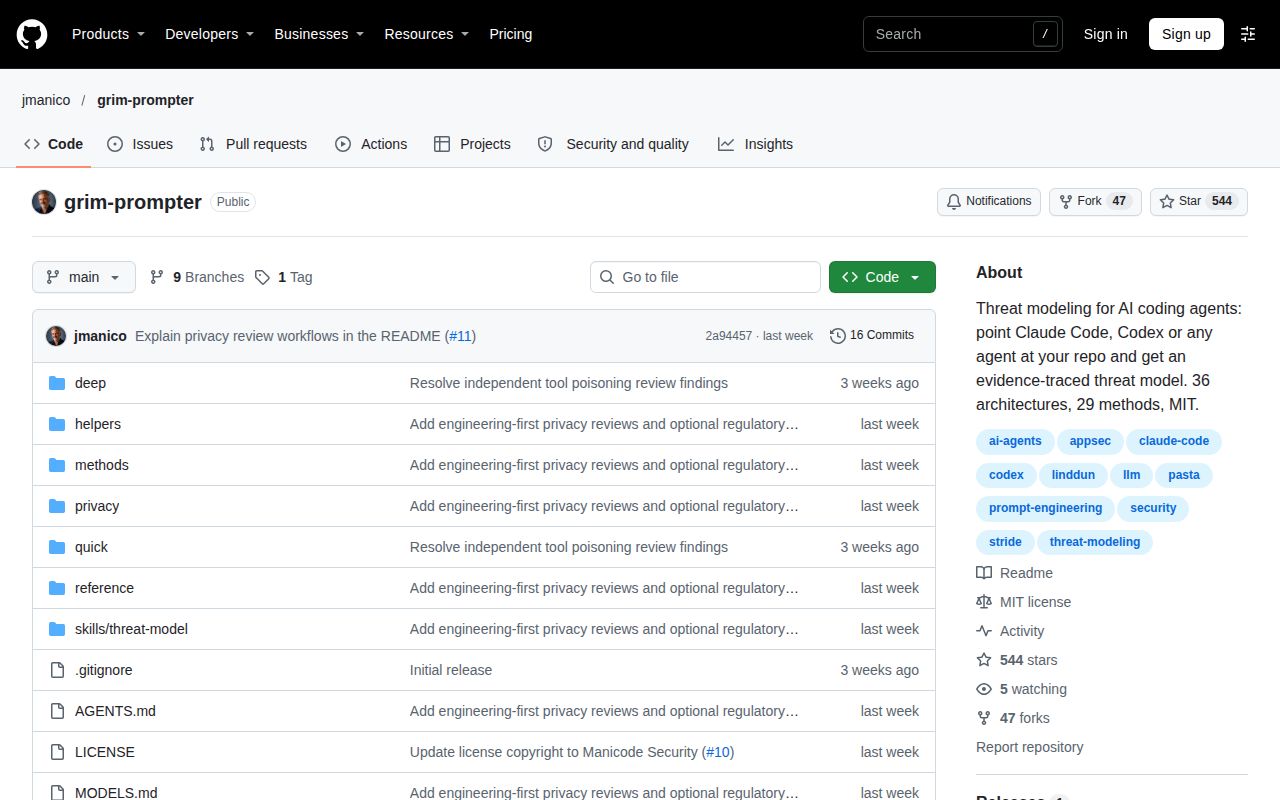
Clone the repository, link skills/threat-model into your agent's skills directory and start a new session. The README installation section gives separate destinations for Claude Code and Codex CLI. Keep the clone in place because the link points back to its prompts, and check for an existing installation before adding another. Other agents can use the documented project-instruction snippet with the path to the clone.
Does Grim Prompter execute builds, tests, or network requests?
The documented default is read-only inspection, with builds, tests, scripts, installs and network access requiring explicit authorization. The README run instructions tell users to enforce this through agent permissions. A proposed test belongs to the report's plan; actual execution requires separate authorization and an actual result. Review the plan's pass, fail and inconclusive criteria before deciding to run it, then record what the execution actually produced.
How do I go deeper than a quick threat model?
Request deep mode for the documented six stages: scope, system modeling, threat analysis, challenge, treatment planning and reporting. The README workflow table gives /threat-model deep web for Claude Code and $threat-model deep web for Codex CLI. Each stage reads the earlier stage's file, and continuation uses the saved run folder. Naming that folder gives the next stage the artifacts the workflow expects to carry forward.
How much risk identification should I entrust to AI?
The README calls the prompts drafts and assigns humans responsibility for challenging and prioritizing findings. Its review procedure asks reviewers to examine prerequisites and controls, supply risk criteria, choose mitigations and assign owners. Use the report to organize that work. Accepting a finding or a fix requires examining the supporting evidence and recording the relevant outcome, including the result of any separately authorized test.
Can I use Grim Prompter commercially?
The README says its MIT license permits commercial use, modification, distribution and selling copies, with copyright and permission notices retained in copies or substantial portions. Its license explanation separately identifies the original method publications and their owners. That distinction matters when packaging prompts or supplying method material: the prompt library's license and the required method sources are separate parts of the review setup.
What can I do with Grim Prompter?
The README documents quick threat modeling, deep analysis, privacy reviews, individual methods and change reviews against a saved baseline. Choose the request around the decision and deliverable you need: a scoped security model, a processing inventory or an update to an existing model. The README workflow descriptions also explain the saved artifacts, giving the person responsible for the review a concrete checklist of outputs to inspect.
What we have not tested yet
Our sandbox produced no threat model, installation result or effectiveness assessment for commit 2a94457. The supplied current README documents workflows without proving that every described behavior belongs to that exact checkout or the separately recorded v1.0.0 release. Installation in the documented agent environment, Windows behavior, generated coverage-ledger quality and independent privacy-workflow results remain outside the completed work. The image label n/a supplies no runtime or operating-system version. The documented requests on this page were not executed for this review.
The API presenter left proposed tests unrun and internal-address access as a hypothesis because network evidence was missing. The supplied excerpts also omit the complete code behind the three findings, so this page reports their substance from the supplied synthesis rather than offering corrected application code. The records provide no reproducible effectiveness benchmark, false-positive rate, measured token consumption, operating cost, comparative security-performance result or measured time saving. Recent project activity supplies no substitute for those results.
LINDDUN PRO requires a data-flow model and lawful applicable mapping/threat-tree guidance; LINDDUN GO requires lawful card material and participant contributions. The README says missing prerequisites leave the selected method partial. Regulatory profiles are explicit opt-ins, and their outputs do not certify compliance or complete a formal DPIA. The supplied records contain no completed check of profile applicability, inventory correctness or repository boundaries against production identities and grants. A threat model also does not certify that a system is secure.
Issue #5 places the suggested second-model rating comparison outside the coverage fix. Issue #7's sample-repository privacy review is a contributor's future plan, and its review-format question has no recorded maintainer answer. The four editorial score dimensions remain unassessed for the evidence gaps described here. Rendered layout, automatic related links, recommendation modules and template content are also outside this text review. For a first evaluation, choose familiar authorization paths, inspect the ledger and compare one reported threat with its cited code before separately authorizing a test and recording its outcome.