The alpha gives one document a layer view and a node view
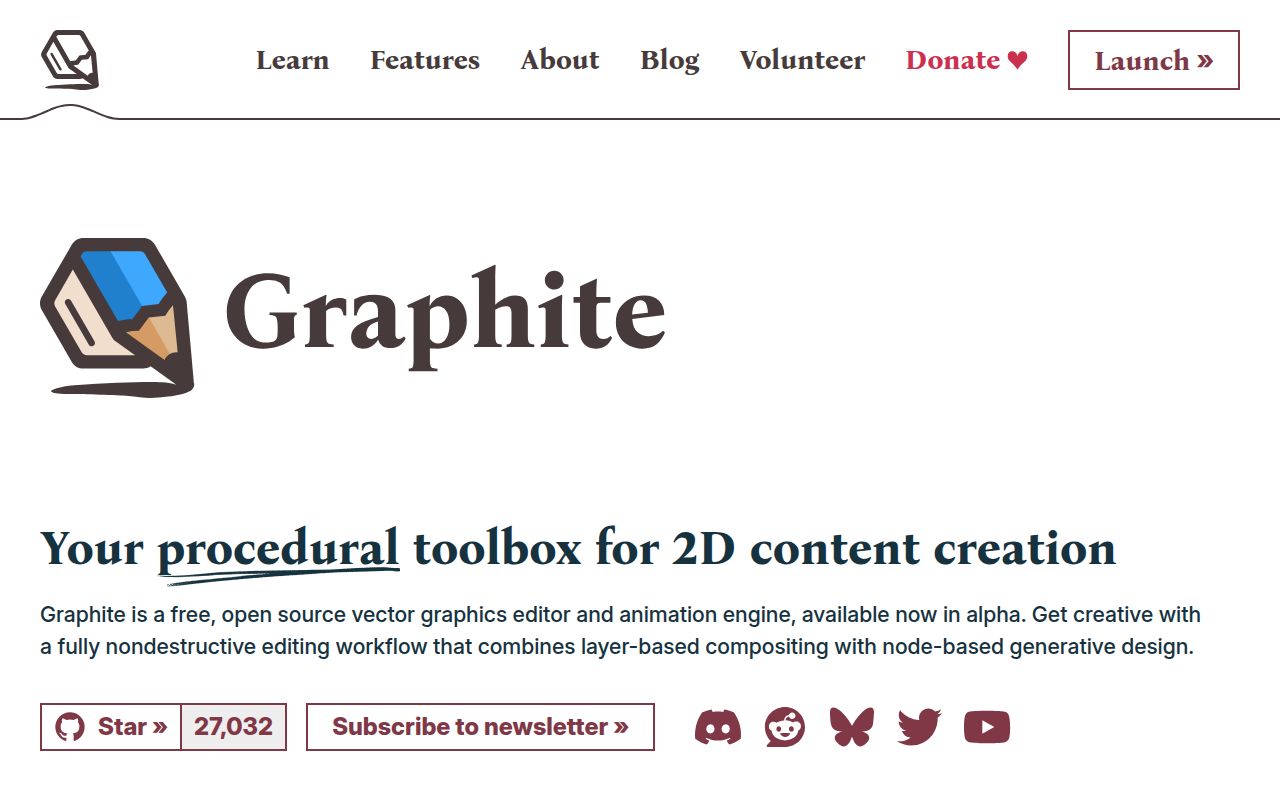
Graphite's current alpha is a 2D vector editor with a procedural engine underneath. The layer panel and node graph are two views of the same document structure, so a designer can use ordinary canvas tools, edit nodes directly, or move between both. That is the reason to try Graphite. It brings parameter-driven construction into a workflow that does not force every user to begin by programming a graph.
The repository has grown well beyond a drawing demo: our checkout contained 1,046 files and roughly 206,883 lines of source. Its node engine handles the operations behind interactive tools, while the browser interface exposes layers, properties, and the canvas. Nondestructive edits keep earlier construction steps available. This approach suits patterns, repeated geometry, and art that needs controlled variations more naturally than a stack of permanently altered pixels.
What happened when we ran it
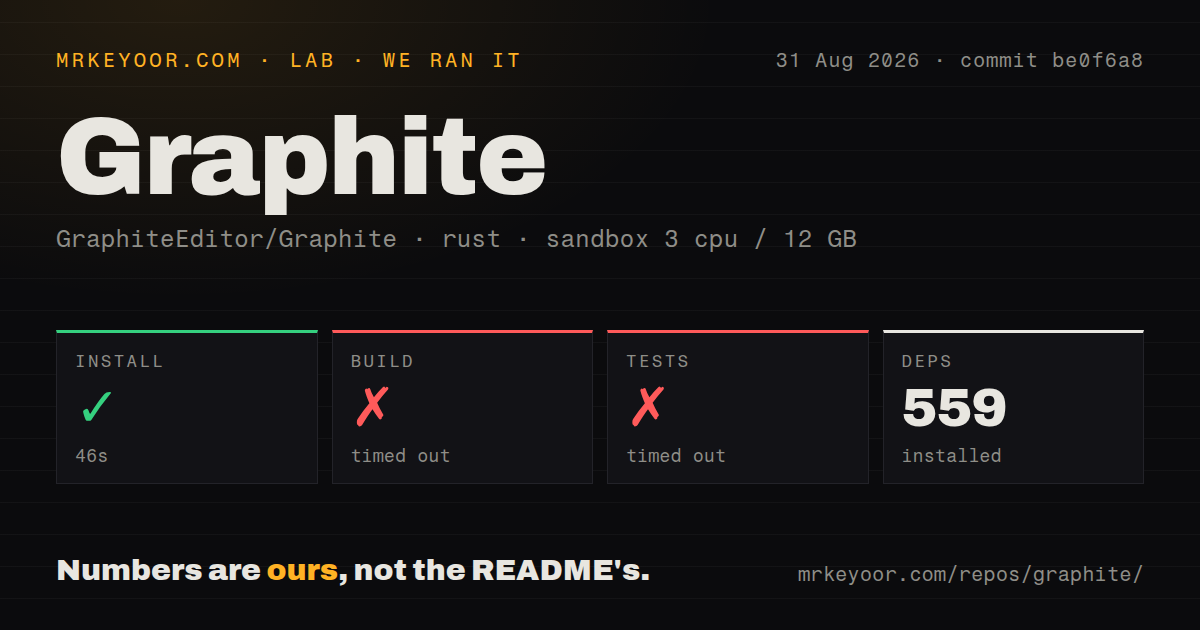
Our sandbox installed 559 packages in 46 seconds at commit be0f6a8. The checkout occupied 14.6 MB before those packages and ran inside an unprivileged container with 3 CPUs and 12 GB of RAM. The repository has 10 CI workflow files. It has no Dockerfile and no tests directory, although the detected Rust commands did begin a substantial compile.
The build did not finish within 900 seconds. A separate test command also timed out at 900 seconds. Its final lines showed Rust compiling diff, color, yansi, pretty_assertions, and env_logger, followed by local packages including math-parser, raster-nodes, graph-craft, graphene-std, document-graph-storage, and document-format. No assertion failed in the visible tail. Both results are compile timeouts, so neither step passed.
A 46-second dependency step led to two 900-second timeouts
Graphite's source guide asks for the latest stable Rust, the current Node.js LTS, and Git. From the repository root, cargo run checks versions and starts a development server at port 8080 with file watching for Rust and frontend changes. Contributors also use Cargo for checking, linting, and formatting, while the frontend directory has npm commands for code checks and fixes. The setup is documented clearly; the compile cost remains the practical barrier.
Our 12 GB sandbox did not run out of memory and the log did not name a missing system package. It simply remained in compilation when each 900-second allowance ended. The evidence supports a narrow conclusion: a clean build and test cycle on this 3-CPU machine takes longer than our 15-minute cap. Developers should budget a warm build cache and avoid treating a first source checkout like a quick frontend install.
Raster editing is experimental and print support is later work
The official feature page describes the current raster toolset as limited and experimental. Graphite can combine vector and raster content and redraw procedural artwork at the current viewing resolution, but its broader selection tools, adjustments, filters, effects, raw photo processing, and painting behavior remain assigned to later roadmap stages. The README also names photo editing, digital painting, desktop publishing, and VFX as future competencies rather than current finished modules.
Version 1.0, a stable document format, desktop releases, PDF export, and local-font access appear in the Alpha 5 roadmap. CMYK, spot colors, ICC profiles, and import for PDF, EPS, AI, DXF, PSD, and TIFF sit farther out. Those labels matter. Graphite is credible for procedural vector experiments now; the roadmap does not make it ready for a print shop, an archive workflow, or an Adobe-file interchange requirement.
Open reports reach saved documents and exported text
Issue 4432 on unreadable saved documents says a NaN value can be serialized as null and then fail to load. The report says affected users must edit the JSON manually to recover the document and suggests checking for NaN before saving. That is a serious alpha boundary. Keep exported copies, use simple test files first, and retain source assets outside the editor.
Issue 4155 on CLI text export reproduces text layers disappearing from PNG, JPG, SVG, and GIF output. Issue 3862 on clipped circle export shows a vector cut at its right and lower edges. Neither report proves every export is broken. Together they justify opening every delivered file in a second viewer and checking text, bounds, fonts, and resolution before deleting the editable document.
Firefox 153 has a reproducible eyedropper crash
Issue 4399 on Firefox 153 reports a Windows 11 crash after selecting the eyedropper and clicking the canvas. The reporter reproduced it in a private window and a new Firefox profile, while Chromium and LibreWolf did not fail. That specificity makes the workaround straightforward for a trial: use a tested Chromium build when color sampling matters, while keeping in mind that another browser is only a workaround for this report.
The same project has 380 open issues and 178 open pull requests. That large queue includes feature tracking, refactors, browser defects, and user-facing bugs, so the combined count is not a defect total. It does show the size of the unfinished surface. Anyone evaluating the alpha should search the open queue for the exact browser, import format, export target, and tool they plan to use.
September 1 activity has not produced ordinary releases
GitHub recorded 27,032 stars and a last push on September 1, 2026. Issue and pull-request activity also continued into September, which is much stronger health evidence than an old tag. GitHub's latest-release endpoint returned no current release object. The source is active, yet downstream users still lack the versioned release rhythm expected from established desktop graphics software.
Issue 4227 on downstream packaging explains the consequence: a Linux package maintainer cannot find normal signed release artifacts tied to a known version. Graphite is easy to sample through the hosted web alpha and expensive to treat as pinned desktop infrastructure. Try its procedural editor on disposable copies, watch the active development, and wait for ordinary releases before making it the only tool that can open important work.