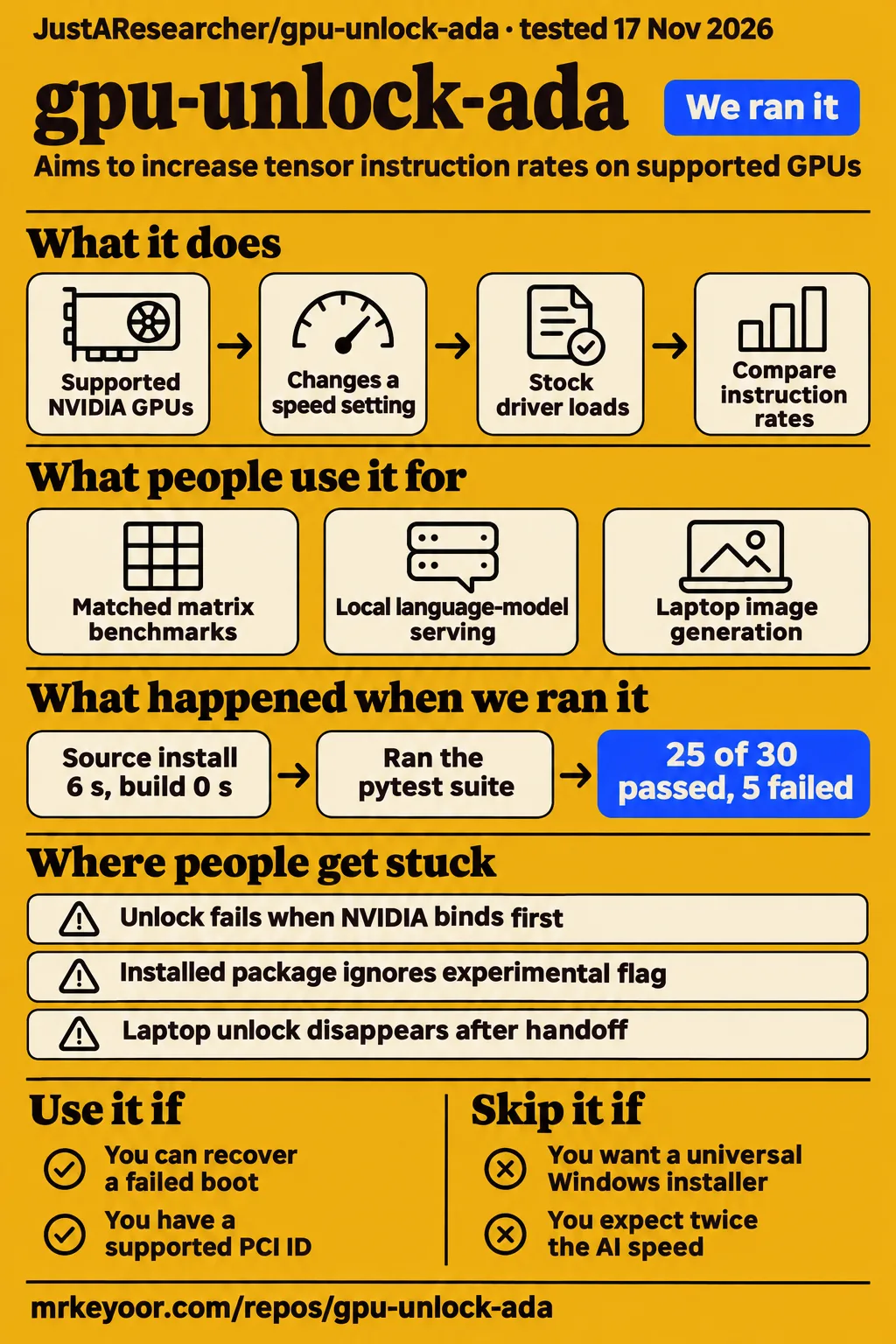
Doubled instruction rates do not double every workload
An independent RTX 4090 owner reported FP16/FP32 instruction throughput rising from 162.7 to 327.6 TF/s, while application matrix results varied by shape. Use gpu-unlock-ada if you own a supported card, can recover a failed boot and have a specific floating-point workload to compare. Skip it if your reason is simply that a post promised twice the AI speed. Our sandbox's install step succeeded, but its test command failed. RTX 4090 reproduction
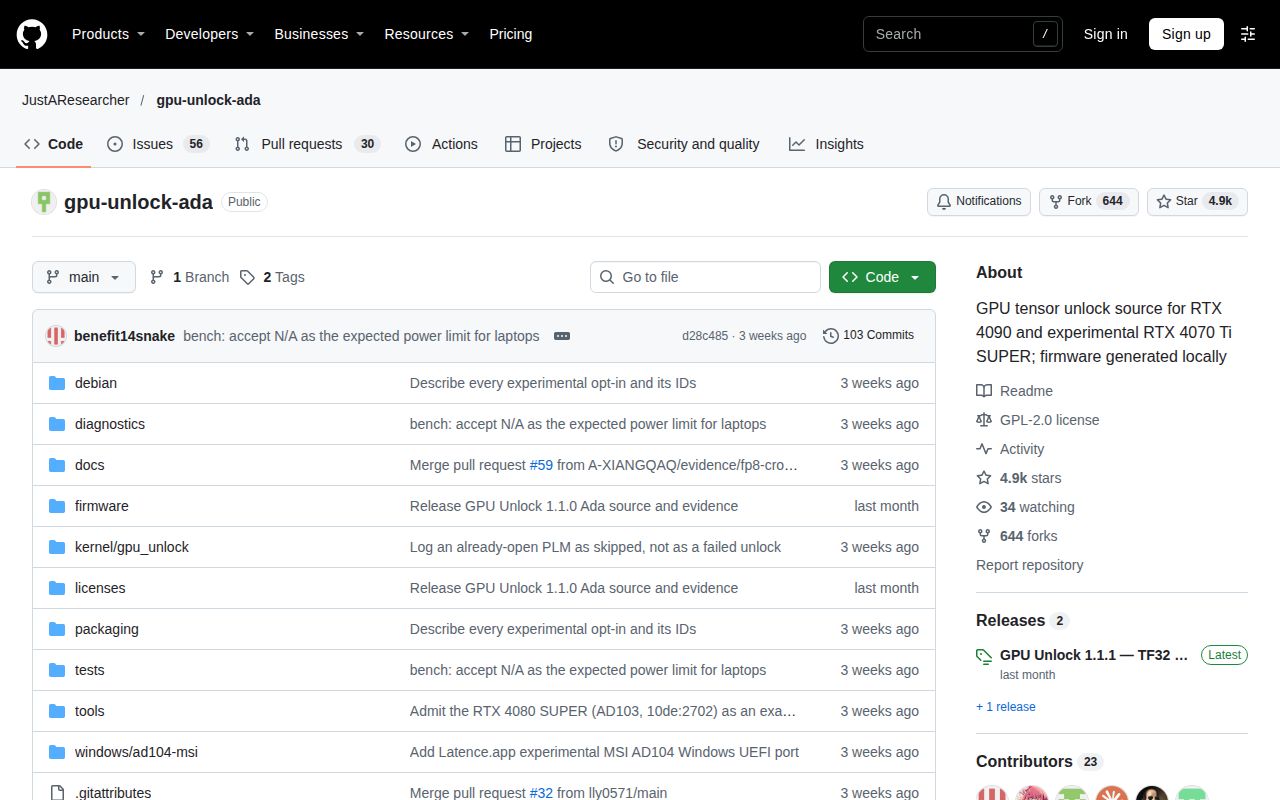
JustAResearcher's project is a Linux kernel module that changes a protected GPU speed setting before the normal NVIDIA driver takes control. It targets the rate of particular tensor instructions, the small matrix operations used inside larger AI calculations. The GPL-2.0-only project keeps the stock driver and generates firmware assets locally. An experimental Windows reference port and separate community ports require their own hardware profiles. Project README
That distinction determines the buying decision, even though the software is free: spend your time here if the affected instructions occupy a meaningful part of your actual job. A microbenchmark repeatedly issuing one instruction answers a different question from how quickly a model generates its next token. Keep those results in different columns.
What people use gpu-unlock-ada for
Owners have used it for matched matrix benchmarks, local language-model serving and laptop image generation, with sharply different outcomes.
| Who ran it | What they did | What they reported |
|---|---|---|
| Independent RTX 4090 owner | Compared stock and unlocked instruction rates, cuBLAS matrix multiplication and numerical outputs | FP16/FP32 rose from 162.7 to 327.6 TF/s; matrix gains depended on shape and included a BF16 regression. Evidence report |
| Oceanswave, ASUS RTX 4090 owner | Ran GEMM and a local language-model server | FP16 GEMM +10%, BF16 +17%, TF32 +56%; prompt processing +2.6%, generation -7%. Report in Zagitta issue #157 |
| japatton, Lenovo Legion Pro 7 Gen 9 owner | Compared PyTorch matrix work and SDXL | Matmul rose 1.74 to 1.86 times and SDXL 1.33 times, with byte-identical outputs and no Xid reported. Laptop issue #4 |
| xPokerr, RTX 4070 SUPER owner | Compared instruction throughput, cuBLAS and quantized llama.cpp | Instruction rate rose from 76.7 to 153.6 TF/s; quantized inference gained nothing. Issue #33 |
Oceanswave's result is the most useful one for a person hoping to accelerate a chat server. The card passed the unlock transaction. Dense matrix work improved. Then the application split in two: reading the prompt became slightly faster, while generating tokens became slower. Calling that entire run an AI speedup would conceal the result the server operator needs.
The Lenovo report makes a different case. A 1.33-times SDXL result is an application measurement someone generating images can recognise. It belongs to that laptop and that workload. The same issue also records ilikenwf's Clevo completing the transaction without a throughput improvement. Shared GPU IDs did not make those laptops interchangeable.
What happened when we ran it
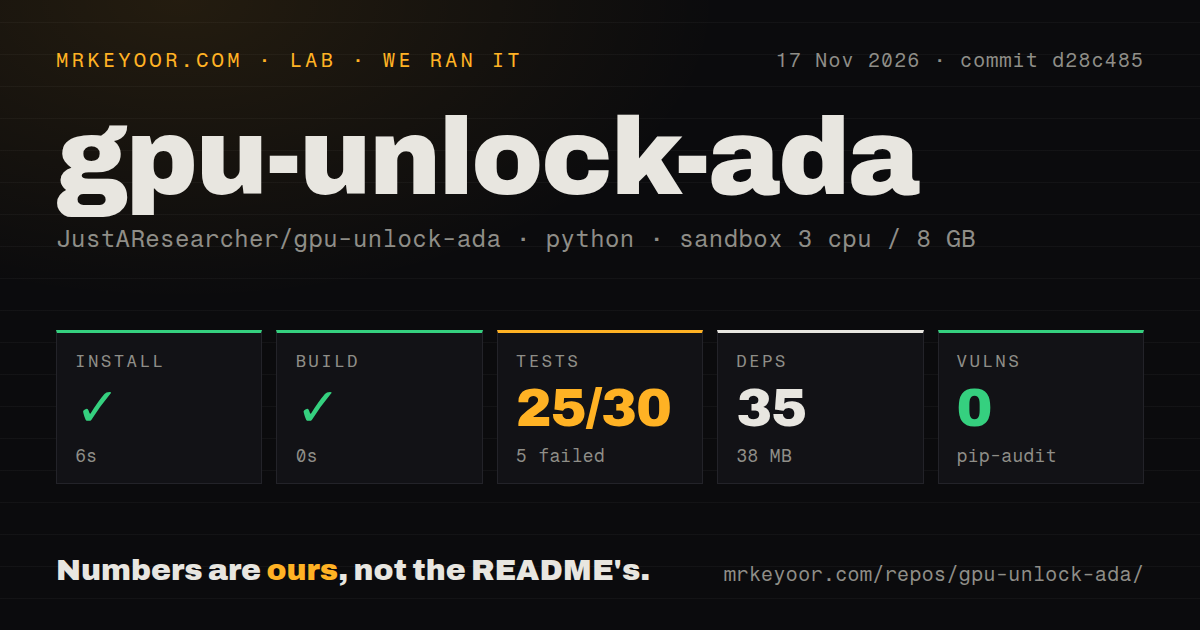
Our sandbox at commit d28c485 on 2026-11-17 completed the install step in 6 seconds and the build step in 0 seconds; the test command exited 1 after 6 seconds.
| Recorded check | Result |
|---|---|
| Install | Succeeded in 6 seconds; 35 dependencies recorded; 38 MB on disk |
| Build | Succeeded in 0 seconds |
| Tests | Failed, exit 1, in 6 seconds |
| Pytest log summary | 25 passed, 5 failed, 11 skipped; 18 subtests passed |
| Dependency audit | pip-audit reported 0 known vulnerabilities |
| Repository scan | 489 files, approximately 13,997 source lines, 1.5 MB checked out |
| Automation and packaging signals | 0 CI workflow files, no Dockerfile, a tests directory present |
The recorded configuration allocated 3 CPUs and 8 GB RAM, with image label ghcr.io/astral-sh/uv:python3.12-bookworm. That label supplies neither the actual Python version nor the operating-system version. The lab classified the ecosystem as Python; the product itself includes a kernel module and firmware tooling. The scan is useful for describing the checked-out tools, while the hardware procedure needs its own assessment.
All five failures named Windows diagnostic tooling under windows/ad104-msi/diagnostic/tests/test_tools.py. They were test_capture_accepts_mock_as_inventory_only, test_capture_rejects_mutations, test_driver_code_hash, test_pe_accepts_built_image and test_pe_rejects_mutations. Each ended in FileNotFoundError; the visible paths include missing files under the diagnostic build directory. The tail does not say why those files were absent. A test expecting a built image is not evidence that a GPU rejected the unlock.
The parser's description says “of 30”, while the raw summary separately lists 11 skips and 18 passing subtests. We preserve the raw categories rather than turn them into a misleading total. Similarly, a build step recorded as zero seconds supplies no evidence that kernel compilation, firmware execution or a Windows boot occurred. The audit result concerns known package advisories, not the safety of firmware transactions.
A separate hands-on attempt stopped at its safety check because no compose.yaml, compose.yml, docker-compose.yaml or docker-compose.yml existed. The record labels this “unsafe repo” under a rule requiring Compose; that is a harness classification, not a discovered GPU vulnerability. Its run label says deployment used the project's own Compose, but the failed step supplies no successful deployment evidence. Teardown reports “ok”.
Where people get stuck: the driver can bind first
Hotcooler's Ubuntu report shows unlock failed (-16) even though the module, firmware and package drop-in were already inside the initramfs. The boot log showed NVIDIA taking ownership first. Issue #112
The reporter had already checked the things an installation guide usually tells you to check: DKMS registration, firmware presence and kernel parameters. The problem lay in the order of early boot. On that host, initrd udev coldplug loaded NVIDIA before the explicit module list reached gpu_unlock. Reinstalling the same files would leave that order intact.
The reported workaround added softdep nvidia pre: gpu_unlock, rebuilt the initramfs and started from full power-off. The next cold boot logged the unlock before NVIDIA bound. If another configuration already supplies a matching NVIDIA softdep, the reporter says to merge the requirements into one line because kmod uses the first match. This is a host-confirmed workaround in an open issue, not a claim that every Ubuntu installation fails. Reporter’s boot traces and workaround
| Symptom | What the record says | Resolution or next decision |
|---|---|---|
unlock failed (-16) |
Hotcooler found NVIDIA bound first during initrd coldplug | Softdep plus rebuilt initramfs and a cold boot worked on that host; issue open. #112 |
| RTX 4060 Ti 16 GB skipped | Issue #22 identified boards reporting 2803 where the earlier path admitted 2805 | Maintainer admitted 2803 under ad106_experimental, with an exact PCI address; issue closed as completed. #22 |
| Installed package ignores experimental flag | MiMillieuh's openSUSE package came from released 1.1.1, while development had more flags | Package maintainer said releases only; choose a source revision that includes the required flag. #30 |
| Laptop unlock disappears after handoff | Mayhem50's MSI Hybrid investigation implicated runtime power management | Disabling runtime power management in the actual NVIDIA adapter key preserved that configuration's unlock. #117 |
Card support belongs to a revision and a PCI ID
The supplied master quick start requires an exact supported device ID and a separate opt-in for experimental Ada cards. A marketing name such as RTX 4070 Ti SUPER cannot select the right path by itself. Master quick start
Start with lspci -Dnn and record the full PCI address as well as the device ID. The documented Linux route needs the running kernel's headers, a C toolchain, DKMS, Python 3 and zstd. It builds local packages and firmware assets, then needs a boot entry that selects the intended card before NVIDIA binds. Keep the original entry available. These are installation instructions from upstream, separate from our measured Python harness steps.
| Source to read | Why its identity matters |
|---|---|
| JustAResearcher upstream master quick start | Describes per-card experimental gates and exact targeting |
| Older main and pinned 4e7fefc quick-start extracts | Describe a narrower early card set |
| brandonjank/gpu-unlock-ada | Maintained fork documenting an experimental Windows/UEFI route |
| Community openSUSE package in issue #30 | Followed released versions, so development flags could be absent |
The source-and-revision distinction resolves contradictory support lists without assuming someone tested every card. In issue #22, the maintainer explicitly admitted both reported memory configurations of device 2803. In issue #4, device 2757 entered behind ad103m_experimental with an exact address. Save the commit with your results, along with the selected boot image and flags. 2803 admission, 2757 admission
Windows success has several separate milestones
IvanoLab's RTX 4060 Ti Windows follow-up reports 87.794 TFLOPS in FP16/FP32 and zero numerical mismatches, superseding the opening post's pending-measurement status. Issue #105
Read Windows reports in stages: did the firmware transaction finish, did the rate survive NVIDIA initialisation, did numerical outputs match, was there a matched stock comparison, and is the tested source available? A successful UEFI readback answers the first question. It cannot substitute for the later ones. IvanoLab supplied source and later CUDA results, but explicitly lacked its own pre-unlock benchmark. The performance figure is a post-unlock rate, not a measured doubling.
Mayhem50's MSI GE78HX report adds a particularly practical detail. Intel continued to own the internal screen and brightness worked, but the initial handoff alone returned to stock throughput. The successful configuration set EnableRuntimePowerManagement=0 in the actual NVIDIA display-adapter registry key, preserving its prior state for rollback. On that machine NVIDIA was 0001 and Intel 0002; those suffixes are machine-specific. A later comment links the published source branch. MSI Hybrid investigation
The brandonjank fork reports a Secure Boot-enabled Windows/WSL2 run with zero mismatches across 2,162,688 checked output cells. It also says the tested EFI was ahead of published source. Treat reproducible source as its own milestone when comparing that report with the subsequently published MSI branch. Fork evidence statement
Boot recovery matters more than the clean package audit
The upstream instructions say to power off before retrying if firmware has not stopped and the module retains DMA buffers. They specifically warn against force-unloading it in that state. This is privileged hardware work, so the clean pip-audit result answers only a small part of the decision. Check-and-disable instructions
For a first attempt, upstream asks for full power-off and a normal boot entry kept available. It also warns that nvidia-smi, CUDA, NVML and nvidia-modprobe can load NVIDIA early during a manual attempt. Follow the packaged boot route for your revision rather than assembling a sequence from several forks. To disable future attempts, remove gpu_unlock.targets= from the kernel command line. Removing packages removes the module and boot integration; power-off returns to a fresh hardware state.
An independent 4090 report measured peak power at 346 W unlocked versus 313 W stock, with lower minimum clocks under load. That makes power and clock telemetry part of an honest comparison. Run the workload you intend to keep, under the same power cap, and retain correctness checks with its timings. A larger instruction number alone is an inadequate reason to accept a worse application result. Power and correctness evidence
gpu-unlock-ada vs Zagitta/gpu-unlock and Windows alternatives
Zagitta/gpu-unlock 2.0 describes broader RTX 40 targeting, while the merged miounet11 tree adds an Ampere-derived resume path and physicsdolphin supplies a separate Windows boot route.
| Option | What the supplied record describes | Pick it when |
|---|---|---|
| JustAResearcher/gpu-unlock-ada | Per-card Ada opt-ins, generally with exact addresses | You want to follow a specific Ada card report and its gates. Quick start |
| Zagitta/gpu-unlock 2.0 | Comparison page describes broader experimental RTX 40 selection through targets=all |
You are assessing that revision's broader selection policy. Version-specific comparison |
| miounet11/gpuunlock | Manually merged Ada paths and an Ampere-derived suspend/resume re-unlock path | You need to inspect that combined implementation for a mixed Ampere/Ada setup. Merged-tree README |
| physicsdolphin/nv-uefi-unlocker | Separate preboot USB project; a Palit 4070 SUPER owner reported matched Windows gains | You need a Windows route and can assess its own profile, Secure Boot and safety requirements. Owner report |
| Stock configuration | Oceanswave's generation rate fell despite faster GEMM | Your existing quantized serving workload already meets its target. Workload report |
An RTX 20-series owner should read an architecture-specific project such as nlzy/turing-unlock rather than copy Ada commands. The merged-tree documentation names a separate Turing module and turing_unlock.targets parameter. For RTX 30-series hardware, check the Ampere list in the exact chosen tree. Similar branding across these repositories is a reason to inspect the source identity, not a compatibility shortcut. Architecture split
What the other reviews get wrong
The claim that Secure Boot must always be disabled conflicts with xPokerr's Linux RTX 4070 SUPER report, which explicitly records Secure Boot on. The separate Windows preboot reports have their own requirements. Linux report
Soft4bro lists Secure Boot disabling as a requirement. That is too broad across the supplied evidence. GPUUnlocker's October 25 overview also describes an early, narrow Ada support set. Later maintainer replies admit additional IDs, including 2803 and 2783. Read the revision attached to the statement before treating an old list as today's rejection policy. Soft4bro overview, GPUUnlocker overview, maintainer's 2783 resolution
The narrator in the supplied “GPU Unlock Overview” video walks through cloning, make install and adding targets=all. The later Ada quick start instead calls for one exact intended card on a multi-GPU host, with experimental flags where required. The transcript supplies a walkthrough, not evidence of the narrator's own matched workload run. Video walkthrough, Ada instructions
RoundtableSpace's X post says the unlock “survives updates”. The quick start explicitly tells readers to check which rebuilt initramfs a boot entry selects after kernel updates. In r/overclocking, the discussion asks about Secure Boot, anti-cheat and lifespan; its claims about one Windows USB tool should not become guarantees for all Linux or Windows paths. X record, boot-image instructions, Reddit discussion
Finally, the extra-core speculation needs separating from tensor-rate work. In issue #109, JeusChrit reports that GA102 and Ada use a different fuse architecture from GA100's older RIR mechanism. That research discussion supplies no demonstrated extra-core unlock. Fuse investigation
Questions people ask
RTX 4090 device 2684 has demonstrated instruction-rate gains; other accepted Ada IDs need the experimental flag and targeting rules of the chosen revision. Whole-application gains depend on the workload. Quick start
Which cards work, what gets faster, and how do I install GPU Unlock?
Use the chosen revision's accepted PCI-ID table, then install its local packages and select the intended card in the boot entry before NVIDIA binds. The affected floating-point tensor paths can improve; quantized generation can gain nothing. Start with the exact-card instructions rather than a generic RTX 40 command. Quick start, workload report
How does gpu-unlock-ada access the protected setting without replacing the driver or modifying the card?
Upstream describes signed firmware execution and a payload that opens the required permissions, writes speed-select overrides and performs PCIe Function Level Reset before the stock driver binds. It does not require a VBIOS flash or patched driver. The independent report shows fuse values unchanged while the override registers change. Project mechanism, register evidence
What installation precautions matter for RTX 30- and 40-series unlocks?
Keep a normal boot entry, match the architecture and PCI ID, and begin from full power-off as upstream instructs. Check module load order in the boot log. The Ubuntu -16 report shows why firmware being present in the initramfs is insufficient on its own. Quick start, Ubuntu report
Is there a one-click GPU Unlock that works on both Windows and Linux?
The supplied evidence describes a Linux module and separate experimental Windows preboot ports with hardware-specific requirements. It supplies no universal one-click path. The Windows 4060 Ti source package explicitly calls itself research source for the captured MSI profile. Windows source statement
Does unlocking an RTX 4060 Ti 16 GB improve ComfyUI?
The 4060 Ti records show instruction-rate and CUDA measurements, not a ComfyUI workflow comparison. They cannot supply a ComfyUI speedup. Keep that distinction when comparing the measured laptop SDXL result with a desktop 4060 Ti purchase or modification decision. 4060 Ti Linux evidence, Windows evidence
Does gpu-unlock-ada work on an RTX 5090?
Issue #12 records Blackwell reconnaissance, not a working RTX 5090 unlock. Its closed status is not a compatibility result. The later rate-encoding discussion also corrects the probed GB202 FMLA32 restriction to one-eighth rate, so a generic half-rate story misses the architecture detail. RTX 5090 investigation
Does the unlock work on an AD103 RTX 4090 Laptop GPU?
Yes on the reported Lenovo systems, while the reported Clevo completed the transaction without a throughput gain. The maintainer admitted device 2757 under an experimental flag with an exact address. Match the laptop's firmware, display route and power-management configuration as well as its GPU ID. Laptop reports and admission
Can testing the unlock damage my GPU or shorten its lifespan?
The supplied short runs cannot answer GPU lifespan or eliminate damage risk. A commenter asking that question is not a safety study. The concrete operating precaution is upstream's instruction to power off when firmware fails to stop, without force-unloading the module. Safety question, upstream recovery instructions
Can I undo the unlock easily, and what happens with anti-cheat requirements?
For the Linux module, remove the opt-in boot parameter to stop future attempts and power off to return to fresh hardware state. A Windows USB-tool author in r/overclocking says that tool cannot bypass an anti-cheat's Secure Boot requirement. Those are separate answers for separate boot routes. Linux disable instructions, USB-tool author's answer
Can I use the unlock while keeping Secure Boot enabled?
xPokerr reports doing so on one Linux RTX 4070 SUPER configuration. The brandonjank fork also records a Windows Secure Boot-enabled run, with a source-version qualification. Secure Boot compatibility belongs to the specific tested route. Linux report, Windows fork statement
Will the unlock improve games or DLSS?
The supplied records contain no matched gaming or DLSS result. The Reddit discussion raises DLSS as a question, and the reply expresses uncertainty. A tensor instruction-rate result cannot answer that application question. DLSS discussion
Is the RTX 4070 Laptop supported?
The supplied overview of accepted IDs does not list an RTX 4070 Laptop path. Desktop RTX 4070 and RTX 4090 Laptop reports are different hardware evidence. The openSUSE user's wish to test a 4070 laptop is not a successful unlock report. Accepted-ID overview, package discussion
What we have not tested yet
Our own run covers source tooling at d28c485, not a successful GPU transaction, supported-machine installation or an application benchmark. We have not tested kernel boot order, Secure Boot, Windows handoff, display recovery, suspend/resume, ComfyUI, gaming or DLSS. The missing diagnostic-file errors need complete command and toolchain logs before anyone can assign an environment or package cause.
The contributed evidence is useful but bounded. The independent 4090 reproduction is one matched pair with desktop activity and clock variation, without an extended stability run. Oceanswave did not investigate the generation regression. The merged suspend/resume implementation has no independent Ada resume validation in this pack. The brandonjank tested EFI was ahead of published source. IvanoLab supplied no same-system stock baseline. None of these records settles fleet reliability, long-duration numerical correctness, hardware lifespan or anti-cheat acceptance.
If you proceed, save a stock result for your exact workload before changing the boot path. Retain the source commit, PCI and subsystem IDs, boot image, driver, power cap, outputs and recovery entry. The decision to keep the unlock should come from that same workload after the change. A successful register write is only the beginning of that comparison.