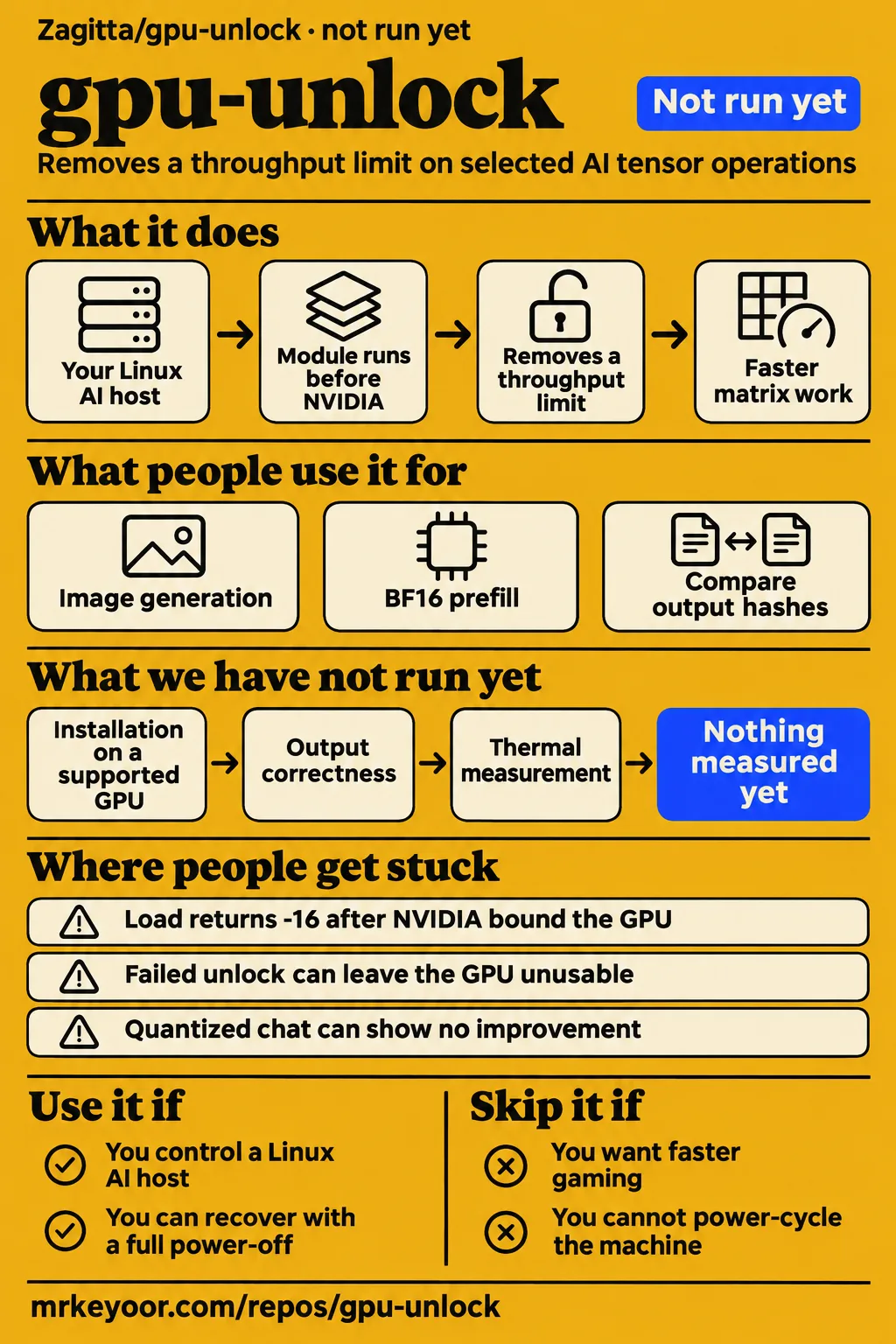
gpu-unlock has credible reported gains for selected AI workloads, including 51% faster Z-Image Turbo in Esequiel378's RTX 3090 report. Use it if you run tensor-heavy AI on a Linux machine you control and can recover with a full power-off. Skip it if your goal is faster gaming or a guaranteed improvement to quantized local chat. Our sandbox did not execute the project: its C code had no supported harness ecosystem and no Dockerfile. RTX 3090 results
What people use gpu-unlock for
Esequiel378 reports 51% faster Z-Image Turbo, 38% faster SD 1.5 and 61% faster BF16 vLLM prefill on one RTX 3090 with the unlock alone. Those are application results worth reading before the README's peak tensor figures. Prefill means processing the prompt before generation begins; decode means generating the answer token by token. A faster first stage needn't make a long streamed answer proportionately faster. Benchmark report
| Who used it | Work performed | Reported outcome |
|---|---|---|
| Esequiel378 | Z-Image Turbo, SD 1.5 and BF16 vLLM on an RTX 3090 under NixOS | Unlock-only throughput gains of 51%, 38% and 61%, respectively. Results |
| GitHub user xielidun | Qwen3.8 Flash Next IQ4_XS in Strata across four RTX 3060 12GB cards | Prefill rose from 450 to 600; decode barely changed. The opening report supplies no unit for those figures. Issue #31 |
| Reddit user grumd | Qwen 27B Q6_K after confirming the RTX 3080 20GB unlock | No measured prefill or decode improvement through the default quantized execution path. LocalLLaMA discussion |
| GitHub user ilikenwf | Mainline gpu-unlock on a Clevo RTX 4090 Laptop in NVIDIA mode | Reports approximately doubled instruction throughput and 175 W maximum draw. The suggested role of the earlier compute mode is the reporter's hypothesis. Laptop report |
The Strata and Q6_K reports make a useful pair. Both involve quantized models, yet their prefill outcomes differ. A model's filename doesn't tell you which arithmetic kernels dominate its runtime. Choose a representative prompt and execution backend before deciding that another user's result applies to your machine. These are individual reports, with their authors and configurations attached, rather than a fleet-wide success rate.
What happened when we ran it
Our 2026-11-17 sandbox record at commit 7eb51bc says NOT RUN: no supported ecosystem for C and no Dockerfile. The recorded configuration was 3 CPUs and 8 GB RAM, with image listed as n/a. That is a harness coverage finding, not a failed GPU benchmark or evidence that gpu-unlock itself is broken.
| Recorded item | Result | What it tells you |
|---|---|---|
| Source snapshot | 7eb51bc, 2026-11-17 | Identifies the recorded clone |
| Sandbox configuration | 3 CPUs, 8 GB RAM, image n/a | Describes the allocated sandbox, not measured resource consumption |
| Execution | NOT RUN: C ecosystem unsupported; no Dockerfile | No installation, build or test result to score |
| Separate hands-on safety step | FAILED: none of compose.yaml, compose.yml, docker-compose.yaml or docker-compose.yml existed | The Compose-only safety rule stopped the attempted route. |
| Teardown | ok | Cleanup status only. |
The hands-on run record also contains a generic sentence saying the project was deployed with its own Docker Compose. That conflicts with the specific failed safety check, which says the required file was absent. We reject that deployment label as evidence of a running system. There is no application result behind it to report.
The rest of this review evaluates documentation and attributed community results. Installation time, test totals and GPU speed from our own machine are unavailable. The image label supplies no operating-system or runtime version. Buying hardware on the assumption that MrKeyoor reproduced the RTX 3090 numbers would misread this review.
Where people get stuck: the module must beat NVIDIA to the card
GitHub issue #93 reports error -16 after manually loading the module once NVIDIA already owned the GPU. The reporter, maksakovaa, later says reinstalling from fix-mkinitcpio-systemd-hook worked. That sequence is more useful than treating every failure as a firmware incompatibility: a package can be present while the early-boot step never happens. Issue #93
| Symptom and source | What the record says | Action supported by that record |
|---|---|---|
| Only the boot argument appears in the journal, #7 | Zagitta says the module isn't loading at all | Inspect the actual initramfs and module-loading path; a boot flag alone isn't success. Installation thread |
| Manual load returns -16, #93 | The attempted load occurred after NVIDIA bound the GPU; the reporter later credits the hook-fix branch | Repair early loading rather than repeatedly loading the module after boot. Hook report |
| Turing changes from -19 to -110, #242 | The loader-halt branch alone left reporters timing out; additional work produced successes | Read the exact patch and card reports. The open thread records a workaround, not a universal fix. Turing thread |
| Laptop unlock disappears, #227 | pantha704 says a modprobe.d setting wasn't honored for the initramfs-loaded NVIDIA module | Their workaround put nvidia.NVreg_DynamicPowerManagement=0x00 on the kernel command line. Laptop thread |
In #7 the user had already added the Limine argument and could see it in the generated configuration. Their journal still showed only the command line. Zagitta explained that a real attempt should log either an unlock or a failure. The thread eventually contains a success report, but the supplied extract doesn't provide a complete reproducible resolution. Copying that user's final status without the missing steps would be poor installation advice.
Turing has a different story. In #242, celisej567 reports that mainline 7eb51bc failed with -19, while the loader-halt branch progressed to -110 and left NVIDIA unable to bind. RakkiPoni's additional patch then drew success reports for TU102, TU104 and TU106. Ledzpg reports one failed cold boot followed by success with the identical patched tree. Keep the actual boot logs with a compatibility report; changing code isn't the only thing that changed between those two outcomes. Patch progression
A matching GPU name isn't a matching board
Issue #28 contains different outcomes for cards sold as GA102-250 RTX 3080 Ti 20GB. The original board reported a successful selector change without the expected BF16 uplift. Other contributors subsequently reported full-rate results on their own GA102-250 cards. This is a reason to collect board identity before making a compatibility judgment. OEM compatibility thread
The original reporter lists PCI ID 10de:2205, board ID 0x300 and VBIOS 94.02.5A.00.32. A successful comparison board has ID 0x151E and VBIOS 94.02.5A.00.02. Downgrading the original system's driver from 615 to 610 improved its measured throughput only partially. A later Windows UEFI test also improved that same board without reaching the comparison result. The thread leaves its underlying constraint unresolved; it doesn't prove that every OEM card fails or that one driver downgrade fixes the class.
For a useful report, record the PCI and subsystem IDs, board ID, VBIOS, kernel, NVIDIA driver, gpu-unlock commit, power cap and benchmark precision. Separate the selector readback from the workload outcome. The board in #28 is the concrete example of why an apparently successful register operation and the expected application gain require separate evidence.
Kernel privileges and a stock boot entry are part of the decision
The upstream README says gpu-unlock runs before the stock NVIDIA driver and requires an explicit kernel-command-line target. It changes firmware state in memory and resets the card before driver handoff. That puts the experiment in the boot path of the machine you rely on, so a recoverable test host is a sensible requirement. Upstream documentation
Esequiel378's report says a failed unlock can leave the GPU unusable until a full power-off and that a reboot can preserve the unlock. Keep a stock boot entry and access to a complete power cycle. Removing the target option controls future attempts; restoring a known stock hardware state can also require cutting power. The Ada guide separately warns against force-unloading a module while firmware may still use retained DMA buffers. Recovery report Ada recovery guidance
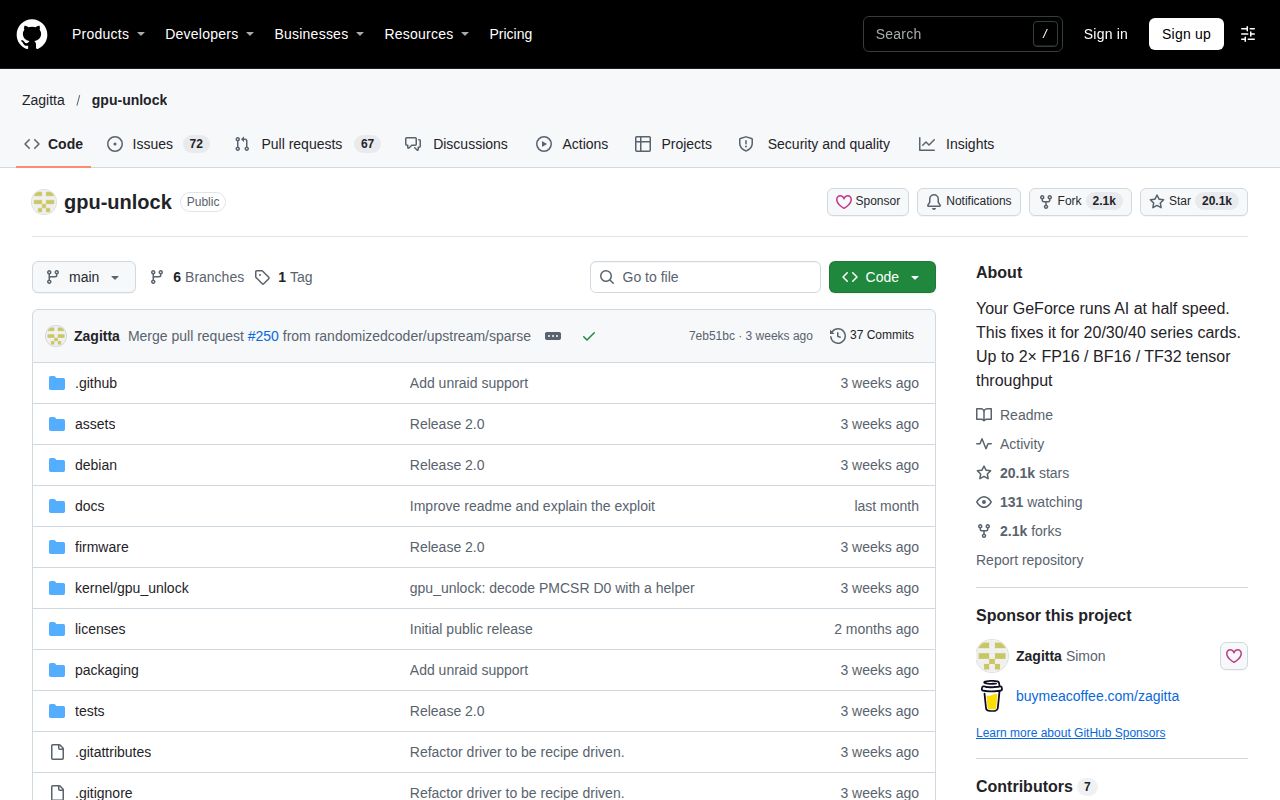
Use Zagitta/gpu-unlock as the project identity. Its FAQ explicitly disclaims associated websites, coins and installers. An unofficial domain can offer a useful explanation without becoming the developer's documentation, and a fork repeating the README isn't another independent performance test. The kernel module's GPL-2.0-only terms also sit alongside separate NVIDIA firmware terms in the upstream notices. Upstream FAQ and notices
Quantized chat and board energy need different readings
Reddit tester grumd reports no prefill or decode improvement for Qwen 27B Q6_K through llama.cpp's default MMQ path. Their explanation is specific: the quantized path uses INT8-to-INT32 arithmetic rather than the throttled floating-point accumulation path. Retaining some BF16 tensors therefore doesn't, by itself, predict a material speedup for the whole model. Execution-path discussion
That discussion also compares MMQ with cuBLAS accumulation paths. grumd reports a speed tradeoff, extra VRAM use and lower measured divergence from a BF16 reference for the cuBLAS paths in their numerical comparison. Those observations concern different execution choices; they aren't evidence that enabling gpu-unlock automatically improves model accuracy. Before switching a backend, compare useful output, memory fit and speed together. A path with a smaller numerical difference can still be the slower choice for the job.
Esequiel378's roughly 40% lower energy per output belongs to the combined unlock and clock-capped curve-offset configuration. The report measures GPU board energy, excludes the rest of the computer and infers lower core voltage rather than measuring it. That makes the result useful for assessing board work per output, but it doesn't supply a household electricity-saving percentage. Keep unlock-only and combined-tuning results separate when comparing them with your own baseline. Energy method
The same author reports stock-matching hashes across 540 image batches in a two-hour soak and zero mismatches across 260 hashed benchmark runs. This is stronger correctness evidence than merely reaching a higher tensor rate. It is still attached to the tested configuration: the report explicitly warns that an unstable clock offset can produce wrong results without crashing. Treat output checking as part of a tuning experiment, rather than assuming a completed job was correct. Correctness and tuning
gpu-unlock vs turing-unlock, Windows UEFI ports and vgpu_unlock
Choose gpu-unlock for the documented Linux tensor-throughput approach; choose a different project when you need a different operating-system route or GPU virtualization. These names overlap enough to mislead searchers. The table separates what people are trying to accomplish from claims about which implementation is faster.
| Alternative | Reason to choose it | Evidence and boundary |
|---|---|---|
| Separate turing-unlock | Investigate the earlier dedicated Turing implementation and its reports | Ph0rk0z reports it working alongside gpu-unlock for 3090s, with moving synthetic benchmarks but no noticeable ComfyUI gain. Mainline later added experimental Turing support. #30 #64 |
| Windows-GPU-UNLOCK | You need the Windows UEFI route named by upstream | Zagitta links the port and says they don't maintain Windows. The laptop thread records an ineffective GA107 Optimus port. FAQ #227 |
| vgpu_unlock or vgpu_unlock-rs | You want one GPU shared across virtual machines | The supplied unofficial comparison describes vGPU functionality, a different goal from restoring tensor throughput. Feature comparison |
| Clock tuning or undervolting | You want to adjust the frequency/power tradeoff | Esequiel378 tests a combined configuration, with better image and prefill results than unlock alone on that card. Matched results |
Patched NVIDIA drivers are another route people discuss. On Hacker News, Zagitta describes this module as a less annoying package than patching the driver. In issue #203, the maintainer says the required VBIOS portions cannot be edited to perform this unlock. Vix Loader's ability to load a modified VBIOS therefore doesn't demonstrate an interchangeable solution. Author's explanation VBIOS discussion
What the other reviews get wrong
MakeUseOf's remove-the-flag-and-reboot rollback advice needs the cold-power-off qualification from the detailed RTX 3090 report. Other broad claims also need the original workload and card attached. An instruction-rate result, a working desktop and a shorter generation job answer different questions. MakeUseOf guide Recovery evidence
The unofficial gpu-unlock.com FAQ describes separate Ampere, Ada and Turing modules. Zagitta later announced experimental Turing and Ada support in mainline 2.0 in #64. Older coverage saying RTX 40 testing is unconfirmed also misses the independent RTX 4090 reports and ilikenwf's mainline laptop result. Those updates improve the evidence for particular configurations; the experimental label still matters. Older FAQ Maintainer update Laptop result
The upstream table's categorical no-change entries deserve scrutiny too. Esequiel378 reports modest decode gains, while the Ada guide distinguishes an FP8 instruction-rate gain from a matched FP8 GEMM that barely changed. Neither supports promising large improvements to every decode or FP8 workload. The observed operation matters more than the precision label alone. Decode results FP8 distinction
The X post by itsharmanjot says there is no BIOS risk. That framing omits the reported need for full-power-off recovery. Meanwhile, the video titled I Tested the GPU Unlock Hack: Is It Worth the Risk? opens by contrasting RTX 3090 arithmetic rates and discusses different accumulation modes. The supplied transcript excerpt supports that explanation, not a measured gaming result. X post Video transcript
Questions people ask
Mixed-precision quantized models can show no speed gain: grumd reports unchanged Q6_K prefill and decode despite a confirmed unlock. The execution path determines whether the newly available throughput helps. LocalLLaMA report
Does gpu-unlock help mixed-precision quantized models that retain some BF16 tensors?
Some quantized workloads improve prefill and others don't. xielidun reports a prefill increase in Strata, whereas grumd reports no gain for Q6_K through MMQ. Benchmark the complete model and backend you intend to use; a retained BF16 tensor doesn't settle the question. Strata report MMQ report
Does gpu-unlock increase GPU temperature?
The upstream FAQ says additional compute may raise temperature slightly while normal power management remains active. Reddit users grumd and andy2na report no temperature change in their unaffected workloads. Those reports describe different loads, so they don't supply one temperature prediction for your card. FAQ User observations
Can gpu-unlock improve gaming performance?
The upstream workload table lists no change for gaming and FP32 CUDA. Choose it for an affected AI computation rather than as a gaming upgrade. The available tensor-rate demonstrations don't turn that documented boundary into an FPS claim. Upstream workload table
Why does NVIDIA limit these tensor operations on GeForce cards?
Zagitta's FAQ attributes the limitation to market segmentation between consumer and professional cards. That is the developer's explanation of NVIDIA's motive, rather than an NVIDIA statement supplied in this evidence. The narrower technical distinction concerns floating-point tensor operations with FP32 accumulation. Developer FAQ
How do I install gpu-unlock on CachyOS with Limine?
The #7 reporter added the target argument in /etc/default/limine and regenerated the configuration with limine-update, but that alone didn't load the module. Pair the bootloader argument with the correct early initramfs loading path. Preserve existing boot arguments and use your card's full PCI address; the sample address isn't a device selector for every machine. Limine installation thread
What should the verification log show after a successful unlock?
Zagitta says targets=all should produce either gpu_unlock: unlocked or gpu_unlock: unlock failed (...). Seeing only the kernel-command-line text means the module isn't loading. NVIDIA remaining the driver in use afterward is expected. Follow the unlock message with a healthy driver check and a matched workload comparison. Maintainer explanation Ada checks
Which benchmark should I use to verify real performance gains?
Use a tensor benchmark with the affected accumulation mode, then time your actual image or model workload. Esequiel378 separates GEMM, image generation, prefill and decode, and compares output hashes. Ph0rk0z's report of moving synthetic benchmarks without noticeable ComfyUI gains shows why the application check matters. Keep driver, kernel, power cap and workload settings matched. Method ComfyUI report
Is NVIDIA driver 610.43.03 required?
The upstream FAQ says no: that pinned driver supplies firmware inputs. The runtime driver is a separate choice. Issue #28 records a partial improvement after a driver change on one unusual board, which doesn't turn that version into a universal runtime requirement. FAQ Board-specific report
Can RTX 20-series Turing cards use gpu-unlock?
Mainline 2.0 includes experimental Turing support according to Zagitta. Issue #242 shows successful patched configurations alongside failures and inconsistent cold-boot behavior. Treat a particular TU102, TU104 or TU106 report as evidence for that setup, rather than a blanket assurance for the generation. Announcement Patch reports
Does gpu-unlock support the RTX 2000 Ada?
A commenter asks about RTX 2000 Ada in #64, but the supplied thread gives no answer or test result. The professional model's name doesn't make it a Turing RTX 20-series card, and that thread's experimental-generation announcement supplies no model-specific outcome. Unanswered question
Can Turing and Ampere unlocks run together in one machine?
Yes, individual reports describe mixed systems. Ph0rk0z used the separate Turing implementation alongside gpu-unlock for 3090s; JayCTBee later reports three RTX 2060 cards and three RTX 3060 cards unlocked with the additional Turing patch. Keep the implementation and patch identity attached to either result. Earlier arrangement Mixed patched system
Is AD103 support in scope, and what validation is needed?
AD103 appears in the experimental Ada work, and #4 discusses the validation needed for a port. The maintainer asks for boot logs, driver output and before/after benchmarks. The Ada guide additionally requires the exact selected card's unlock message, healthy nvidia-smi and a workload check. Offline firmware similarities alone aren't an application result. Port discussion Experimental checks
What we have not tested yet
We have not reproduced installation or executed gpu-unlock on a supported GPU. Our sandbox stopped before execution, and the separate Compose safety check failed. No local build timing, test count, vulnerability audit, output-correctness result, thermal measurement or runtime version is available. The supplied latest-release lookup is null and does not establish the latest release.
The community reports leave practical questions open: whole-system energy savings, audio-processing models and a family voice-assistant workload lack a measured answer in this pack. The RTX 3090 benchmark disabled resume handling, and upstream excludes hibernation from its documented resume support. The GA107 Windows Optimus report failed to retain an effective unlock. Fleet reliability, every laptop power-management configuration and every board variant remain untested by us.
Our recommendation is to start with a stock reference for the exact job you want to accelerate, plus a tested route back to a powered-off stock boot. If that job already runs through an unaffected quantized kernel, the published no-gain result is a good reason to leave the boot path alone.