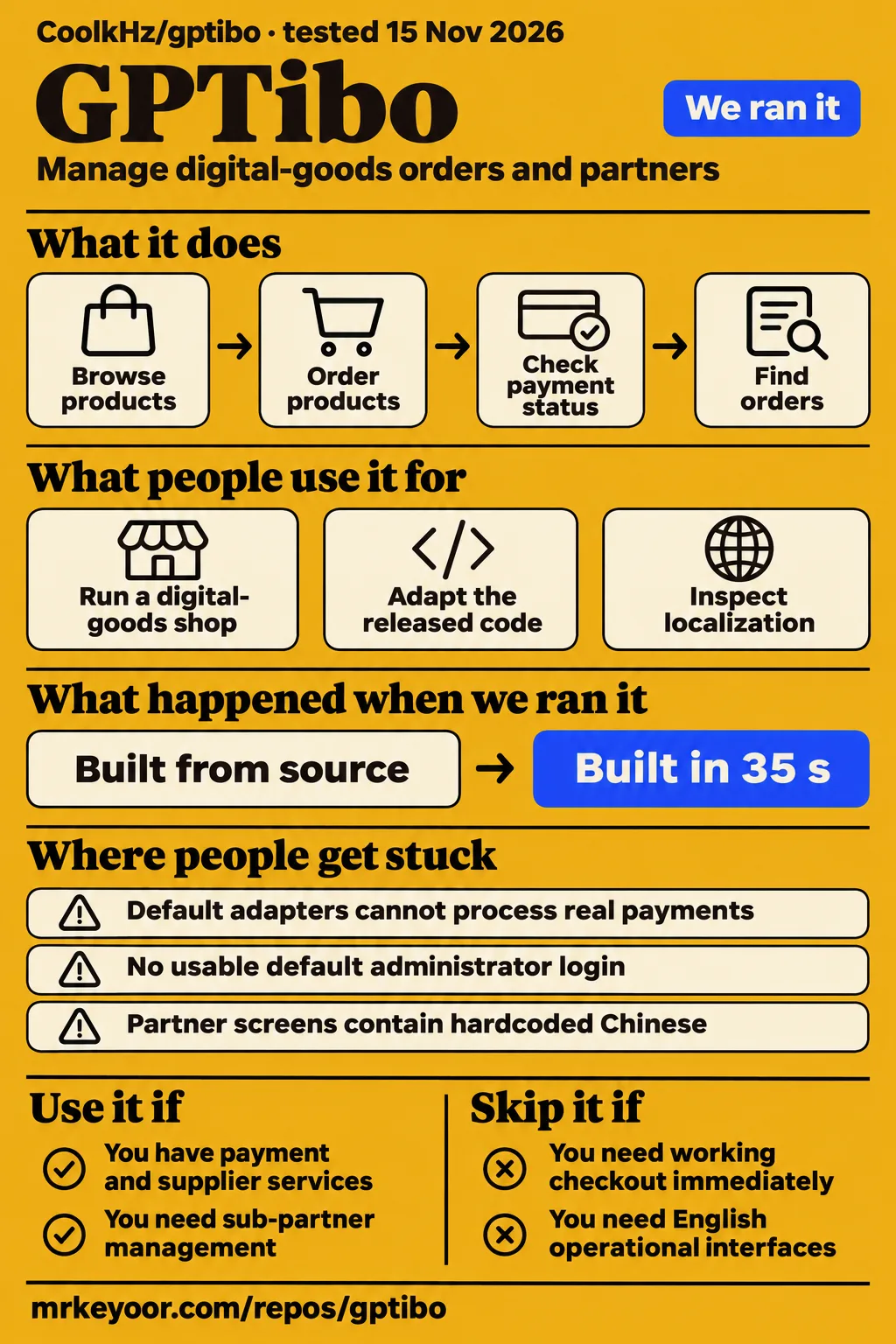
GPTibo passed our install, build and test steps, but its payment and supplier connections need your own implementation. Use it if you already have those services and want to adapt a digital-goods shop with a reseller workspace. Skip it if you need a store you can open for business immediately. Start with the transaction you intend to sell: connect its payment, delivery and refund handling before expanding the catalogue.
What you can do with GPTibo
GPTibo combines a customer storefront, an administration panel and a partner workspace in one React and TypeScript project. The Chinese README describes browsing products, ordering, checking payment status, finding orders and requesting after-sales help. Administration covers pricing, customers, refunds, partners, settlement and notifications. Partners get branding, custom domains, products, order statistics and management of sub-partners. GPTibo project README
That structure suits a developer who otherwise would assemble a shop and reseller portal separately. A customer-facing change can involve the back office, the partner interface and the backend, so begin with one product and its order lifecycle before adapting the whole catalogue. The README says the public release contains storefront-side supplier adapters and excludes the independent supply platform and supplier execution system. Those supplier relationships and services belong in the implementation budget.
What people use gptibo for
The supplied records describe an operated digital-goods storefront and a contributor's local Go/PostgreSQL deployment used to inspect localization. These are two different uses of the project: running the original service and adapting its released code. They give a prospective operator concrete examples to examine alongside the README's feature list. Original operator announcement, local deployment and localization request
- 0xraco announced that the original GPTibo service had stopped operating because growing traffic, service delivery and daily maintenance exceeded the time and energy available. The author released the frontend and backend source after stopping the service. 0xraco's shutdown announcement
- The contributor behind issue #2 says the request came from a local Go and PostgreSQL deployment. Their inspection identified Chinese and English storefront locales and translation work in administration, partner screens, emails and server errors. Contributor's localization report
The shutdown account puts maintenance alongside implementation in the buying decision. Hosting this source gives you a place to manage orders and partners, while the operator still handles service delivery and day-to-day work. A reseller storefront makes sense when those interfaces replace work you already perform manually. Write down who will handle delayed delivery, refunds and partner questions before deciding how much of the catalogue to import.
What happened when we ran it
Our November 15, 2026 hands-on attempt recorded a failed safety step because it found none of the Compose filenames it required. The error was unsafe repo: none of compose.yaml, compose.yml, docker-compose.yaml, docker-compose.yml exists (rule: a compose file is required). The separate run summary says the project deployed using its own Compose with every port bound to 127.0.0.1.
The README places the Go deployment under services/storefront/, and the supplied pack includes that directory's Compose configuration. The failed safety step records what the harness found, while the documentation gives a nested deployment path. The teardown record says teardown: ok. Keeping those records separate preserves the failure without turning it into a claim that GPTibo has no Compose deployment. Recorded Compose configuration
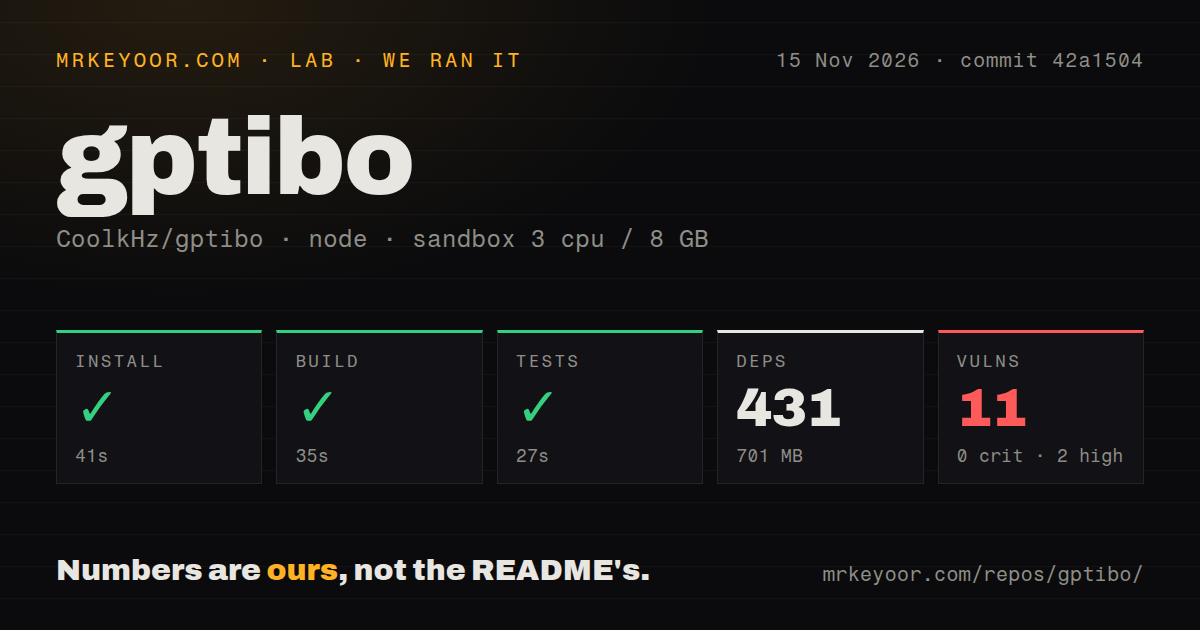
Our source sandbox at commit 42a1504 completed installation in 41 seconds, build in 35 seconds and tests in 27 seconds. These are our measured source-step results, separate from the hands-on deployment records. The run recorded 431 dependencies occupying 701 MB and an npm audit total of 11 known vulnerabilities. The table preserves the supplied outcomes and repository scan rather than substituting figures from a setup article.
| Source sandbox check | Our result |
|---|---|
| Install | Succeeded in 41 seconds |
| Build | Succeeded in 35 seconds |
| Tests | Succeeded in 27 seconds |
| Dependencies | 431 recorded, 701 MB on disk |
| npm audit | 11 known vulnerabilities: 2 high, 6 moderate, 3 low, 0 critical |
| Repository scan | 688 files, about 61,458 source lines, 4.7 MB checked out |
| Automation signals | 1 CI workflow file, a tests directory, no Dockerfile found by the scan |
The source run used 3 CPUs, 8 GB of RAM and the recorded image label lab-node:22. The README requests Node.js 24 and lists npm, Git and Python 3 among its prerequisites. Installation, build and test each returned a successful result in the supplied harness. The two high-severity audit findings are a concrete item for package-level investigation before choosing dependency changes or preparing a deployment.
Where people get stuck: identity and integrations come first
A fresh GPTibo installation requires your own administrator identity, TOTP and email verification service before full administrator login. The default configuration supplies no usable administrator account and initiates no real payments, procurement or notifications. Getting into the back office is therefore a configuration task. The README documents the identity requirements beside the storefront, administration and partner entry paths. GPTibo configuration and entry points
| Obstacle | Documented next action | Evidence status |
|---|---|---|
| No working administrator account | Configure your own administrator identity, TOTP and email service | Required setup; no default login |
| Anonymous payment and supplier adapters | Match endpoints, signatures, product mappings, amounts and callbacks to your own services | Operator integration work |
| Reusing the original production database | Install into a fresh database | Anonymized migrations are incompatible with the original database |
| Database coverage mistaken for a complete transaction check | Use a dedicated local test database and separately exercise the transaction | Upstream documents separate coverage boundaries |
| Stablecoin checkout expected from JangoPay | Read issue #3 before budgeting around it | Proposal deferred; issue open |
The README names gatewaya and gatewayb as anonymous payment adapters and uses generic names for supplier adapters. It instructs operators to match addresses, signatures, product mappings, amounts and callbacks to their service agreements. Begin with those agreements, configure identity and email, then work through an order. The reserved example.invalid addresses and demonstration amounts are examples to replace during integration. GPTibo adapter requirements
In issue #3, the JangoPay proposer offered payment creation, webhook signature checking and order-status updates. The maintainer replied that it was not needed for now and requested contact details for possible future demand. The tracker also contains issue #1, titled "错误申请," recorded as closed with no comments. These are distinct discussion outcomes: a deferred integration offer and an empty closed report. JangoPay discussion, issue #1 record
English storefront support stops short of the back office
The contributor in issue #2 reported Chinese and English storefront locales alongside hardcoded Chinese in administration, partner screens, emails and server errors. Their request sought Vietnamese as a third storefront language. The supplied readable GitHub page gives the final status as closed as not planned. The report remains useful as an attributed map of the areas an English-speaking operator would need to inspect. GitHub issue #2
The contributor names src/lib/storefront-locale.ts and src/lib/storefront-messages.ts for storefront language work, with header and footer changes in src/App.tsx. They also identify CNY currency formatting, the zh-CN locale and the Asia/Shanghai timezone in administrative and export paths. Their proposed work includes language detection, a selector option and persistence after refresh. Contributor's localization inspection
For adaptation, turn that report into a review of the order as staff encounter it: customer text, administrator screens, partner screens, email and exported records. The contributor explicitly separates storefront translation from internationalization work elsewhere. Keep currency and timezone changes connected to that same order review so the customer-facing language, operational records and displayed amounts receive attention together. This is a suggested work sequence based on the reported locations.
Security defaults keep the API on loopback
The supplied Compose extract publishes the API as 127.0.0.1:8093:8093, and the Go deployment guide says PostgreSQL has no host-port mapping. The guide also separates the migration owner from the runtime database role. These documented settings give a concrete starting point for reviewing how the backend is exposed and which database identity runs the application. Compose API binding, Go deployment guide
The public configuration example says forwarded headers remain untrusted by default and calls for exact ingress network addresses. When adding a reverse proxy, configure the networks you control. The Go guide describes an optional administrator and mail overlay, independent secrets and integration switches that default to off. Review those settings together with the public origin and proxy configuration before connecting the application to external traffic. Proxy configuration example, Go configuration guide
Payment callbacks and order state also belong in that review. The README asks operators to match signatures, amounts and callbacks to their own services, and the public release supplies anonymous adapters. Follow the callback through the intended order transition while reviewing the provider protocol. The npm audit results add a separate dependency task: investigate the reported packages before selecting a remedy. Container exposure, integration behavior and dependency findings answer different deployment questions.
The operator's shutdown is the useful warning about volume
0xraco attributed the closure to growing traffic, service-delivery pressure and daily maintenance exceeding available time and energy. That account makes staffing and service ownership part of the deployment decision. Before importing a catalogue, decide who handles delayed delivery, payment disputes and partner questions, then connect those responsibilities to the refund, notification and reseller interfaces described in the README. Original operator's announcement, documented shop workflows
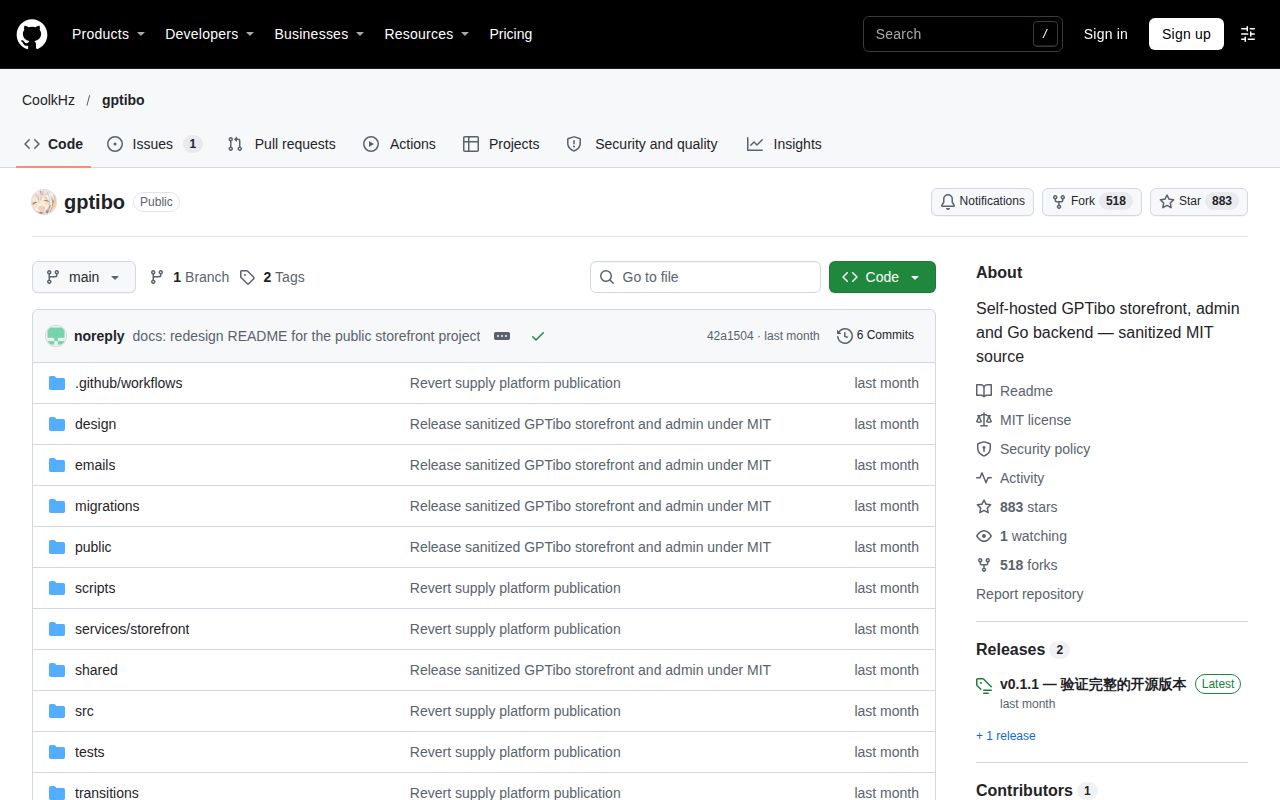
GPTibo's Go design separates API and business-worker processes, while the Cloudflare implementation uses Workers and D1. Those choices give the operator different infrastructure to manage. The November 15 snapshot recorded 883 stars and 518 forks, and Rising.dev recorded zero commits in the preceding 30 days. Repository metadata gives October 14, 2026 as the last push. These dated figures describe attention and recent activity for the deployment decision. Activity snapshot
GPTibo vs Go/PostgreSQL, Cloudflare Workers/D1, Medusa and Saleor
GPTibo documents Go/PostgreSQL and Cloudflare Workers/D1 backends, while Medusa and Saleor offer different commerce architectures. Start the comparison with the workflows and services you intend to own: product delivery, payment callbacks, refunds and partner management. The table separates GPTibo's deployment choices from a proposed payment adapter and two alternative platforms, so each option has a clear role in the decision.
| Choice | What the evidence describes | When to choose it |
|---|---|---|
| GPTibo with Go and PostgreSQL | A separate API and business worker, with PostgreSQL | You already operate this stack and want its documented deployment path |
| GPTibo with Cloudflare Workers and D1 | A Worker backend with D1 and Wrangler | Your target environment is Cloudflare and your required workflows fit that implementation |
| JangoPay proposal | A proposed supplementary stablecoin payment channel | Discuss an adapter if customers need it and budget implementation work |
| Medusa | Commerce building blocks and a customization framework | You want a commerce framework and intend to build around its modules |
| Saleor | A GraphQL, API-only commerce platform with channel-level pricing and currencies | You want an API-first system and control over the storefront implementation |
The GPTibo README describes the two backend stacks and their local entry points. The JangoPay row reflects the proposer's offer and the maintainer's deferral in issue #3. Use those records to assign implementation work to the selected stack and payment service. A provider name in an issue belongs in that planning conversation with its actual discussion status attached. GPTibo backend options, JangoPay proposal
Medusa describes an open-source commerce platform with a built-in framework for customization, including products, carts, orders and payments. Saleor describes a GraphQL, API-only platform with per-channel control of pricing and currencies. Compare those architectures when GPTibo's digital-goods and partner structure does not fit the application you intend to build. Medusa project README, Saleor project README
What the other reviews get wrong
ToolPotion categorizes GPTibo under "AI Coding Assistants," although its description calls it a storefront and administration platform. The project README identifies a self-hosted digital-goods shop with customer, administration and partner interfaces. Use that product identity when deciding whether the repository answers your requirements. A developer looking for a coding assistant would be following the wrong category. ToolPotion listing, GPTibo README
Hysenlabs answers "Yes" to continued maintenance, while the November 15 activity snapshot records zero commits in the preceding 30 days and repository metadata gives October 14 as the last push. Prefer those dated observations when planning upstream involvement. HotRepo describes backend choice as deployment-shaped, while Hysenlabs says the implementations differ in capability. The primary README identifies their stacks and shared storefront role. Hysenlabs overview, HotRepo overview, dated activity snapshot
Gridinsoft assesses the historical gptibo.com domain using automated checks and domain-related signals. Its extract lists a first-check timestamp, a registration timestamp and a displayed domain age. Keep that assessment attached to the hosted domain it examines. For a developer evaluating this repository, the relevant deployment evidence on this page is the source run, documented configuration and integration requirements. Gridinsoft domain assessment
Questions people ask
GPTibo's code uses the MIT licence, permitting use, modification and distribution while retaining the copyright and licence notices. The README separately assigns third-party resources their own licence conditions and reserves trademarks and artwork to their rights holders. That answers the commercial-use question at the code level; follow the linked resource notices when choosing which visual materials to reuse. GPTibo licence and resource notices
Is GPTibo open source, and can I use it commercially?
Yes, GPTibo releases its code under MIT, with copyright and licence notices retained when using, modifying or distributing it. The README also links separate brand-resource and third-party-style notices. Read those alongside the code licence when preparing a storefront, because they describe rights in materials that can appear in the interface. GPTibo licensing section
How difficult is GPTibo to install and run locally?
Our source installation succeeded in 41 seconds; operating the shop also requires backend, identity, mail, payment and supplier configuration. The README lists Node.js 24, npm, Git and Python 3, then gives separate Go/PostgreSQL and Workers/D1 paths. Use the measured install result for the source step and the documented configuration sequence to plan the remaining implementation work. GPTibo setup requirements
How do I deploy GPTibo with Docker?
The documented Docker sequence runs from services/storefront/, beginning with secret generation and Compose validation. It then builds the API image, starts PostgreSQL, runs migrations, grants runtime permissions and starts the API and worker. The frontend starts separately through the documented Vite configuration. Follow the directory-specific instructions when preparing this deployment. Go backend Docker instructions
Should I choose Go and PostgreSQL or Cloudflare Workers and D1 for a small deployment?
Go/PostgreSQL provides the documented API-and-worker deployment; Cloudflare provides Workers, D1 and Wrangler. Choose around the infrastructure and integration work you can maintain. The README gives a local startup path for each, including separate frontend development options. Put your required payment, delivery and partner workflows beside those instructions before choosing which implementation to adapt. GPTibo backend startup paths
How do GPTibo's two backends stay compatible with the same frontend API?
Both backends serve the storefront, and the Go documentation identifies frontend/backend route-contract tests that require the TypeScript parser. It directs developers to install npm dependencies at the repository root before running Go checks. Those documented contracts are the starting point for examining route compatibility while adapting the frontend and selected backend together. Go backend testing instructions
How do I implement a real payment provider such as Stripe?
The README directs operators to match endpoint addresses, signatures, product mappings, amounts and callbacks to their own service agreements. Begin with the anonymous payment adapters and the provider protocol, then connect the intended payment outcome to order state. The Go documentation places additional integration configuration in an optional overlay whose switches default to off. GPTibo adapter requirements, Go integration configuration
Can JangoPay be integrated as a stablecoin payment adapter?
Issue #3 contains an offer to implement JangoPay payment creation, webhook signature checking and order-status updates. The maintainer deferred the offer and requested contact details for possible future demand. That discussion provides a concrete starting point for an adapter conversation and identifies the proposed work. The supplied record keeps the issue open. JangoPay integration discussion
Can GPTibo add Vietnamese alongside Chinese and English?
Issue #2 requests Vietnamese as a third storefront locale alongside Chinese and English. The contributor identifies locale types, message mappings, browser-language detection and header/footer selector changes, then describes checks for switching and retaining the selected language. The readable GitHub page records the final issue status as closed as not planned. Vietnamese localization request
How does a partner get a branded storefront on a custom domain, and how are sub-resellers enabled?
The README lists partner branding, custom domains and sub-partner management among the partner workspace's capabilities. For the Go deployment, the backend guide identifies an optional domain configuration overlay using newly created cloud resources. Start with those feature and configuration entries, then map the intended partner structure to the shop you are adapting. GPTibo partner features, Go domain configuration
What files and database migrations must change to add a new product type?
The README locates frontend code in src/, Go services in services/storefront/, the Cloudflare backend in worker/ and D1 migrations in migrations/. Use that layout to trace the selected product's display, ordering and delivery paths. The contribution guidance asks for regression tests when changing transaction or accounting logic, tying the change to its business behavior. GPTibo layout and contribution guidance
Is GPTibo still maintained?
The supplied repository metadata records October 14, 2026 as the last push, and the November 15 activity snapshot records zero commits in the preceding 30 days. Issue #3 includes a maintainer response to the JangoPay offer. These dated observations give a more precise activity description than an unqualified maintenance label when budgeting your own development and support work. Activity snapshot, maintainer discussion
Is gptibo.com safe to use?
Gridinsoft classifies the historical domain assessment as "Unsettled Website" and describes its method as automated checks. The record concerns gptibo.com, while this review evaluates the released source and its documented deployment requirements. Keep the hosted service's identity, payment destination and support arrangements separate from the configuration work involved in hosting your own copy. Gridinsoft domain assessment
What we have not tested yet
Our evidence establishes successful source steps and a failed hands-on safety step, not a completed transaction. The deployment summary conflicts with the safety result and needs a corrected run before supporting a runtime conclusion. Real payments, supplier delivery, refunds, custom domains, sub-reseller operation, full database integration coverage and sustained checkout traffic remain outside the completed checks. The records supply no measured GPTibo throughput result; the shutdown announcement identifies operational pressure without a database bottleneck or checkout-rate ceiling.
The npm results supply no passing-test count, actual toolchain versions, package-level audit diagnosis or proof that Go database tests ran. The image label alone identifies neither runtime version nor operating system. The repository scan's Dockerfile result and the nested deployment documentation are separate observations. The supplied configuration supports the loopback API binding and documented absence of a PostgreSQL host-port mapping, rather than a broader container-hardening or application-security judgment.
The records contain no completed comparison of both backends against the same order scenarios, demonstrated Stripe adapter, translated administration observed in a browser or complete partner administration walkthrough. Issue #2's closure supplies no Vietnamese implementation result. A currency formatter alone supplies no evidence of amount representation or settlement behavior. The sampled issues and activity counts provide no support commitment, abandonment finding or future maintenance guarantee. No comparative performance test accompanies the Medusa and Saleor descriptions.
Gridinsoft's first-check timestamp does not date the displayed 44-day age assessment, so the extract supports no chronology-inconsistency claim. Its automated domain assessment also supplies no repository security audit or conclusion about a particular checkout. The video and Bilibili search records supply no attributable GPTibo setup demonstration. Rendered layout, related links, recommendation modules and other site-level elements are outside this text-and-evidence review.
The next useful acceptance check is one product on the chosen backend: pay through the intended provider, deliver through the intended supplier, handle a failed callback and process a refund. This is proposed work, not an executed correction or new test result. Until that produces an auditable order trail, budget for integrating and operating the shop alongside the source setup.