
What happened when we ran it
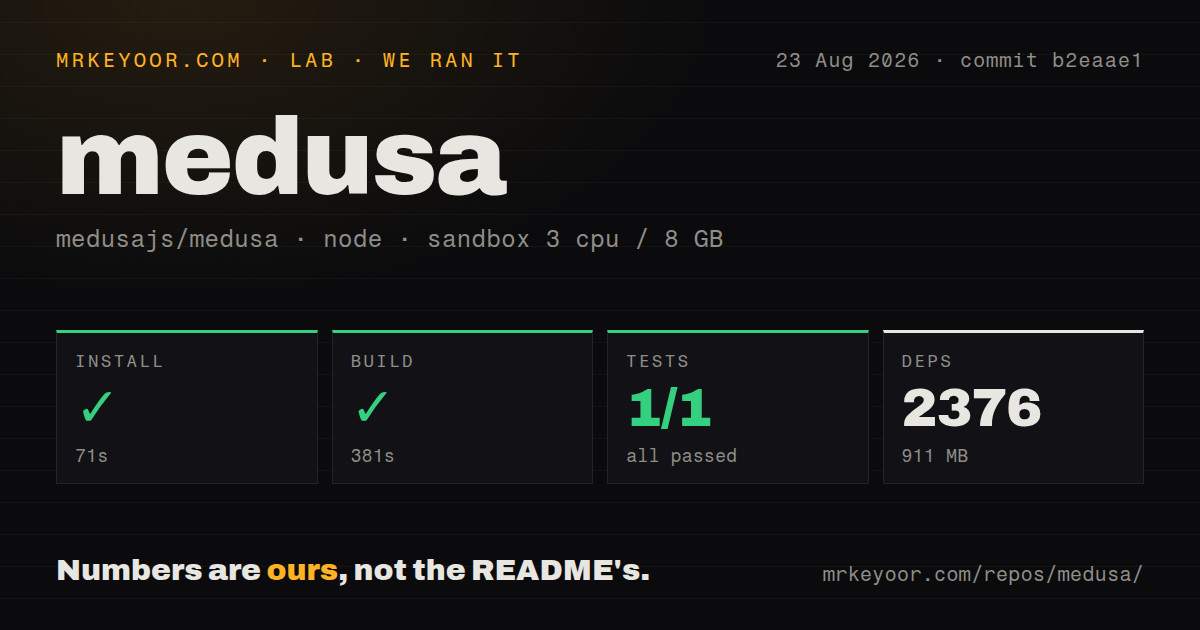
Our Node 22 sandbox installed 2,376 Yarn packages in 71 seconds, consuming 911 MB on disk. Building commit b2eaae1 took 381 seconds. The checkout was 268.3 MB, with 23,847 files and about 1,311,624 source lines, which makes Medusa one of the larger commerce codebases a team can choose to own.
The available Jest target succeeded in 374 seconds, with 1 test passed and none failed. That result is too narrow to support a broad quality claim about a monorepo with 38 CI workflow files. It says the target we found passed in our sandbox; store teams still need tests for their own checkout, pricing, tax, payment, refund, and fulfillment paths.
Medusa supplies a commerce core, not a finished shop
Medusa provides TypeScript modules for products, pricing, carts, orders, inventory, payments, fulfillment, tax, customers, and promotions. Developers can add data models, API routes, background work, subscribers, and workflows without forking the core. The customer-facing storefront stays separate. The installer can add a Next.js starter, but each team owns its design, hosting, accessibility, analytics, and customer experience.
That split suits custom products and punishes buyers who expected a boxed store. The repository uses an open-core model: core commerce modules are under MIT, while identified Enterprise Edition material requires a commercial agreement.
Where the flexibility earns its keep
Medusa makes the most sense when the business model is the hard part. The README explicitly positions it for direct-to-consumer and B2B stores, marketplaces, distributor platforms, point-of-sale systems, and service businesses. Those projects often need custom approval flows, unusual price lists, split fulfillment, vendor logic, or connections to an existing enterprise system. A module and workflow architecture gives those changes a defined home.
Release 2.19.0 added inventory CSV export, custom fulfillment addresses, notification preferences for order edits, and generic OIDC authentication. It also moved the admin to Vite 7 and React Router 7, a breaking change with newer Node and browser requirements. Useful commerce work and migration cost arrive together.
The admin dashboard is another meaningful advantage. Internal users need to manage products, orders, customers, promotions, and settings without waiting for a developer. Medusa includes that base and supports dashboard extensions, so a team can add business-specific screens while retaining the standard operating interface. That is much more useful than an API-only foundation that leaves every internal tool unfinished.
PostgreSQL is only the first production dependency
Local installation is approachable by commerce-platform standards. The official guide requires Node.js 20 or newer, Git, and PostgreSQL. Running create-medusa-app creates the backend and admin, and can add the Next.js starter storefront. A developer can therefore inspect products and make API calls without assembling the repository by hand.
Production is a longer checklist. A functioning store needs payment and fulfillment providers, transactional email, durable file storage, tax decisions, secrets, backups, logging, monitoring, and a deployment plan for both backend and storefront. Search and caching may add further services. Teams also need seed data, integration tests, and a safe process for webhooks and financial workflows. Medusa Cloud offers managed deployments and scaling, which is the easiest official route, but self-hosting means owning those choices.
Installation itself currently has an unusual wrinkle. Open issue 16294 says the large number of preview and snapshot versions on npm can trigger 429 errors for some installs. The maintainers recommend newer Yarn or pnpm releases while they work with npm. That is a workaround, not a fatal design problem, but it weakens the otherwise tidy first run.
ARM64 Linux operators have a more serious reason to test before committing. Open issue 16011 reports medusa db:migrate hanging on fresh projects across Medusa 2.16.0 and 2.17.2 on ARM64 Linux while equivalent x86_64 systems complete. The report includes several Node versions and environments. It does not prove every ARM host will fail, but it is specific enough that an Ampere or similar deployment should make migration testing an early gate.
Upgrades require attention
Medusa is active, and active frameworks move. Version 2.19.0 requires Vite 7, React Router 7, and newer Node point releases; it also removes several JS SDK product-option methods. Pin versions, read release notes, and run tests against real checkout, refund, tax, and fulfillment paths.
Recent open reports also cover misaligned columns in paginated product CSV exports, store credit behavior when an amount is zero, and field restrictions that may depend on an undocumented feature flag. These are not reasons to reject the whole platform. They are reminders that commerce bugs touch money and operations, so a green build needs domain-level assertions rather than only unit tests around custom code.
Health and the decision
The repository was pushed on August 26, 2026, and v2.19.0 was released on August 13. GitHub listed 170 open issues and pull requests, with bug reports and fixes updated on August 26. More than 36,000 stars and the README's 14,000-member Discord claim indicate a large audience, though neither guarantees support for a particular integration.
Documentation is one of Medusa’s best arguments. The site goes far beyond installation into framework concepts, modules, workflows, API references, storefront development, admin extensions, integrations, recipes, testing, and deployment. Release notes call out breaking behavior with migration advice. Newcomers still face a large conceptual map, but the answers are generally available.
Use Medusa when a custom commerce model justifies owning a software platform and TypeScript is a comfortable operating language. It gives a capable team far more structure than a homegrown backend while preserving control over the storefront and business logic. If your priority is opening a conventional shop with minimal technical ownership, its strengths become responsibilities, and a hosted service is the better purchase.