It wraps subscription image generation with stricter file rules
GPT Image Skill gives Codex, Claude Code, and Google Antigravity one written procedure for creating or editing images. A direct request is forwarded unchanged. A request for several concepts lets the agent write a separate prompt for each design while preserving shared constraints. Generated PNGs stay under the active project, and local PNG, JPEG, or WebP references are passed as files rather than replaced with text descriptions. That is useful when an agent must keep identity, layout, or brand material attached to a job.
The project does not call the OpenAI Images API. Its bridge uses Codex's built-in image capability under Sign in with ChatGPT and removes API-related environment variables from child processes. The README says image generation consumes included ChatGPT or Codex usage and remains subject to plan and workspace limits. It also says the current Free plan does not include image generation. This is a workflow wrapper around an entitlement you already have, not a route around billing or account restrictions.
Reference files must exist before the bridge starts
Claude Code and Antigravity users face a concrete attachment boundary: an image visible in the outer conversation is not automatically available to the nested Codex process. The skill requires a readable filesystem path. If the host exposes a temporary attachment path, the agent copies that exact file into the project's input folder. If it exposes no path, the user must save the image in the workspace first. The runner refuses to guess from a cache directory, which avoids selecting an unrelated or private image.
Follow-up revisions require similar care. Each bridge call is temporary, so a request to change the latest result must use that result as the next edit target and reattach any references that still matter. For multiple images, batch concurrency defaults to 2 and tops out at 4. Jobs can share a reference, but one batch output cannot become another job's input inside the same stage. Workflows with dependencies therefore run in stages rather than as one manifest.
What happened when we ran it
We did not run commit 3be04a6 in our sandbox. The lab classified the JavaScript repository as having no supported ecosystem target for this job, and it found no Dockerfile. That means we have no measured install duration, package count, disk use, build result, test result, or vulnerability result. The screenshots and checked boxes in the README are project evidence, not substitutes for an independent execution on our box.
The absence of a lab run matters more here because installation asks an agent to inspect local tools, keep a persistent clone, create links for 3 agent hosts, and possibly install missing user-level software. The repository's contract limits those actions and tells the installer to stop before administrator elevation, destructive replacement, discarded changes, credential reading, or altered authentication. Those are sensible written controls. We could not confirm their behavior through the supplied sandbox measurement.
Node.js 22 and a persistent clone are hard requirements
The documented setup requires Git, Node.js 22 or newer, Codex CLI, and ChatGPT subscription authentication. macOS, Linux, native Windows, and WSL2 are supported; WSL1 is explicitly rejected. The installed skills are links or junctions back to the clone, so deleting that clone later breaks them. On WSL2, the README says to keep the clone, Node.js, Codex, and the working project on the Linux side rather than mixing Windows and Linux runtimes.
Bootstrap targets Codex, Claude Code, and Antigravity together, then returns one readiness report. A browser or device sign-in remains the user's job. The contract says the installer must not read a password, token, API key, or Codex auth file. A passing setup confirms paths and ChatGPT sign-in, not whether that account may generate an image. The first live request is still where entitlement, usage limits, and the current built-in renderer meet.
Transparency checks bytes, not visual quality
For a transparent-background request, the runner separates the creative prompt from the background setting. It then requires PNG output with an alpha channel or transparency chunk. That catches a file that cannot represent transparency, but it cannot tell whether the subject has a clean edge or whether the renderer painted a checkerboard. The README is candid about this boundary and does not market its signature check as visual review. Exact requested pixel dimensions may also vary with the built-in generator.
The normal path deliberately avoids model discovery, planning, extra inspection, fallback turns, and automatic generation retries. Codex chooses a current account-available model while the bridge requests Low reasoning. Users can choose account defaults or pin a model as an advanced option, but the repository keeps no model allowlist. That reduces stale configuration, while also making the account and current Codex catalog part of reproducibility.
A three-day-old repo has almost no maintenance record
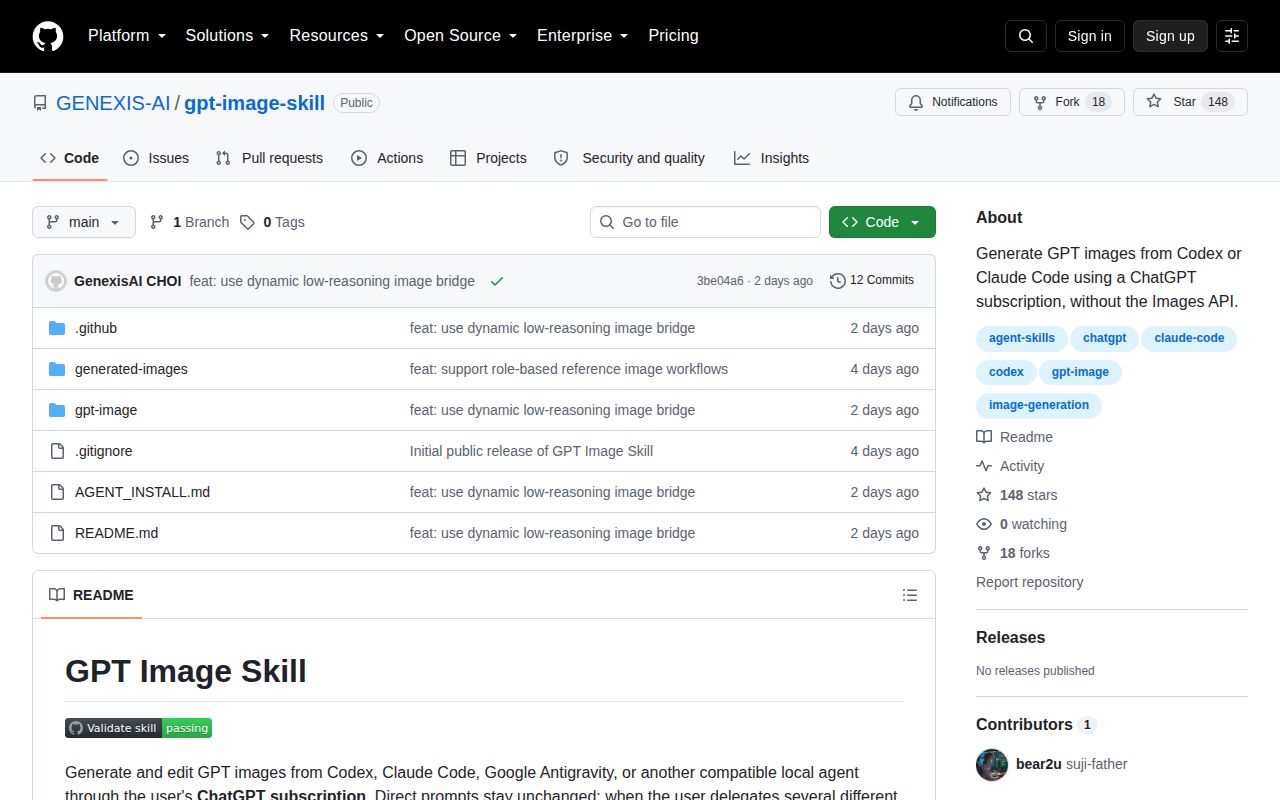
GitHub says the repository was created on August 26, 2026 and last pushed on August 28. It had 148 stars and 0 open issues or pull requests when we fetched it, and the latest-release endpoint returned no release. Zero open reports in a project this new says little about defect handling because users have barely had time to file or resolve anything. The repository also declares no license, a direct blocker for organizations that require clear reuse terms.
GPT Image Skill is best treated as inspectable installation policy plus a convenience bridge, not as an established image platform. Its handling of references, prior edits, bounded batches, API-key rejection, and workspace-only output addresses real agent mistakes. The trade is trust: you are adding a young local runner around an account-bound service, and our lab could not execute commit 3be04a6. Read the installer and runner before use, keep the clone pinned, and do not infer production readiness from the README's smoke images.