The What and Why of Agent Skills
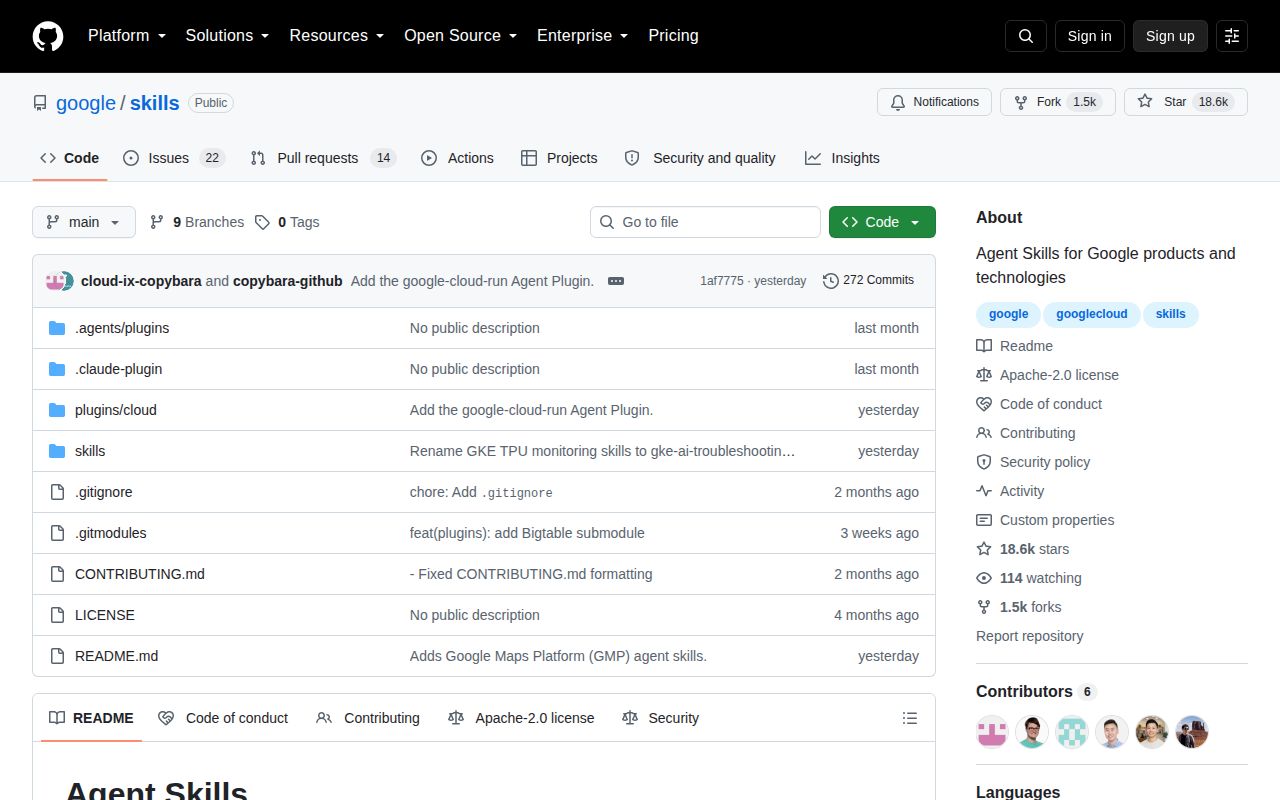
The rise of AI agents has created a new challenge: how do you give a powerful language model the actual ability to do things in the real world, especially within complex technical environments like a public cloud? The google/skills repository is Google's answer for its own Cloud Platform (GCP). This isn't an AI agent itself, but rather a library of capabilities, or "skills," that you can plug into an agent built on the agentskills.io platform.
Think of it as a specialized, high-level SDK for AI. Instead of teaching an agent how to make dozens of sequential API calls to, say, set up a Retrieval-Augmented Generation (RAG) pipeline, you can give it a single skill: google-cloud-solution-rag-enterprise-search-gke-sqldb. The agent can then invoke this skill to perform the entire complex workflow. The repository is a vast collection of these pre-packaged solutions, covering a stunning breadth of Google's cloud offerings, from foundational setup to advanced AI and infrastructure management.
Deep Integration and Codified Expertise
The primary strength of google/skills is the sheer depth of its integration with the Google Cloud ecosystem. This is not a superficial set of tools. The list of skills reads like a catalog of solutions an enterprise would pay a team of expensive consultants to build. There are skills for multi-product architectures like a "Borderless open data lakehouse agentic AI system" and granular operational tasks like "GKE JobSet Interruption Troubleshooting."
This collection effectively codifies Google's own best practices. The presence of skills for the "Well-Architected Framework," specifically targeting cost optimization and operational excellence, is telling. Using this library means you are not just automating tasks; you are automating them in the Google-approved way. For organizations heavily invested in GCP, this is a massive accelerator. It reduces the need for developers to become deep experts in every niche of the platform. The agent, equipped with these skills, becomes the expert.
The focus is squarely on modern, demanding workloads. There is heavy emphasis on Google Kubernetes Engine (GKE), especially for AI/ML inference, BigQuery for data analytics, and the new "Agent Platform" for building with Gemini. Skills like "GKE TPU Dynamic Slices Monitoring & Management" and "Live bidirectional multimodal streaming agentic AI solution" demonstrate that this project is aimed at the cutting edge of cloud computing, not just managing legacy applications.
The Double-Edged Sword of Lock-In
The project's greatest strength is also its most significant weakness: extreme vendor lock-in. Every skill is meticulously crafted for Google Cloud services. This is fantastic if GCP is your entire world, but the moment you consider a multi-cloud strategy or a migration, this entire library of accumulated knowledge becomes useless. It creates a powerful incentive to stay within the Google ecosystem.
This lock-in extends beyond the cloud provider. The installation command, npx skills add google/skills, reveals a dependency on the agentskills.io platform. These skills are not generic Python modules you can easily import into a LangChain or Microsoft Autogen agent. They are designed for a specific framework. Adopting this library means you are committing not just to Google Cloud, but also to a particular architecture for building your AI agents. This is a critical strategic decision that shouldn't be taken lightly.
Furthermore, the documentation within the repository itself is sparse. The main README is little more than a table of contents, linking out to individual skill directories. There is no high-level architectural overview, conceptual guide, or quickstart tutorial for the uninitiated. It feels like a component of a much larger product, with the assumption that users will arrive with pre-existing context from the main agentskills.io platform.
An Active but Immature Project
Judging by the project's activity, it is a high priority for Google. With over 16,500 stars, a last push date of yesterday, and a remarkably low 32 open issues, the repository is buzzing with life and appears to be well-maintained. Its recent appearance on GitHub's trending list confirms it has captured significant developer interest.
However, the README explicitly states it is "under active development," and there are no official releases listed. This signals that the API and available skills are likely to change frequently. While this is great for getting the latest features, it makes it a risky dependency for a stable, production system where predictability is key. Teams using this should be prepared for potential breaking changes and should pin their dependencies carefully.
In a real-world stack, google/skills fits in as a powerful accelerator for platform engineering and MLOps teams that are all-in on Google Cloud. It enables the creation of sophisticated internal developer platforms (IDPs) or AI-powered chatbots that can handle complex requests from developers, data scientists, and operations staff. An engineer could ask an agent, "Deploy our new model to GKE with GPU acceleration and set up monitoring," and the agent would use skills from this repository to execute that command reliably. It is the bridge that connects natural language intent to complex cloud reality, but only if that reality is painted in Google's colors.