Twenty-four skills turn engineering habits into agent instructions
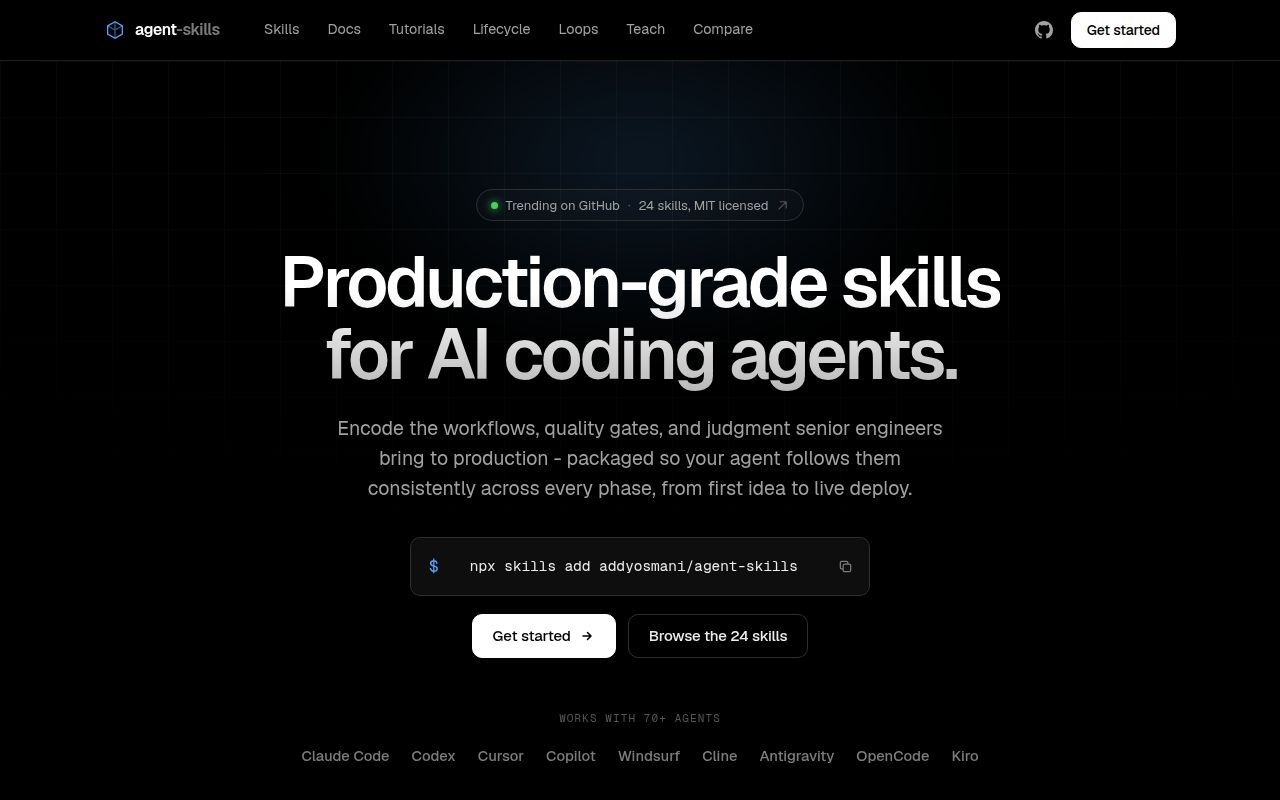
Agent Skills packages a software-development lifecycle as Markdown instructions. The collection covers requirements interviews, specifications, planning, incremental implementation, tests, security, performance, documentation, observability, release work, and related reviews. Eight slash commands route work through larger stages such as /spec, /build, and /ship. Specialist agent definitions add focused code, test, security, and web-performance reviews.
The useful idea is that an agent receives a process at the moment it needs it rather than carrying every policy in one prompt. Each skill has triggers, steps, checkpoints, warning signs, and verification requirements. Because the files are plain text, a team can inspect and edit them. The pack supports more than 70 agents through the skills CLI, while Claude Code, Codex, Gemini CLI, Command Code, and others have tailored installation notes.
Start with one failure mode, not all 24 skills
A full lifecycle can help a team whose agent routinely skips tests or starts coding before requirements settle. It can also bury a small fix under ceremony. The README offers an incremental adoption route for existing codebases, which is the right default. Pick one recurring problem, install the related skill, and compare the resulting diff, test evidence, and review time against similar work without it. Keep the instruction only if it improves an outcome you can name.
The pack also includes /build auto, which generates a plan and implements each task after one plan approval. It says tasks remain test-driven, are committed individually, and execution pauses on failures or risky actions. That is a strong operating opinion. Repositories that prohibit automatic commits, require approval per production change, or have expensive tests must edit that workflow before use rather than assuming the label auto matches local governance.
What happened when we ran it
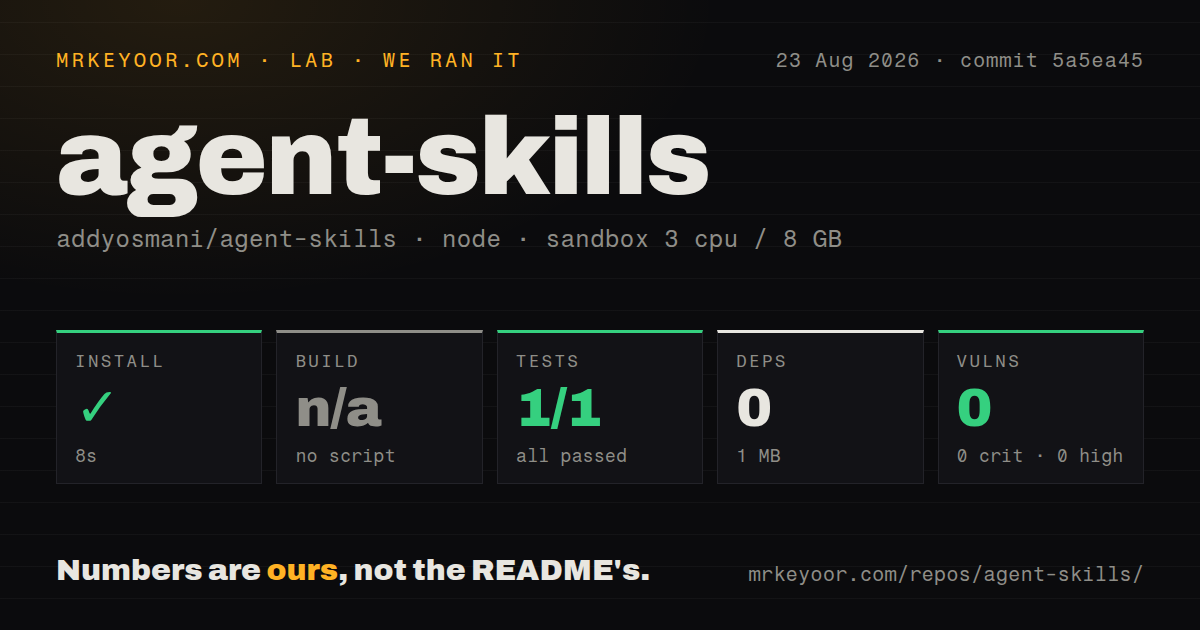
Our sandbox cloned commit 5a5ea45 and worked inside evals/fixtures/ci-cd-and-automation/, the project location identified by the harness. The npm install completed in 8 seconds, installed 0 packages, and occupied 1 MB. There was no build script or target, so the build step was skipped. npm audit found 0 known vulnerabilities at every reported severity.
The test command finished in 6 seconds. Node's test runner reported 1 passed and 0 failed out of 1. That green result is real but narrow. It does not demonstrate that all 24 skills improve planning, code quality, or release safety across different models and repositories. Treat the fixture as a check that one packaged behavior works, then design local evaluations around the agent mistakes that prompted installation.
The repository was compact: 187 files, about 3,421 lines of source, and 0.8 MB checked out. It had 1 CI workflow, a tests directory, and no Dockerfile. Most content is Markdown rather than an application service, so installation does not introduce a runtime daemon. The continuing cost is context, instruction conflicts, and time spent following steps, none of which our 6-second fixture test measures.
Single-skill installs lose shared reference files
The fastest command can install all skills or select one by name. The README warns that a per-skill npx install copies only skills/<name>/ and omits the root references/ directory. The chosen skill still runs, but links to supplementary checklists no longer resolve. Issue 361 tracks that portability gap. Clone or install the whole repository when the security, testing, accessibility, performance, or observability references are part of why you chose the pack.
Agent-specific paths also differ. Claude Code can use a marketplace plugin, but GitHub SSH configuration may block the clone; the README provides an HTTPS route and a Git rewrite workaround. Codex native plugin support requires CLI v0.122 or newer. OpenCode has a current documentation conflict in issue 515: its guide says to carry the root AGENTS.md, while that file says it configures work on this repository and should not be copied elsewhere.
Optional hooks need a separate security decision
Most skills are instructions, but optional hooks cross into executable behavior. Issue 295 reports SSRF, cache-poisoning, and symlink-overwrite concerns in the WebFetch cache and simplify-ignore hooks. The report says those hooks are not wired by default and that the standard session-start hook reviewed clean. That scope matters: it is a warning against enabling optional automation without inspection, rather than evidence that a default Markdown install executes the reported paths.
Source-driven instructions deserve the same skepticism they request from agents. Read shell scripts before activation, pin the revision installed, and decide which network or filesystem actions are acceptable. Teams should also reconcile skill rules with repository-level instructions. When two documents disagree about commits, approvals, or file ownership, the agent may choose the wrong one unless precedence is written down.
Active releases still leave context cost to the adopter
GitHub showed 90,094 stars, 120 combined issues and pull requests, and a last push on August 21, 2026. Release 0.6.7 landed on August 14 with a Codex session-start fix, aligned plugin versions, repaired reference links, Command Code support, and new CI guards. That activity shows maintainers respond to integration failures, not that every skill fits every model generation.
Issue 433 is a useful counterweight: one user removed the pack after reviewing its context impact with newer Claude models, while explicitly saying the observation lacked before-and-after data. That is not a benchmark. It is a reason to measure. Agent Skills is best treated as source code for team behavior: inspect it, choose narrowly, test it against actual work, and delete any instruction whose cost exceeds the mistake it prevents.