JHipster generates an application stack, not a starter folder
JHipster takes choices about architecture, database, authentication, build system, and client framework, then writes a working Java application around them. Spring Boot is the backend foundation; Angular, React, and Vue are the supported client families. It can target a monolith or a microservice architecture, with JDL available to describe applications and entities. The appeal is consistency: a team can create several services without rebuilding security, entity screens, test wiring, and deployment files by hand.
That output is far broader than a dependency picker. Release v9.2.0 mentions more than 3,000 EJS templates, Spring Boot 4.0.7, Gradle 9.6.1, Node 24.18.0, and webpack-dev-server 6. A generated project therefore contains decisions from several fast-moving ecosystems. JHipster can save the first weeks of assembly, but the generated repository becomes your application. Its upgrades deserve the same review as a large framework migration.
Java 21 or 25 and Node 22 or 24 narrow the supported path
The repository README now gives a small, useful compatibility table. GitHub Actions verifies Java 21 and 25 against Node 22 and 24. Using those combinations removes one class of uncertainty when contributing to the generator. The published package installs globally with npm, while the documentation also describes a Docker route for people who want the toolchain contained.
Application setup grows with the selected blueprint. Maven or Gradle has to fetch the Java side, npm installs the generated client, and databases or identity providers must exist before realistic use. Docker deployment may need registry credentials. A microservice selection adds service discovery, gateways, and multiple deployable units. None of that is a defect in the generator. It means the short global install command measures access to JHipster, not the effort required to operate what it creates.
What happened when we ran it
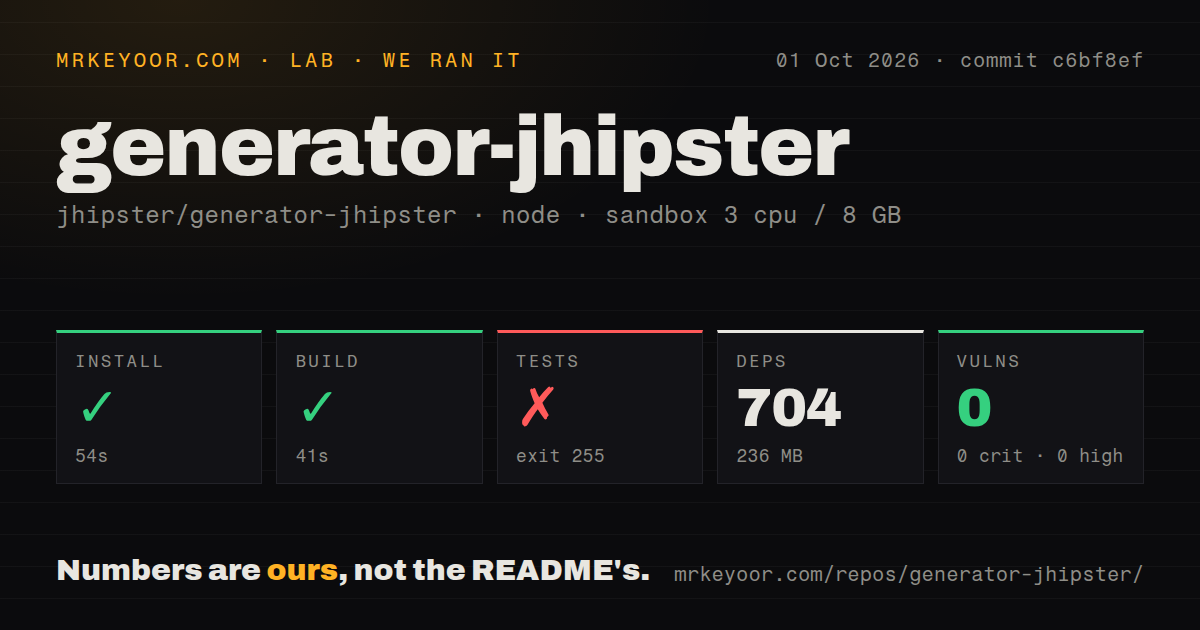
Our clean Node 22 sandbox installed 711 npm packages in 61 seconds. The resulting dependency directory used 239 MB, and npm audit reported 0 known vulnerabilities across critical, high, moderate, and low severities. The build succeeded in 44 seconds. Those are respectable numbers for a generator spanning thousands of source files and several application families.
The test command was different. It ran for 141 seconds and exited 255. Mocha reported 10,348 passing, 888 failing, and 47 pending out of 11,236 tests. The final log lines listed contexts such as invalid Java field names, invalid Angular field names, missing files, existing application configuration, and unidirectional relationship options. The supplied tail did not include failure messages or stack traces, so it supports no claim about the cause.
A high passing count cannot turn that command green. The useful conclusion is that commit 88a26c9 installed and built in our fresh unprivileged container, while its complete measured test step did not pass there. The checkout contained 3,981 files, about 136,611 lines of source, and 18.4 MB before installation. It also had 24 CI workflow files, a Dockerfile, and a tests directory, which matches the project's unusually wide compatibility surface.
A generated codebase trades early speed for long ownership
JHipster is most persuasive when an organization has already chosen its stack. A Java shop standardizing on Spring Boot, one of 3 client frameworks, and a known database can encode those choices once. Entity generation and JDL then reduce repeated work. Daily build matrices cover Angular, React, Vue, Maven, Gradle, SQL, NoSQL, OAuth 2.0, JWT, Docker, and Windows combinations.
The same matrix explains why upgrades can be involved. Version 9.2.0 completed a move to Vitest for generated front ends, removed Jest from client choices, tightened generated backend security, and repaired framework-specific entity behavior. An existing generated application does not magically receive every correction. Teams need the documented upgrade process, meaningful diffs, and regression tests around their custom code.
Generated code also changes the debugging question. When something breaks, engineers must decide whether the problem comes from local edits, a chosen blueprint, a template, or an upstream framework. That is manageable when several teams share JHipster knowledge. It is a costly tax when one developer generated an application once and nobody understands the conventions six months later.
The August 26 activity shows a maintained but moving target
GitHub listed 22,446 stars and 92 combined issues and pull requests, with the last push on August 26, 2026. Current work included React's move to Vite and Angular microfrontend changes. Release v9.2.0 was published on July 10, 2026, so the repository had both a recent stable tag and post-release development. The combined open count should not be read as 92 bugs.
The project is mature enough to have explicit support combinations, extensive CI, daily generated-application builds, and a detailed release process. Our 888 failing tests still matter because they show that a fresh supported Node image did not reproduce a clean suite for the measured commit. Before standardizing, generate the exact application shape your teams want, build it on the target Java version, and test an upgrade.
JHipster earns its cost when the conventions repeat
A single conventional Spring API rarely needs this much machinery. Spring Initializr gets that team to a smaller starting point, while a custom Cookiecutter template fits organizations with established conventions outside JHipster's menu. JHipster becomes easier to justify when multiple applications share authentication, entity patterns, front-end structure, and deployment assumptions.
Our run found a fast build, a clean dependency audit, and a large failing suite in the same checkout. That mixed result fits the product: there is serious engineering here, but also a very wide surface to verify. Adopt it as an organizational platform with owners and upgrade practice. Do not treat the generator as a one-time shortcut whose output will maintain itself.