Five skills cover a narrow band of agent work
Garden Skills is a collection, not a general agent framework. The five entries target web presentations, frontend design, GPT Image 2 work, knowledge retrieval, and styled article production. Each skill puts its method in readable instructions and supporting files, so a developer can inspect what the agent will be told before installing it. The main README is in English, with Chinese and Japanese translations available.
That focus is useful if your backlog resembles the gallery. A frontend team can reuse the design workflow, while a content team can turn a script into a 16:9 presentation or an article into a themed page. Backend migrations, observability, database operations, and deployment are outside the current five-skill set. The 19.4 MB checkout should be judged as a small specialist shelf, not as an all-purpose agent toolkit.
Installation is easy, versioning is per skill
The README documents five installation routes. npx skills add can install the collection or one named skill. Claude Code users can subscribe through the plugin marketplace. Teams that need reproducibility can download an immutable zip, verify its SHA-256 checksum, or pin the repository as a submodule. Manual copies are also documented for .claude/skills, .agents/skills, and .codex/skills.
The catch is version shape. Formal releases belong to individual skills, and the latest GitHub release on July 12, 2026 was web-design-engineer-v1.3.0. Installing the repository head and pinning a released zip are different choices. A team that has reviewed one workflow should pin that artifact, record its checksum, and update after reading its diff. Subscribing to a marketplace pack trades that control for easier updates.
What happened when we ran it
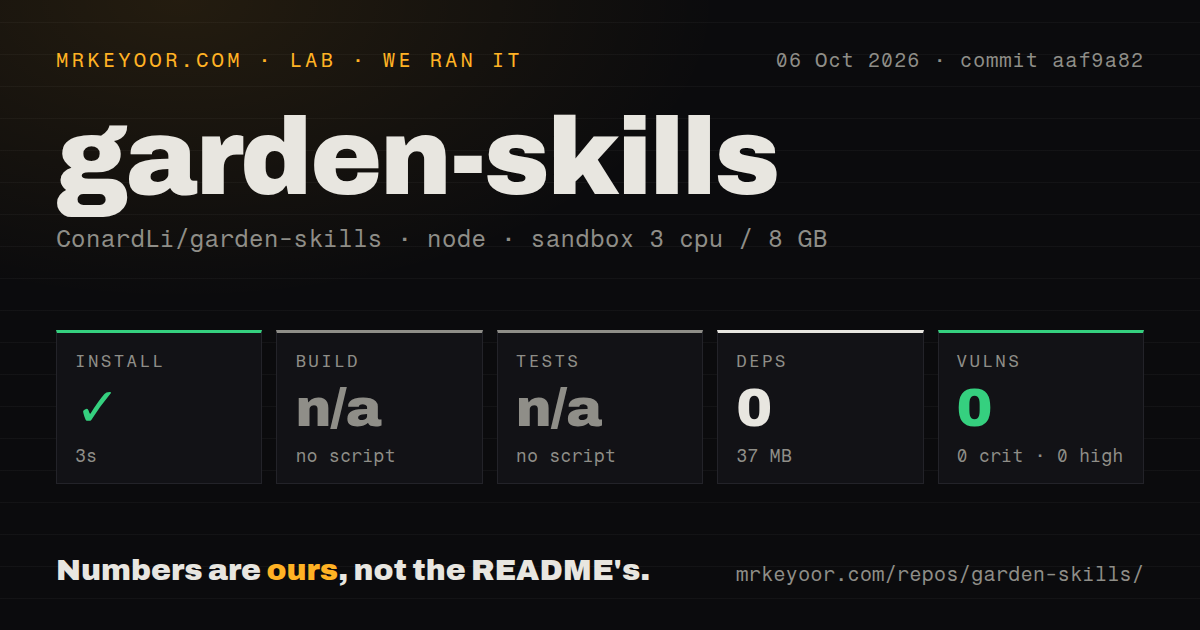
Our sandbox installed commit aaf9a82 in 21 seconds and npm reported 0 packages installed. The repository occupied 19.4 MB, with 592 files and about 12,569 lines of source. Npm audit found 0 known vulnerabilities. Those numbers make the checkout cheap to try and leave little dependency surface at the repository root.
There was no build script or target, so we skipped the build. There was also no test script or target, and no tests directory, so we skipped tests. Two CI workflow files were present, but that does not turn an absent local suite into a pass. Our run establishes that the repository can be installed as checked out; it does not prove that each agent follows every instruction or that generated artifacts meet their acceptance criteria.
The instructions are the product and the trust boundary
A skill changes agent behavior by adding context, procedures, scripts, and sometimes commands. Garden Skills makes those materials visible, which is preferable to installing a black box, but visibility only helps if someone reads them. The web design skill can ask an agent to create or change application code. The image skill supports local generation, host-native delegation, or prompt-only use, and a chosen runtime may require an API credential.
Treat each directory like code from a dependency. Review its SKILL.md, scripts, referenced assets, expected write locations, and network calls. Then test it in a disposable project with the same agent your team uses. The root install adding 0 packages does not mean later generated projects have no dependencies. It means Garden itself did not pull a package tree during our measured setup.
Presentation automation has two concrete failure reports
The web presentation workflow has detailed checkpoints and a fixed 1920 by 1080 stage, but open issue 27 describes a repeatable auto-mode problem. Pressing Space at the start gate can also reach the stage navigation handler, skip step 0, and put narration out of sync. The reporter says clicking the gate avoids the problem. Anyone recording unattended playback should verify the opening step before a long capture.
Issue 28 describes a different coordination limit from a 9-chapter, 44-step production. Parallel agents independently redrew the same four-quadrant map across four chapters, changing its position, size, and orientation. The eventual fix was a shared component. That is a useful warning for teams attracted to parallel generation: shared visual elements need to be identified and implemented once before work fans out.
July activity is current, while the open queue mixes issues and PRs
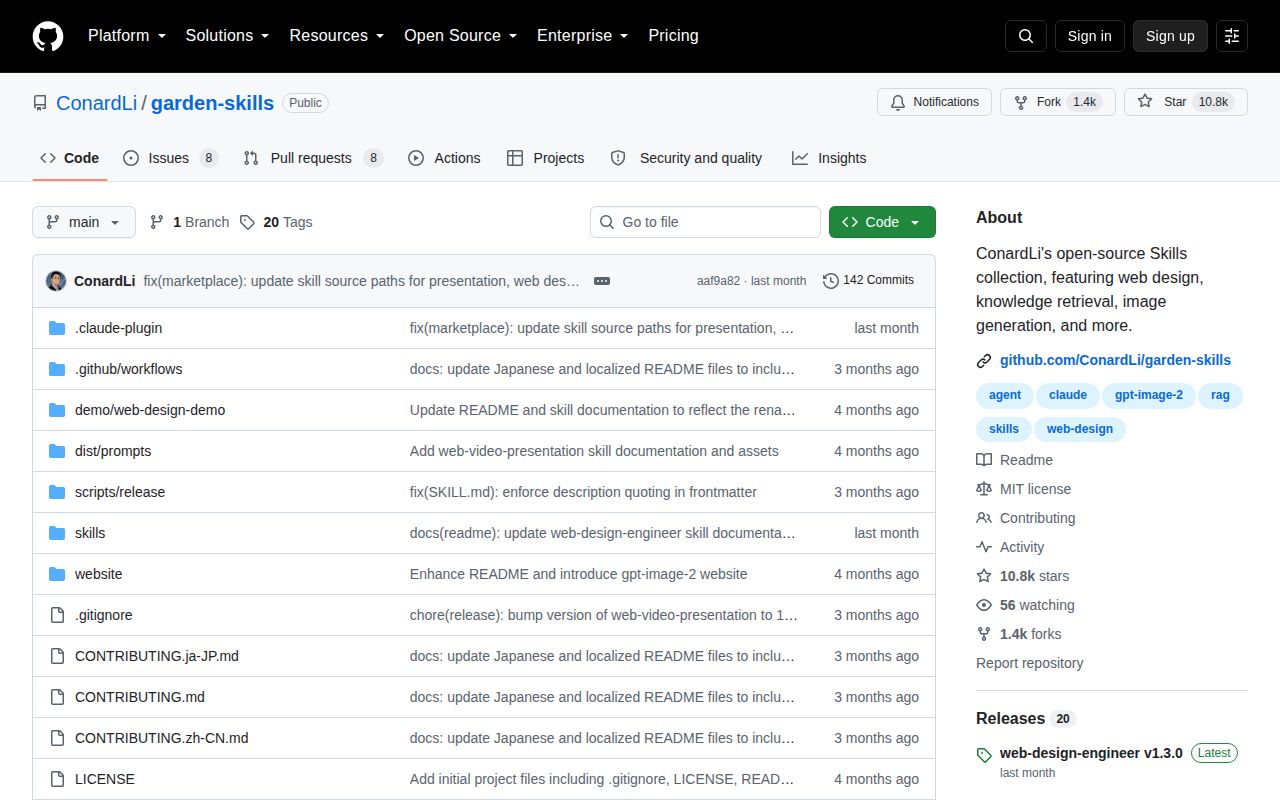
GitHub showed 10,754 stars and 16 open issues and pull requests when fetched. The last push was July 12, 2026, the same day as the latest release. Open items include bug reports, feature requests, and proposed skill additions, so the combined count should not be read as 16 confirmed defects. The dated push and recent discussion show maintenance activity without proving response times or release cadence.
Garden Skills is worth sampling when a named workflow saves repeated prompt design. Its strongest property is that the instructions are available to inspect, pin, and edit. Its weakest property is equally plain: our 21-second install had no executable build or test target. The right adoption unit is one reviewed skill for one recurring job, followed by comparison of its output against your own acceptance checks.