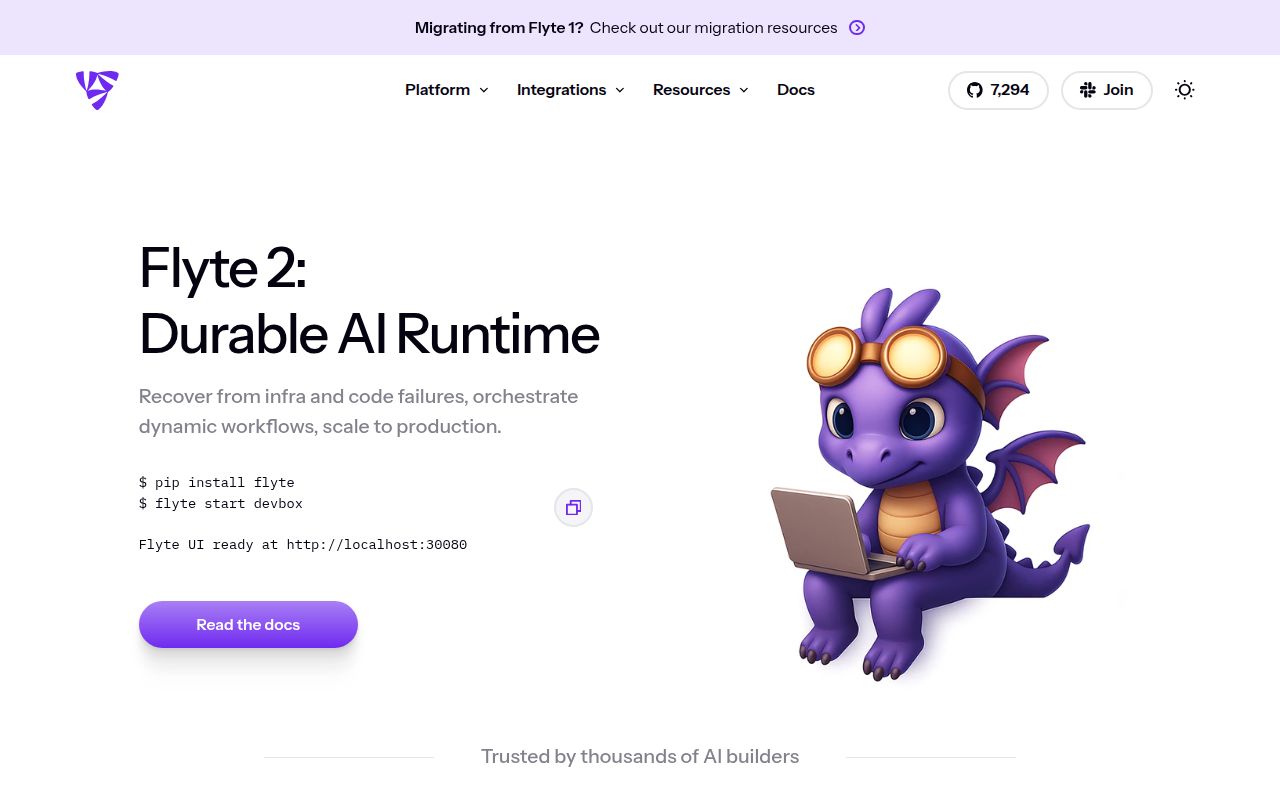
Flyte 2 covers workflows and model services from Python
The user-facing idea is appealing: define tasks in ordinary Python, run independent calls concurrently with asyncio, and let Flyte package and execute them on managed compute. The same API can describe a workflow or serve a FastAPI model. Runs have tracked results, while the CLI can invoke the same task definition. That puts batch pipelines, model endpoints, and agent jobs under one execution model instead of several schedulers.
The repository boundary needs attention. The main checkout is mostly the Go backend, controllers, and protocol definitions, while the full SDK and development tools live in flyteorg/flyte-sdk. Our scan found 1,938 files and about 514,637 source lines at commit 674fd3d. A developer following only uv pip install flyte is trying the Python surface; a platform engineer reviewing this repository is evaluating a much larger distributed system.
The open backend is promised, while hosted production exists now
Flyte 2 is labeled generally available in the README, but the same page says its open-source backend is coming soon. It directs teams needing a production backend today to Union.ai. That distinction changes the buying decision. General availability describes the Flyte 2 product line and SDK experience; it does not mean the repository currently offers the finished public self-hosting path that every buyer may expect from Flyte 1.
The backend guide describes gRPC Queue, Run, and State services backed by PostgreSQL, with LISTEN/NOTIFY for streaming. Kubernetes primitives schedule tasks as pods, and the design includes multi-cluster routing, service-account identity, and pod log tracking. Its contributor prerequisites span Go 1.26.5, Buf, Node/npm, Python 3.9 with uv, and Rust. This is platform software for a team that already knows how to run clusters and databases.
What happened when we ran it
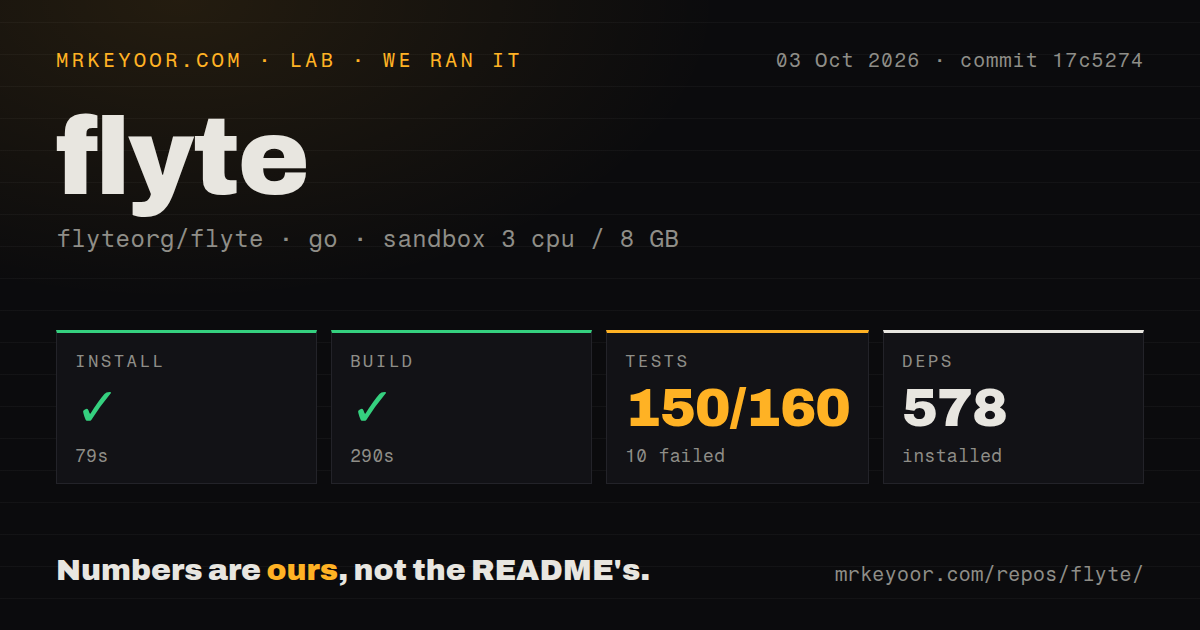
Our sandbox installed 574 packages in 60 seconds and completed the build in 231 seconds. The repository was 24.9 MB checked out before dependencies. Those steps succeeded in the supplied golang:1.24-bookworm image, using an unprivileged Debian container with 3 CPUs, 8 GB of RAM, and no secrets. The build result confirms the source compiles in that measured environment; it does not stand in for a Kubernetes deployment.
Tests failed with exit code 1 after 140 seconds. Go reported 149 passed and 10 failed out of 159. The log tail says embedded Postgres could not initialize databases through /tmp/embedded-postgres-15432/bin/initdb and the equivalent path on port 15433. Failures then appear in runs/repository/impl, runs/service, and runs/test/api. The tail does not say why initdb failed, so blaming permissions, packages, or the container would be guesswork.
Kubernetes and Postgres are part of the operating model
Flyte's backend does more than queue Python functions. It builds or references container images, creates Kubernetes resources, tracks task state, moves metadata through services, and stores run data in Postgres. A serious pilot therefore needs a cluster namespace, identity rules, image registry access, database backup, logs, and resource limits. The Devbox and Codespaces routes are useful for learning, but neither proves the controls needed for a shared ML platform.
Release v2.0.44 was published August 26, 2026. Its notes include a fix for tasks whose containers exit non-zero and previously relaunched forever, service-to-service authentication, image-builder identity work, and dependency updates. Those changes show that task lifecycle and service boundaries are still receiving direct attention. Pin the chart, binaries, and SDK together during evaluation, then run failure drills for pod exits, controller restarts, and database interruptions.
Stale forks can execute code from before an edit
Open issue 7923 reports a sharp problem for agent repair loops and interactive development. In one long-lived process, run() builds and caches a code bundle, then a later fork() with the same arguments may reuse that bundle even after files change and modules reload. The report says the old code runs without a warning because file contents are not part of the memoization key. It provides a workaround that clears a semi-private cache.
Issue 7926 describes a different control-plane failure on v2.0.42: a run disappeared from the UI while a root TaskAction remained for 17 days and its pod kept being recreated. The reporter had to delete TaskAction resources with kubectl after the orphan blocked a node drain. The trigger was unknown, so this is not a universal behavior claim. It is a reason to alert on orphaned custom resources and document manual termination before adoption.
Current maintenance is strong, but Flyte 2 is still moving
GitHub recorded the last push on August 28, 2026, 7,294 stars, and 165 combined issues and pull requests. Same-day work covered a Helm chart, service settings, multi-cluster support, and controller fixes. Issue 7867 also reports the UI stopping at 5,999 displayed actions for a completed run with more than 10,000 actions, a concrete warning for teams whose workflows fan out heavily.
Flyte has an established name, Apache 2.0 licensing, and LF AI & Data graduation, but this review is about the current Flyte 2 repository boundary. The code is active and the vision is credible. The open backend promise is still a promise in the main README, and our 10 failed tests leave local setup work unresolved. Existing Flyte operators can justify a careful trial; newcomers wanting self-hosted orchestration today should compare Argo, Kubeflow Pipelines, Dagster, and Prefect.