Every workflow step is a Kubernetes container
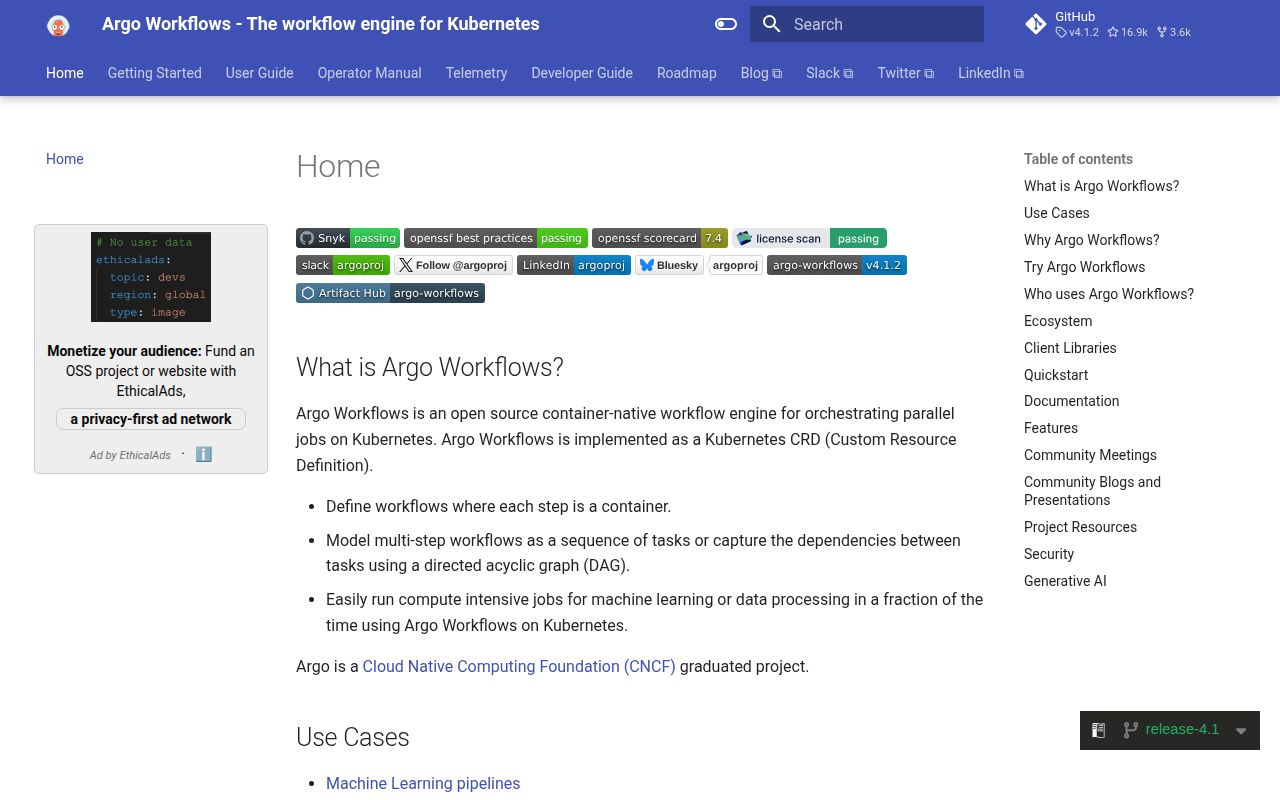
Argo Workflows represents a job as either ordered steps or a directed acyclic graph. Each node runs in a container, and workflow resources carry parameters, artifacts, retry rules, conditions, timeouts, and dependencies. The controller turns that declaration into pods and tracks their state. This model is direct for batch systems whose work is already packaged as images.
The container boundary is also the main filter for adoption. A 20-line function becomes an image, registry artifact, pod specification, and cluster execution. That cost can be worthwhile for GPU jobs, isolated data transforms, or pipelines that need different runtimes per step. It is less attractive for many tiny application callbacks that share libraries and state. Argo orchestrates Kubernetes work; it does not hide Kubernetes.
DAGs, artifacts, retries, and schedules are built in
The feature list covers both execution and operations. Workflows can loop, branch, suspend, resume, cancel, retry, memoize resubmissions, and run on a cron schedule. Parallelism limits and Kubernetes placement settings control where work lands. Exit hooks support cleanup or notification, while garbage-collection policies remove completed pods and workflows.
Artifacts can move through S3, Artifactory, Alibaba OSS, Azure Blob, HTTP, Git, GCS, raw storage, or plugins. The server exposes HTTP and gRPC APIs plus a web interface. Workflow templates keep reusable definitions in the cluster. Archiving retains completed runs for later access. These pieces form a capable batch platform, but they require databases, object stores, credentials, and retention rules beyond the 10-second source build we measured.
What happened when we ran it
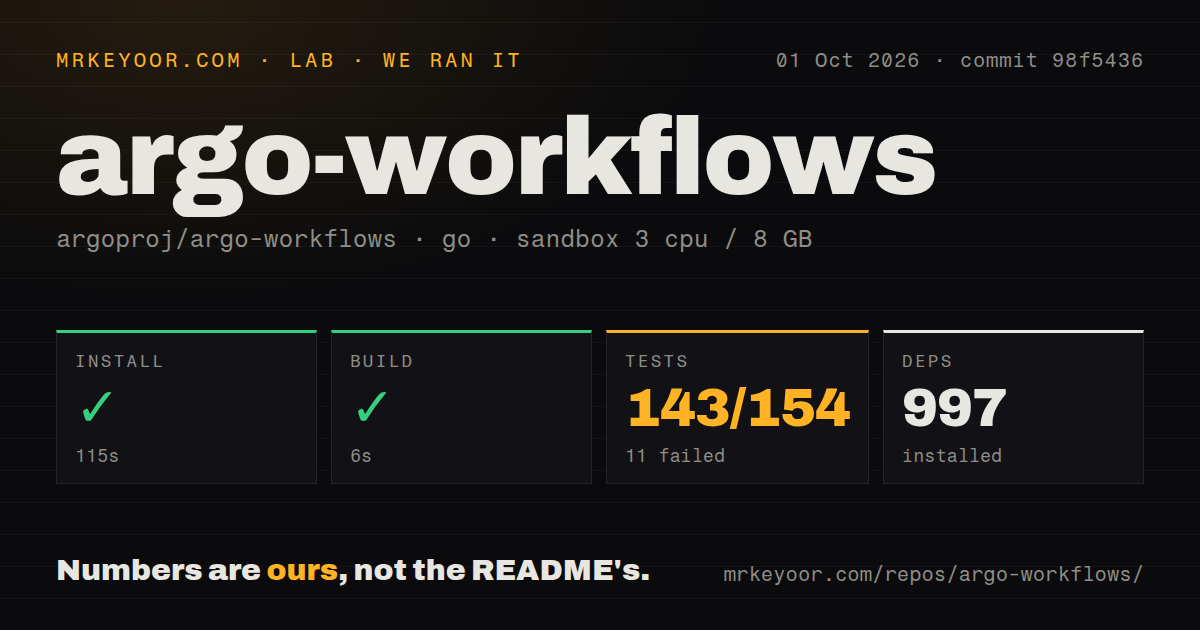
Our fresh Debian sandbox installed 976 Go packages in 111 seconds. commit f016ad8 contained 2,985 files, about 320,754 lines of source, and an 83.2 MB checkout. The build completed successfully in 10 seconds. We found 17 CI workflow files, a Dockerfile, and a tests directory.
The test command ran for 396 seconds and ended with exit code 1. The harness counted 5 passing packages and 1 failure out of 6. TestLockMetricsDatabase/mysql failed immediately because its test-container library could not find rootless Docker and therefore could not create a Docker provider for MySQL. Other workflow packages shown in the tail passed or had no test files.
That failure is specific and bounded. It does not show a controller compilation problem or a broken database algorithm. It shows that the complete test path expects a container provider even inside an unprivileged Go build environment. We did not add Docker access to the sandbox. Contributors should provide the documented container test dependency or select a test scope that does not claim to cover MySQL-backed lock metrics.
Cluster permissions are part of the workflow design
A workflow pod may read secrets, mount volumes, call cloud APIs, create Kubernetes resources, or reach internal services. Argo supports service accounts and normal Kubernetes scheduling controls, so administrators can constrain those capabilities. The workflow author still chooses images and templates that run with them. Treat shared templates as code with an authority level, not as harmless YAML snippets.
The server brings another boundary. Single sign-on through OAuth2 or OIDC is available, and webhook triggers can submit work. Exposing the API or UI requires authentication, authorization, network policy, and audit decisions. Artifact credentials deserve separate scope from the controller's cluster permissions. A user who can submit an arbitrary container may have a route to every secret or network target available to that workflow service account.
The quick start installs more than a CLI
Release v4.1.2 provides a compressed CLI binary for macOS and Linux. The controller quick start then creates an argo namespace and applies the release installation manifest. That distinction matters: the CLI submits and inspects work, while the cluster installation supplies CRDs, controller behavior, and the server components needed for actual execution.
Production should avoid treating one kubectl apply as the finished design. Pin release artifacts, review the manifest, define namespace ownership, restrict workflow pods, configure artifact storage, and decide what to archive. Set quotas before a loop or broad fan-out turns one submission into too many pods. The README says about 200 organizations are listed as users, but their presence does not determine suitable limits for another cluster.
SDKs make authoring less dependent on handwritten YAML
The project documents client libraries for Java, Go, Python through Hera, and TypeScript through Juno. Hera is particularly useful for teams that want Python composition while retaining Argo as the execution engine. The resulting workflow still resolves to Argo resources and container tasks, which keeps the cluster behavior inspectable.
Compare that with the alternatives by execution model. Airflow centers scheduler-managed data DAGs and a broad Python operator ecosystem. Temporal persists application workflow state and replays code. Flyte adds typed data and ML abstractions on Kubernetes. Argo is the cleaner choice when the job graph is general, the containers already exist, and the platform team wants Kubernetes semantics visible rather than wrapped in a domain-specific layer.
August 2026 activity supports a mature adoption case
GitHub showed 16,938 stars, 1,266 open issues and pull requests, and an Apache-2.0 license. The last push was August 26, 2026, five days after release v4.1.2. The combined open count is large but includes pull requests; paired with a current release and same-week push, it describes a busy project rather than abandonment. Argo Workflows is also a CNCF graduated project.
The decision is mostly architectural. Existing Kubernetes teams with containerized batch jobs get a mature controller, UI, APIs, artifacts, schedules, and several SDK choices. Teams without Kubernetes inherit cluster operations before running their first useful DAG. Our 5-of-6 test result is encouraging because the one failure names an absent Docker provider, but a serious evaluation still needs a cluster, artifact store, restricted service accounts, and representative concurrent jobs.