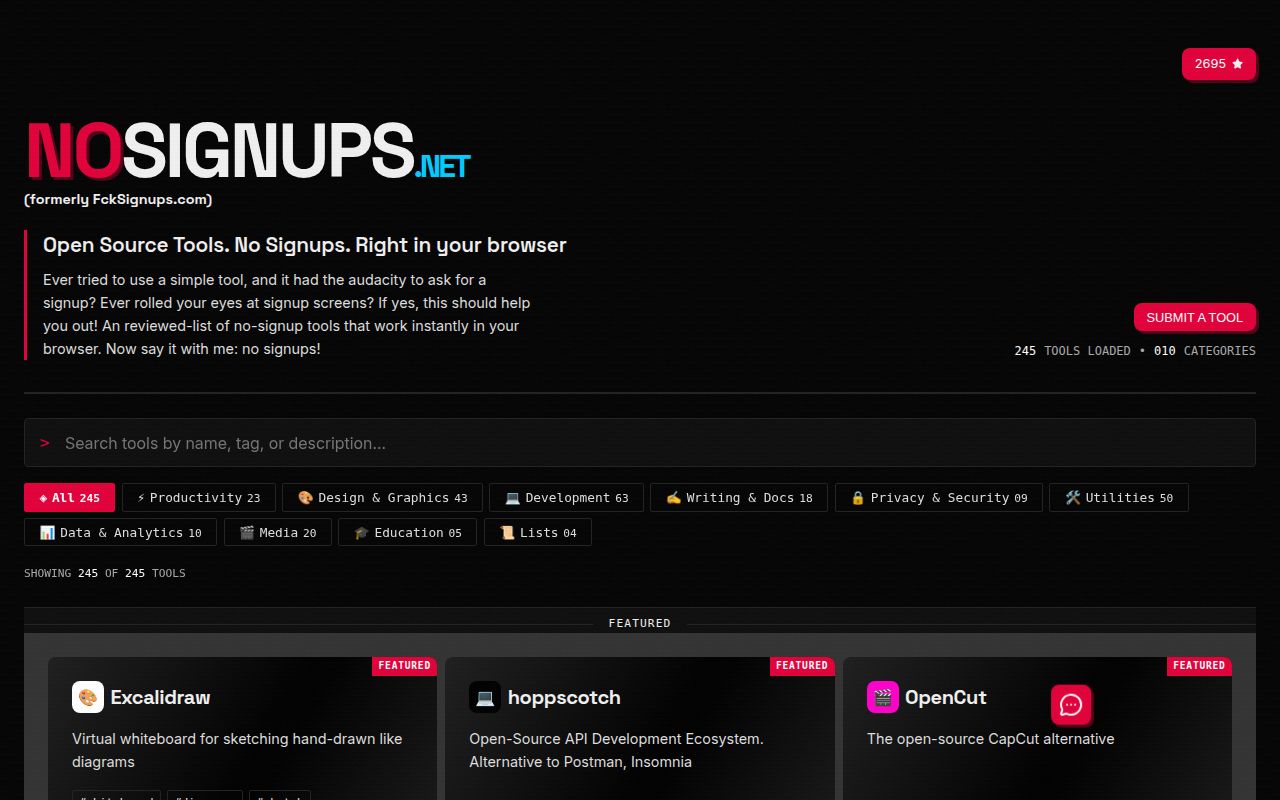
The directory contains 245 tools across 10 categories
The checked NoSignups catalog contains 245 browser tools across 10 categories, all usable without account creation. Every entry in that snapshot links to a GitHub repository. Categories cover productivity, design, development, writing, privacy, utilities, data, media, and education, plus an all-items view. That is a useful constraint: you can inspect the code and license instead of taking a site's privacy claims entirely on trust.
The promise is narrower than the name may first suggest. NoSignups is a directory, so using its website does not make every linked service private or locally operated. The README says individual tools retain their own licenses, and the catalog sends visitors to those tools' public URLs. Treat each entry as a lead. Check where processing happens, what the linked deployment logs, and whether its source matches the hosted instance before uploading confidential files.
Search covers 3 catalog fields and uses stars for ties
The React interface searches 3 parts of each entry: its name, description, and tags. Multiple search words must all match, and ties are sorted by the stored GitHub star count. Results are divided into featured, editor's picks, and entries that meet the base criteria. In the checked data, 25 tools were featured and 24 were editor's picks. That layout is fast to scan and more practical than reading a long Markdown list.
Selection remains editorial. The README says featured tools rise because the maintainer considers them unusual, and it plainly calls that choice biased. Stars are stored in the catalog rather than guaranteed live on every page load. Neither signal establishes security, privacy, or even continued availability. NoSignups helps answer "what can I try without registering?" It does not answer whether a given service is suitable for payroll records, customer files, health data, or unreleased code.
What happened when we ran it
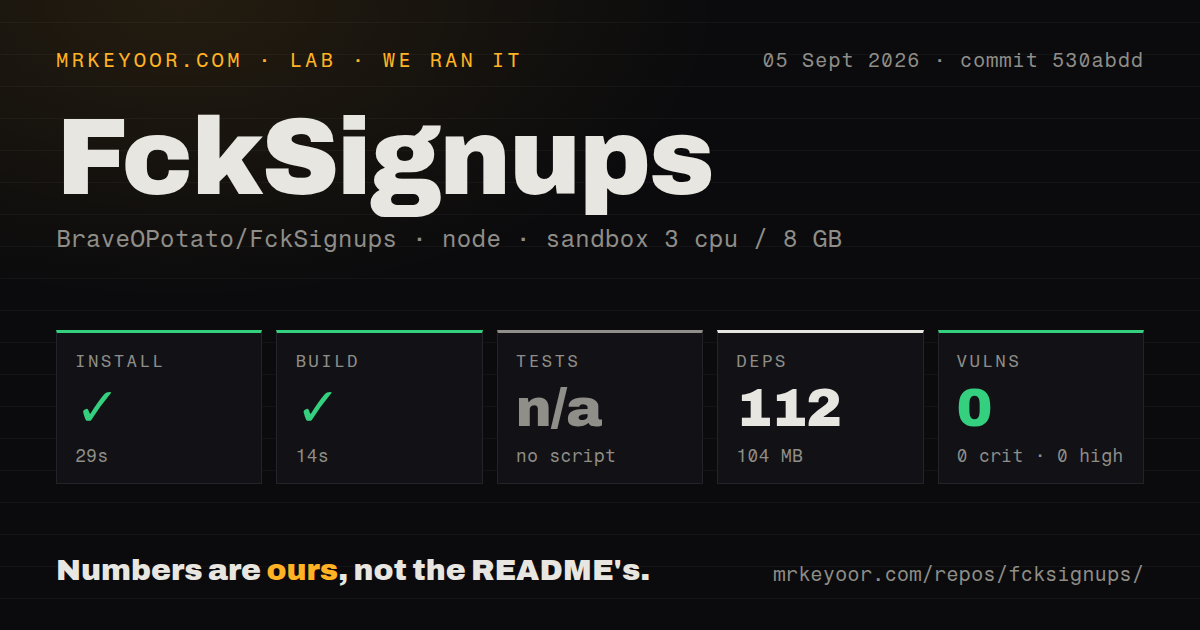
Our sandbox installed 112 npm packages in 29 seconds, leaving 104 MB on disk. The build finished successfully in 14 seconds at commit 530abdd. The checkout itself was 1.8 MB, with 68 files and about 2,738 lines of source, so this is a modest React application rather than a large portal framework. Our measurement setup used a fresh unprivileged container with 3 CPUs and 8 GB of RAM.
There was no test script or target, so we skipped tests rather than inventing a passing result. Npm audit found 0 known vulnerabilities: 0 critical, 0 high, 0 moderate, and 0 low. We measured no CI workflow and no tests directory in the repository. Those facts do not show that the directory is broken. They show that changes to filtering, fallback data, links, and submissions lack a visible automated safety net in this commit.
The 440-issue and PR queue puts pressure on curation
GitHub listed 440 issues and pull requests combined when we fetched the repository. Recent activity on September 5, 2026 was dominated by tool submission requests, with another submission represented by a pull request. Closed activity on August 22 included several older submissions. The last repository push was August 22, so the project is active, but intake is arriving faster than a casual maintainer can assess each service deeply. The combined count should not be read as 440 software defects.
That queue matters because the acceptance rule is intentionally simple: a tool must work without creating an account, descriptions stay under 140 characters, and submissions use 3 to 5 tags. Those rules keep contributions consistent, but they say little about data retention, build provenance, dependency maintenance, or whether the hosted copy tracks its open source. A competent developer should repeat the account check and inspect the linked repository before recommending any entry inside a company.
Self-hosting covers the directory, not 245 services
Running NoSignups locally is uncomplicated. The README gives a clone, npm install, and development-server command. No credentials are needed for the basic site. The application first obtains the current catalog from a configured JSON URL and falls back to bundled data when that fetch fails. That fallback is a sensible availability choice, though a fork must decide who updates the catalog and how often.
Forking also makes you the publisher. You will need a deployment target, link checks, a review process for submissions, and a way to refresh star counts. The repository includes management scripts and a Cloudflare Worker area, yet the README does not provide an operations guide for that path. Our 14-second build proves the front end compiles in the stated container. It does not prove the listed services work or that the remote catalog and report forms are configured for your domain.
No tagged release means deployments should pin a commit
GitHub returned no latest release for NoSignups, and the repository had no Dockerfile at commit 530abdd. The license is GPL-3.0 for the directory code, while third-party entries retain separate licenses. A fork can be small, but repeatable upgrades require choosing a known commit, recording local configuration, and testing the generated site yourself. There is no release tag here to carry that discipline for you.
NoSignups works best as a quick, opinionated index. Its 245-entry catalog saves search time, and the zero-vulnerability audit plus successful build make the codebase approachable. The limits are just as important: 440 open issues and pull requests strain review capacity, featured placement is subjective, and the project has no automated tests in the checked commit. Use the directory to find candidates, then make the final trust decision at the linked project's code and deployment.