FastGPT combines agents, retrieval, and workflows in one console
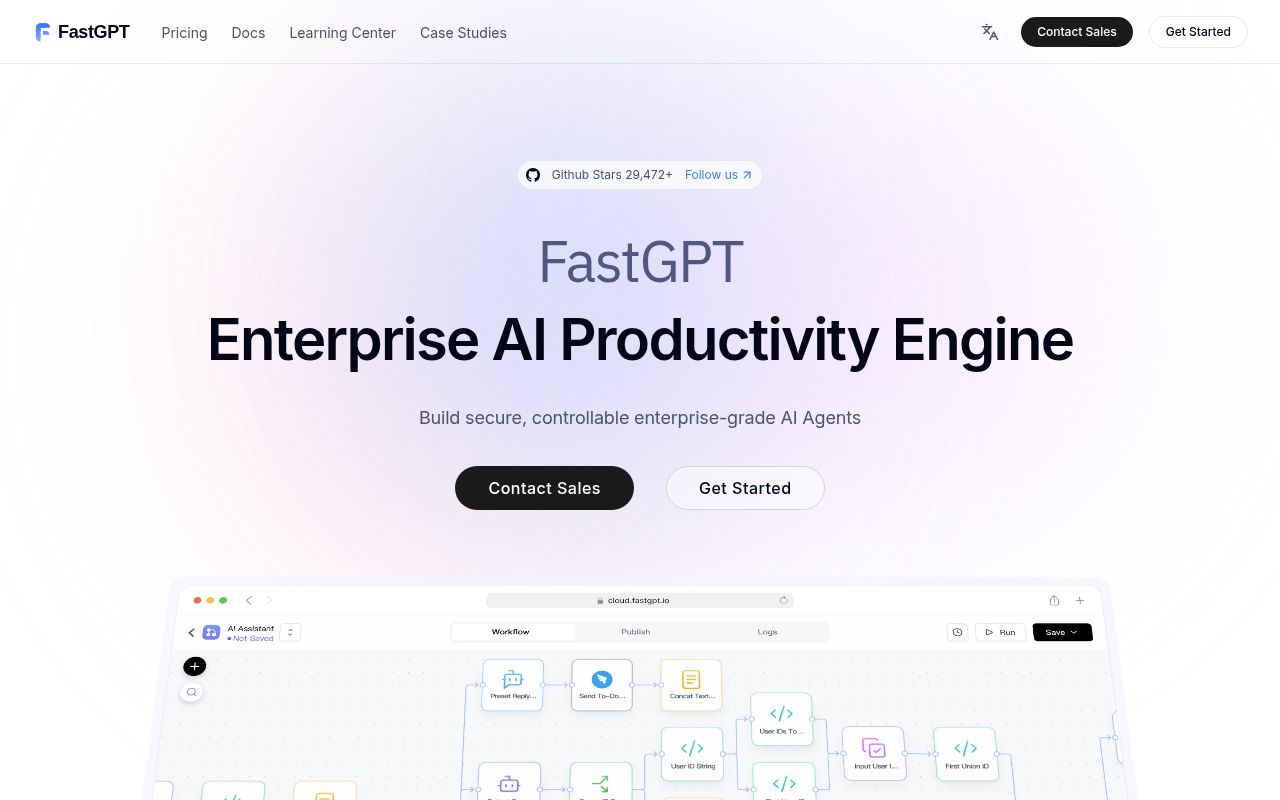
FastGPT is aimed at teams that would otherwise connect a model gateway, document ingestion, retrieval, workflow execution, tools, chat sharing, and usage records themselves. The visual Flow editor handles dialogue and plugin workflows, including basic RPA nodes. Knowledge bases accept common text, office, spreadsheet, and web inputs, then support chunk editing, hybrid retrieval, reranking, and API access.
The primary README is Chinese and links to an English translation plus Indonesian, Thai, Vietnamese, and Japanese versions. The English README explains the broad feature set and Docker quick start. Current release notes and much of the issue discussion remain Chinese, so an English-only operations group should inspect the depth of translated deployment and upgrade material before adopting it. A translated landing page is not the same as full operational parity.
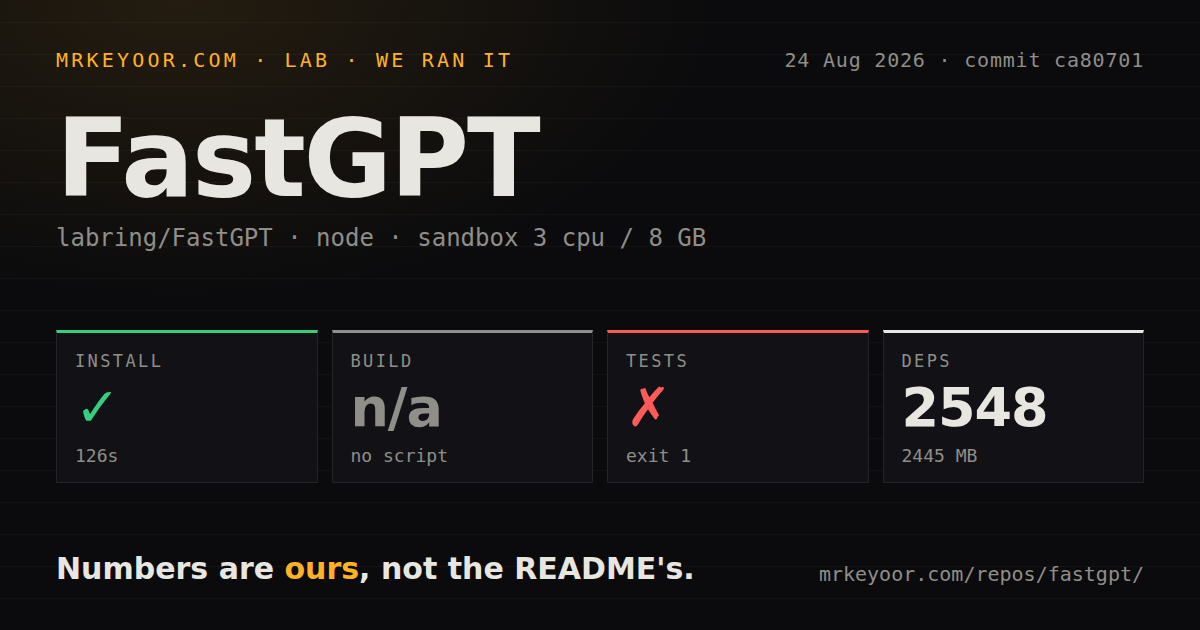
The 2,445 MB install reflects a large application platform
This is a substantial TypeScript monorepo rather than a small agent library. commit ca80701 contained 6,041 files, about 630,120 lines of source, and a 193.1 MB checkout. Our scan found 21 CI workflow files, a tests directory, and workspace configuration, but no Dockerfile at the repository root. The development dependency tree is large enough to matter on CI workers and contributor laptops.
Our sandbox installed 2,548 pnpm packages in 126 seconds and consumed 2,445 MB on disk. That figure covers the repository workspace, not the Docker Compose runtime or model storage. It does not include container images, database data, uploaded documents, embeddings, or agent sandbox images. A self-hoster should budget those separately and keep persistent data outside disposable application containers.
What happened when we ran it
The repository had no build script or target for our harness, so we skipped the build instead of inventing a substitute. Tests ran for 44 seconds and exited with code 1. The command launched a Mongo-aware wrapper and asked Turborepo to test five named packages. Turborepo then reported that no package named @fastgpt/admin existed in the workspace, and pnpm ended with an ELIFECYCLE failure.
The log does not show an application assertion failure, a Mongo connection error, or a count of passed tests. It shows a workspace filter that did not resolve at commit ca80701. We cannot infer whether the package was renamed, removed, private, or omitted from this checkout. The useful finding is exact: the repository's invoked test path did not reach a passing suite in our 3-CPU, 8 GB Node 22 sandbox.
Docker Compose starts the stack, then operations begin
The English quick start runs a downloaded shell script to obtain configuration, followed by docker compose up -d. It exposes the application at port 3000 and documents root with password 1234 as the initial login. Change that credential before exposing the service. Model providers need their own credentials, and deployed workflows may need keys for tools, storage, or third-party APIs.
Agent execution adds more moving pieces. Release v4.16.1 tells operators to set a complete OpenSandbox runtime image in both application components. The default image is non-root; installing apt dependencies requires a root image and may use a configured mirror. The same release introduces team-installed process-mode plugins and explicitly says they carry a security risk. It mentions serverless isolation as future support, so buyers should not describe that isolation as available now.
Upgrading to v4.16.1 requires ordered data migration
The latest release requires operators to finish the v4.16.0 initHttpToolSchema conversion before running v4.16.1's initToolJsonSchemaStorage. The second migration has a dry-run mode and checks historical MCP and HTTP tool applications before changing their JSON Schema storage. That is good defensive behavior, but it makes backups, version order, root-key handling, and change review part of a routine upgrade.
Open issue 7284 reports that historical knowledge-base chunks became unviewable after one private deployment moved from v4.14.7 to v4.15.1, even after the documented scripts were run; retrieval still worked for that reporter. Issue 7252 separately describes OpenSandbox and proxy configuration as difficult and inconsistent. These reports do not prove every upgrade fails. They are enough to justify restoring a production snapshot in staging and opening old datasets before promoting a new release.
License and sandbox controls can rule it out early
FastGPT's license follows Apache 2.0 with added conditions. It permits commercial backend use and enterprise delivery, but requires written authorization for a similar multi-tenant SaaS. It also says the console logo and copyright information may not be removed or changed without commercial authorization. Product companies should review those terms before treating the repository as an ordinary Apache-licensed dependency.
Open issue 7345 requests domain-based sandbox egress policy and inspection of external tool output before it reaches users, model context, records, Redis, MongoDB, or logs. The request is detailed because agent tools cross a serious trust boundary. Until such controls are documented and verified, enterprise operators need compensating network policy, tool allowlists, output handling, and audit rules outside FastGPT. Bidirectional MCP support expands the same boundary, so the review tags include MCP.
August activity is high, and the operator burden is real
GitHub recorded 29,472 stars, 172 combined issues and pull requests, and a push on August 26, 2026. Version 4.16.1 was released on August 21 with sandbox configuration, plugin management, MCP authentication, storage changes, and several fixes. The dates show current development, while the 172 figure should not be mistaken for a confirmed bug count.
FastGPT earns a trial when a team wants its whole visual agent and retrieval product, especially when Chinese documentation and community discussion are accessible. Our failed test command, 2,445 MB workspace, ordered migrations, sandbox choices, and custom license make it a poor casual self-host. Treat it as an application platform with data and security duties, then compare that operating cost with its hosted service and the three alternatives.