Kestra joins scheduled and event-driven work in YAML
Kestra treats a workflow as declarative YAML whether it is written in a repository, edited through the built-in code editor, changed by API, or rearranged in the visual topology editor. A flow contains tasks, inputs, outputs, variables, and triggers inside a namespace. Schedules cover recurring jobs, while event triggers react to files, messages, and external systems. Retries, timeouts, backfills, subflows, parallel branches, labels, and conditional tasks cover the machinery teams usually add after a simple scheduler reaches production.
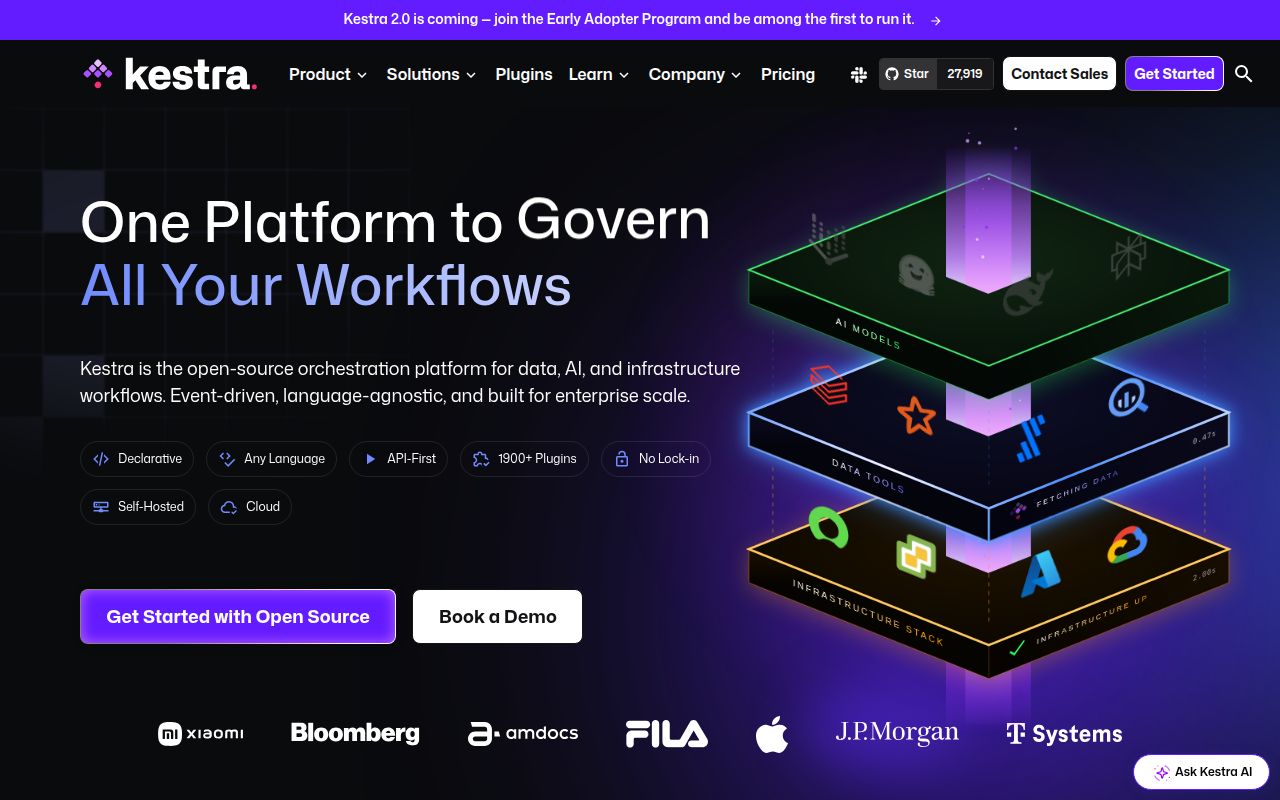
The result suits a wider range than a classic data DAG. A single Kestra installation can run SQL, Python, Node.js, R, Go, and shell tasks, invoke APIs, start containers, or dispatch Kubernetes jobs. Plugins connect cloud storage, databases, Kafka, Redis, Pulsar, AMQP, MQTT, SQS, Pub/Sub, and notification systems. That breadth is the main reason to choose it. A team can give data, infrastructure, and application automation one visible execution model instead of maintaining separate schedulers.
The visual editor preserves code, with some UI gaps
Kestra's topology editor supports drag and drop, completion, syntax checks, and a live graph. Changes made through the UI update the YAML definition, so visual users and Git users work on the same artifact. This is more credible than a diagram that cannot round-trip to deployable code. The official Terraform provider and Git integration add a path for promotion between environments, while namespaces and labels help organize a shared installation.
Current issue #18610 describes a concrete UI limit: data files such as Avro, Parquet, ORC, CSV, and Excel have no plugin-supplied preview renderer. The platform currently has 4 core renderer types covering text, ION, images, and PDF. A binary file can therefore fall back to an unhelpful text preview or only offer download. This does not stop the workflow, but it weakens the UI when operators inspect the data artifacts those workflows produce.
What happened when we ran it
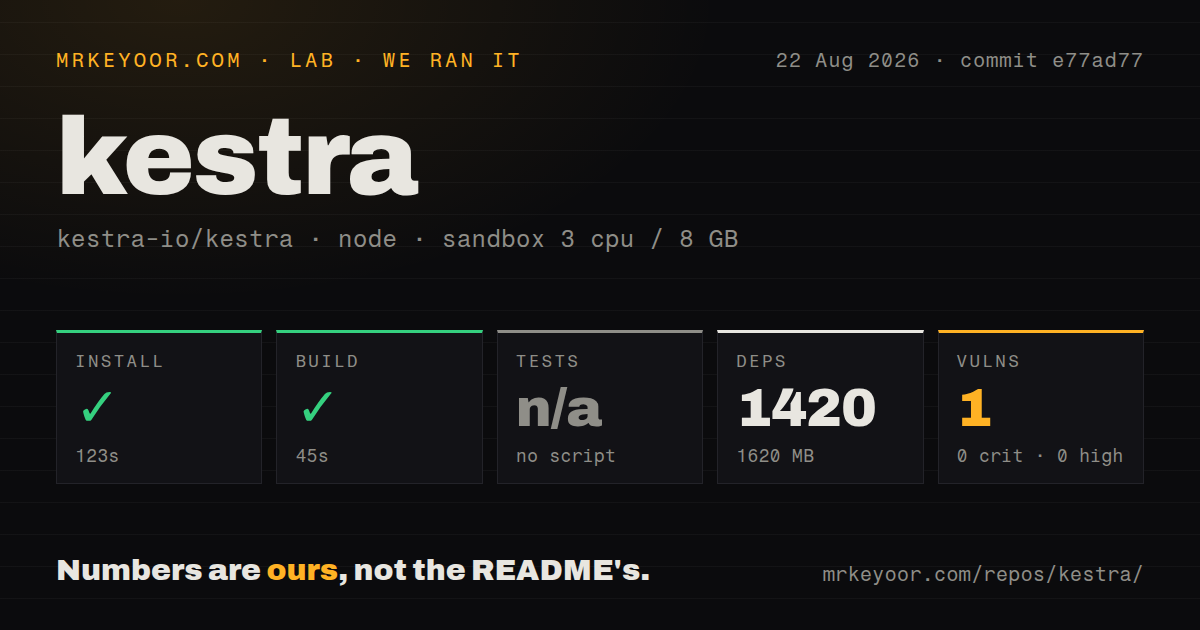
Our sandbox measured the ui workspace at commit e77ad77. npm installed 1,420 packages in 123 seconds and occupied 1,620 MB. The UI build completed successfully in 45 seconds. The full checkout contained 5,023 files and about 505,981 source lines, using 39.2 MB. The environment was an unprivileged Node 22 Debian container with 3 CPUs, 8 GB of RAM, and no secrets.
The UI package had no npm test script or target, so the harness skipped tests. npm audit found 1 known vulnerability at moderate severity, with 0 critical, 0 high, and 0 low findings. The repository includes a tests directory and 22 CI workflow files, but those facts do not give us a backend test result or a running-server result. Our measurement proves that this UI snapshot installs and builds under the stated container, nothing more.
The 1-command server trial grants broad Docker control
The README launches a local server on port 8080 with one Docker command. That container runs as root, persists /app/storage, mounts /tmp, and receives the host Docker socket. The setup makes script and container tasks easy to demonstrate because Kestra can start sibling containers. It also grants the process control over the Docker daemon, which is effectively host-level power on many systems. Use a disposable workstation or isolated runner rather than a shared production host for that quick start.
Production is a different exercise. Kestra documents Docker Compose, Podman, Kubernetes, and deployments across AWS, Google Cloud, and Azure. Operators must choose storage, database, task runners, queues, network paths, secrets, authentication, and plugin policy. Workflows also need credentials for every system they touch. A plugin catalog reduces integration code; it does not remove permission design. The correct proof is one representative flow that runs, fails, retries, emits artifacts, and survives a service restart.
Plugins are the advantage and the upgrade surface
Hundreds of integrations let teams assemble useful flows without wrapping every service themselves. Task runners separate orchestration from execution and can send work to remote machines, Docker, or Kubernetes. Custom plugins cover internal systems. Because workflows remain language agnostic, a platform team can set one operational standard without rewriting every existing script into Java or Python. That is a meaningful advantage over schedulers tied closely to one programming model.
Plugin behavior must still be pinned and tested. Release v1.3.30 fixed schema revalidation so newly added plugins appear in completion, corrected concurrency accounting for unfinished tasks, and handled deeper JDBC deadlock causes. The current develop branch is already tracking 2.0 work. Issue #18500 reports an empty matched Switch case remaining in RUNNING forever on a 2.0 snapshot across both open-source and Enterprise core. That report is not evidence against v1.3.30, but it is relevant to early 2.0 evaluation.
Active development favors teams that can manage change
GitHub recorded 27,921 stars, 722 open issues and pull requests, and a push on August 26, 2026. The latest stable release we fetched was v1.3.30 from July 28. Current issue traffic includes UI work, dev-container Docker access, file previews, core flow behavior, and destructive API filtering. A stale tag alone would not show abandonment here; the later push and active discussion show ongoing work across the next release line.
Kestra makes sense when the organization wants one visible automation system for several kinds of work. Start with a flow that crosses a real boundary, such as a scheduled query followed by a container task and an event notification. Check the needed plugins and edition before designing around them. If the main job is a Python data DAG, Airflow, Dagster, or Prefect may be easier to staff. If mixed teams need YAML, events, UI editing, and many execution targets, Kestra earns the operational weight.