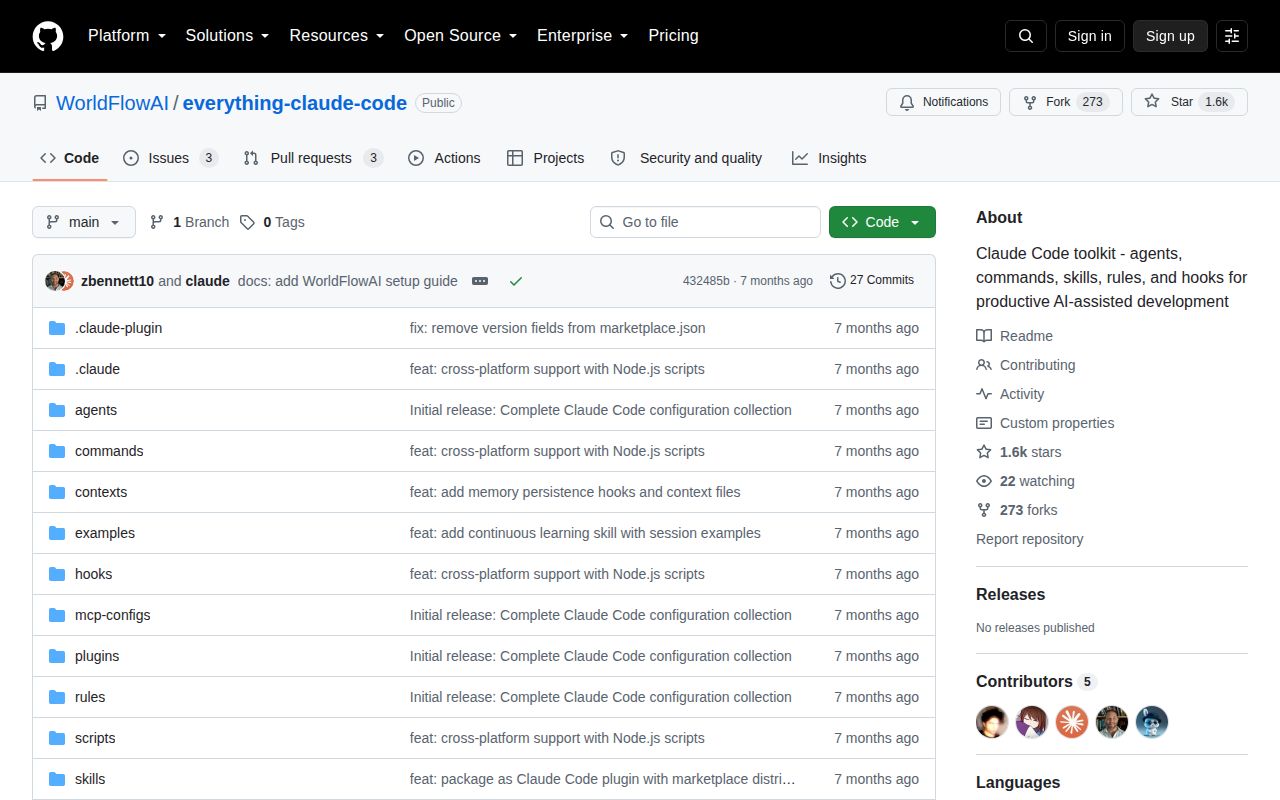
A useful collection in the wrong repository
Everything Claude Code packages the configuration layer that many Claude Code users eventually build for themselves. There are specialist agents for planning, architecture, testing, review, security, build errors, refactoring, end-to-end tests, and documentation. Commands provide shortcuts into those workflows. Skills hold repeatable methods, rules set persistent expectations, and hooks save session state or suggest context compaction. The repository also includes example contexts and MCP server configurations.
As a catalogue of ideas, it is valuable. A developer can see how a planner agent limits its role, how a test-driven workflow is expressed in Markdown, and how Node.js hooks support Windows, macOS, and Linux. Package-manager detection checks an environment variable, project configuration, package metadata, lockfiles, and a global preference. The README sensibly advises users to take only what fits, modify it, and remove the rest.
The problem is provenance. The requested WorldFlowAI repository is not presented as an independent product. Its README badges, clone command, marketplace command, plugin homepage, plugin repository field, author credit, and guide links point to the original affaan-m/everything-claude-code, now renamed affaan-m/ECC. The WorldFlowAI copy adds a setup guide for two internal projects, but otherwise asks users to install from somewhere else. That makes this repository a snapshot with local notes, not the source you should normally follow.
Installation is less direct than it appears
The advertised easy path is to add a Claude Code marketplace and install the plugin. Those two commands name the affaan-m repository and marketplace. They may take you to the canonical project after GitHub's rename handling, but they do not install from the WorldFlowAI repository being reviewed. A user who wants this exact snapshot must instead clone it and copy components manually.
Manual setup has several judgment calls. Agents, skills, commands, and rules go into the user-level Claude directory, which means they can affect work across projects. Hook definitions must be merged into settings rather than blindly replacing an existing file. MCP examples contain credential placeholders that need real secrets, and every enabled tool consumes context. The README itself recommends keeping fewer than ten MCP servers enabled per project and fewer than eighty tools active.
Hooks deserve particular scrutiny because they run on lifecycle and tool events. Here they persist session context, evaluate sessions, and suggest compaction. Those behaviors can be useful, but copying automation into a global configuration is a trust decision. Read the scripts, decide where their output is stored, and test in a disposable project before allowing them into daily work. The WorldFlowAI guide also refers to local paths, Rust conventions, and ML workflow advice for Synapse and Arbiter. That material is specific to its owner and should not become a universal rule by accident.
Some promised components are not discoverable
The most damaging defect is documented in issue #6. Three skills and eleven commands lack the frontmatter Claude Code uses for discovery or command presentation. The affected list includes the evaluation harness and verification loop skills, plus commands such as build-fix, code-review, learn, checkpoint, and verify. These are not obscure extras. Several are central to the README's recommended workflow. Their content can be good while remaining unavailable through the interface users expect.
Pull request #5 supplies frontmatter, a root instruction file, environment documentation, a Node version file, and a validation script. It also adds continuous integration for the repository's existing tests. The contributor reports 62 tests passing on that branch, but the pull request was still open on August 12. The default branch therefore does not receive those fixes or automatically run the suite. Another open issue reports malformed frontmatter in a separate skill.
This distinction matters when judging the phrase production-ready. The collection has been used in real workflows, and the Node scripts show attention to cross-platform behavior. Yet a toolkit for configuring an agent must be dependable at the discovery layer. Missing metadata that silently hides components is exactly the kind of defect a validation job should catch before publication.
Activity exists, maintenance does not follow it
The last push to the default branch was January 23, 2026, the day the WorldFlowAI repository was created. GitHub listed six open issues and pull requests in August, including multiple contributions opened months after that final push. Recent issue activity proves that people are examining the project, but it does not prove maintainers are integrating fixes. No GitHub release is published for this repository, and GitHub's license field is empty even though the README and plugin manifest say MIT. A root license file is also absent from the listed top-level contents.
That health picture is different from an abandoned idea with no users. The repository has substantial interest and a useful review queue. It is also different from an actively maintained tool. The default branch has not moved while concrete repairs wait. Meanwhile, the canonical affaan-m/ECC repository was pushed on August 19 and carries the MIT license in GitHub's metadata.
What to take, and what to leave
Borrowing individual patterns is the defensible use. The agent role files, modular rules, package-manager detection order, and hook structure can shorten the time needed to design your own setup. The warnings about context use and selective adoption are sound. Copy one component, inspect it, adapt it to the project, and verify Claude Code can actually discover it.
Installing the entire WorldFlowAI snapshot is harder to justify. It mixes upstream material, organization-specific notes, unresolved metadata defects, and global automation. Start with the maintained affaan-m/ECC source if you want this collection. Choose a narrower workflow project such as Superpowers if you want stronger cohesion. Keep the official Claude Code repository close for supported behavior. This snapshot is a readable reference, but it is not the version we would put into a fresh development environment.