PriceAI compares offers without guaranteeing the seller
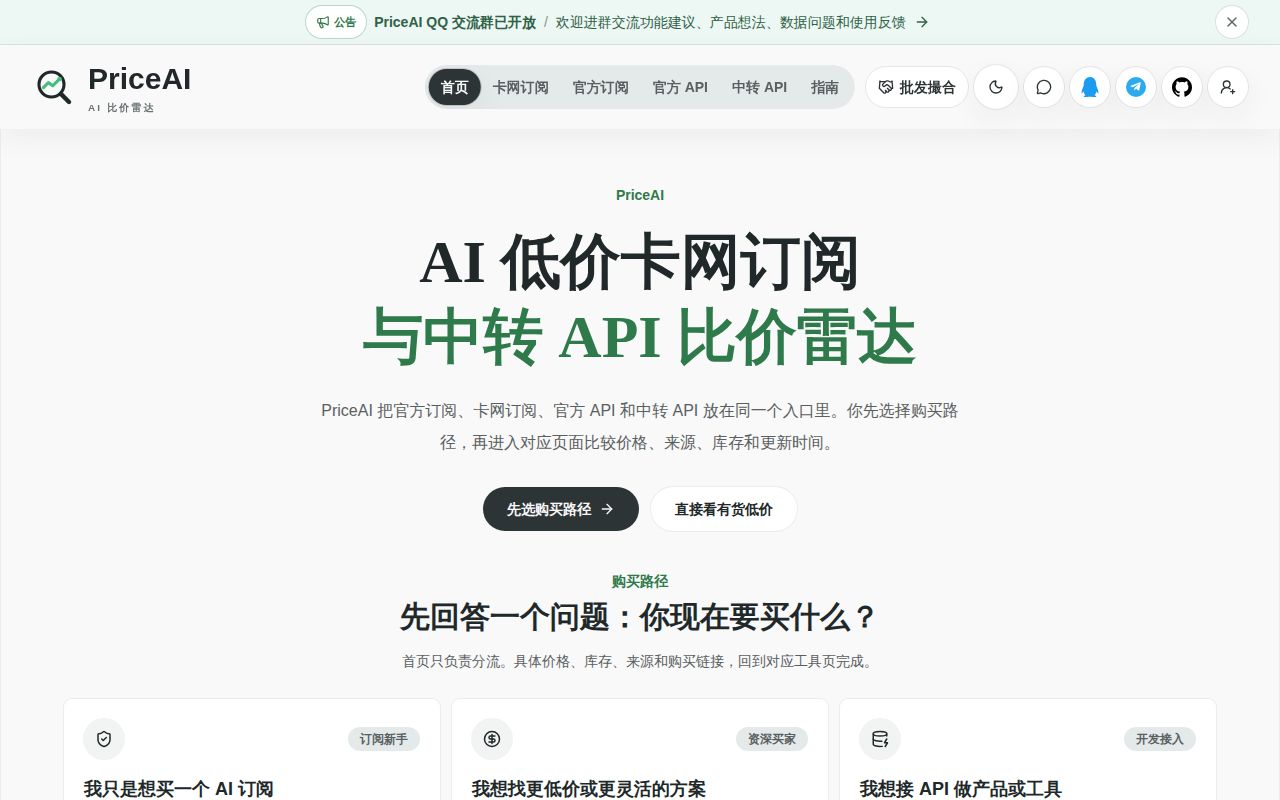
An available subscription offer can mean a top-up, an account, or a redeemable code. PriceAI keeps those delivery differences visible while comparing official subscriptions, third-party shops, and model API providers. The Chinese-first README and public operating guides target readers comfortable with that market. I found an English license, but no English setup guide among the linked public documentation. International developers should expect to translate operational instructions before taking on maintenance.
The repository we measured contained 869 files and roughly 146,828 source lines. This is a substantial Next.js application, with collectors, moderation, and administration behind the comparison pages. Its useful idea is preserving the original title, source, stock status, and update time alongside the normalized offer. That gives you a trail to check when two listings appear equivalent. A lower number on the page still leaves the seller's delivery and refund terms to examine.
What happened when we ran it
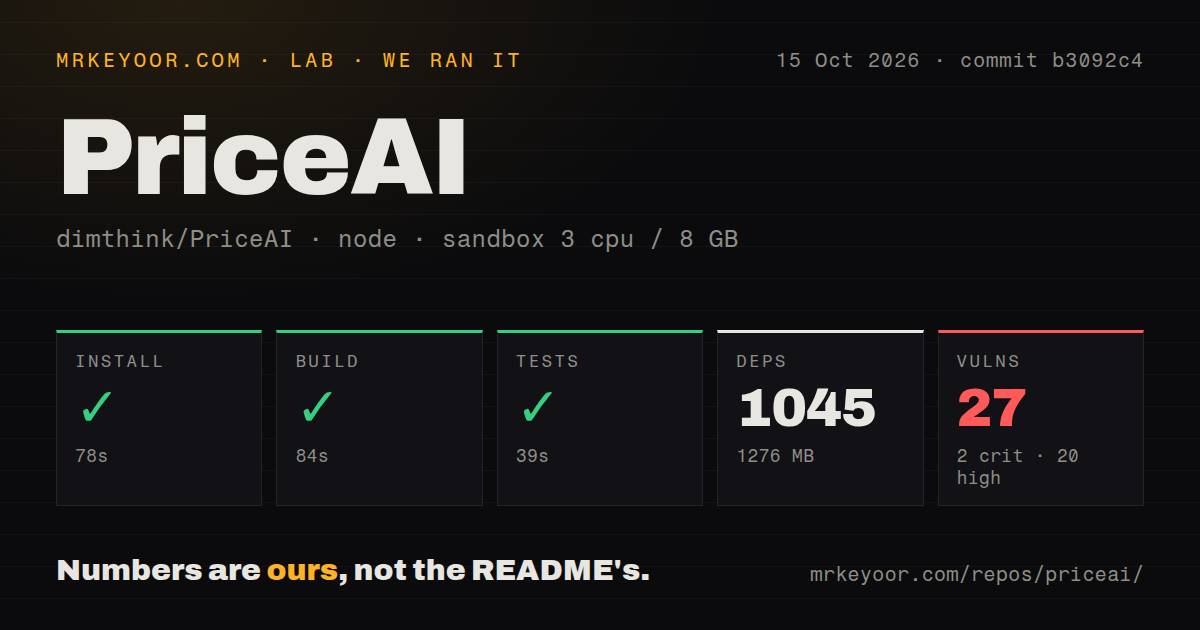
Our run installed PriceAI commit b3092c4 in 78 seconds, adding 1,045 packages and occupying 1,276 MB. The build succeeded in 84 seconds, and the test step succeeded in 39 seconds. We ran it on 2026-10-15 in a fresh unprivileged Debian container using lab-node:22, with 3 CPUs, 8 GB of RAM, and no secrets. The supplied results contain no individual test count, so there is no basis for claiming one.
Npm audit reported 27 known vulnerabilities: 2 critical, 20 high, 2 moderate, and 3 low. Our scan found 14 CI workflow files, no Dockerfile, and no tests directory. That last finding does not contradict the successful test command, since checks need not live in a directory named tests. The audit summary does not establish which advisories are reachable in production, but I would require that investigation before exposing a maintained fork to users.
The quick start shows demo data until Supabase is configured
The configuration guide says the frontend falls back to built-in demonstration data when Supabase is absent. A page appearing after the quick start therefore proves very little about a working price service. Real operation needs a Supabase project, database migrations, public read credentials, and a server-only service-role credential for writes. Administration also needs a password and session secret. Scheduled collection has a separate authorization secret.
Our successful 84-second build happened without secrets, which makes the demo-data distinction especially useful. It confirms that the source can build in that setting, without showing that collectors can write fresh prices into a configured database. The README's collection commands are another operational step after setup. Someone taking over the app must arrange sources, run collection, and inspect the resulting records and collection logs rather than trust a populated-looking homepage.
Production uses Workers, a database, and scheduled collectors
The deployment guide recommends Cloudflare Workers through OpenNext, with Supabase storing data and GitHub Actions or independent collection nodes refreshing it. It explicitly directs users away from the older Vercel production route. Cloudflare account credentials join the database and application secrets. For sources needing a particular network location or human confirmation, the guide advises against frequent collection from GitHub-hosted runners. This affects where the system can run reliably.
The 1,276 MB environment we measured covers the repository setup, without proving that this production chain works. The model detector adds another boundary: the README says a separately maintained service receives temporary API keys and executes protocol probes. The main app supplies its entry point and report display. If that feature matters to you, evaluate the detector service and its handling of keys separately. A passing main-repository test step cannot answer those questions.
The current license restricts public forks and commercial use
PriceAI's license explicitly identifies itself as source-available and says it is outside the Open Source Initiative definition. It permits personal deployment and internal non-commercial use, while requiring written permission for public hosted services and commercial use. That is a decisive reason to choose something else if your purpose is launching a comparison site. The README also separates rights to code from rights to production data, guides, and brand assets.
Even after accepting those limits, the 35.1 MB checkout is not a licensed copy of the operating service's dataset. You must read the separate data policy and establish what information your deployment may use. I would consider PriceAI for private study of collectors and offer normalization, or for a permitted personal deployment. I would not select it as the foundation of a public product on the assumption that a visible GitHub repository grants unrestricted reuse.
September activity shows maintenance, with stock accuracy still worth checking
GitHub reported a last push of 2026-09-28, 4,134 stars, and 5 open issues and PRs on October 16. The latest release, v1.3.0, dates to June 29. September activity includes closed source-submission requests and an open request for an assistant to explain the site's choices. Closed issue 15 reports an offer marked available when the shop had no stock. Its closed status does not prove every current stock record is accurate.
Our 39-second successful test step gives PriceAI a better starting point than an unverified demo, but fresh offers remain an ongoing operating responsibility. For a few shops, changedetection.io or urlwatch can monitor selected pages without adopting this catalog application. Neither supplies PriceAI's normalized comparison database. Use PriceAI when that database and moderation workflow justify the upkeep and its license permits your deployment. Before buying through any listing, return to the seller and confirm the actual product and stock.