NestJS pros and cons start with structure versus ceremony
NestJS gives a Node.js backend a house style, and its starter makes the tradeoff visible in 5 files: a controller, its test, a module, a service, and main.ts. Controllers receive requests, providers contain application logic, modules declare boundaries, and dependency injection connects the pieces. Teams get a shared vocabulary for services and tests, while developers give up some freedom to arrange code however they like.
The README says the architecture is heavily inspired by Angular. That can feel excessive beside a small Express router, but the structure starts earning its keep when several people must find the same kinds of code, replace providers in tests, or apply guards and validation consistently. NestJS v12 requires Node.js v20.19+ or v22.12+. JavaScript remains supported, although the documentation and programming model favor TypeScript.
NestJS v12.0.0 uses Express by default; Fastify still changes platform details
NestJS v12.0.0 does not replace the HTTP engine. The default @nestjs/platform-express package runs Express, while @nestjs/platform-fastify selects Fastify. NestJS can carry most application logic across those adapters and reuse its building blocks for WebSockets, microservice transports, GraphQL, scheduled work, and command-line applications. Code that reaches into a platform API remains tied to the selected adapter.
Express middleware and Fastify plugins have different interfaces, so an adapter switch needs testing around uploads, authentication, error handling, and every platform-specific package. Issue 13158 is a warning for file-heavy services: the reporter says the documented upload decorator path returns a Buffer, which can place the full upload in memory. The issue had 14 comments and remained open after its July 28, 2026 update.
What happened when we ran it
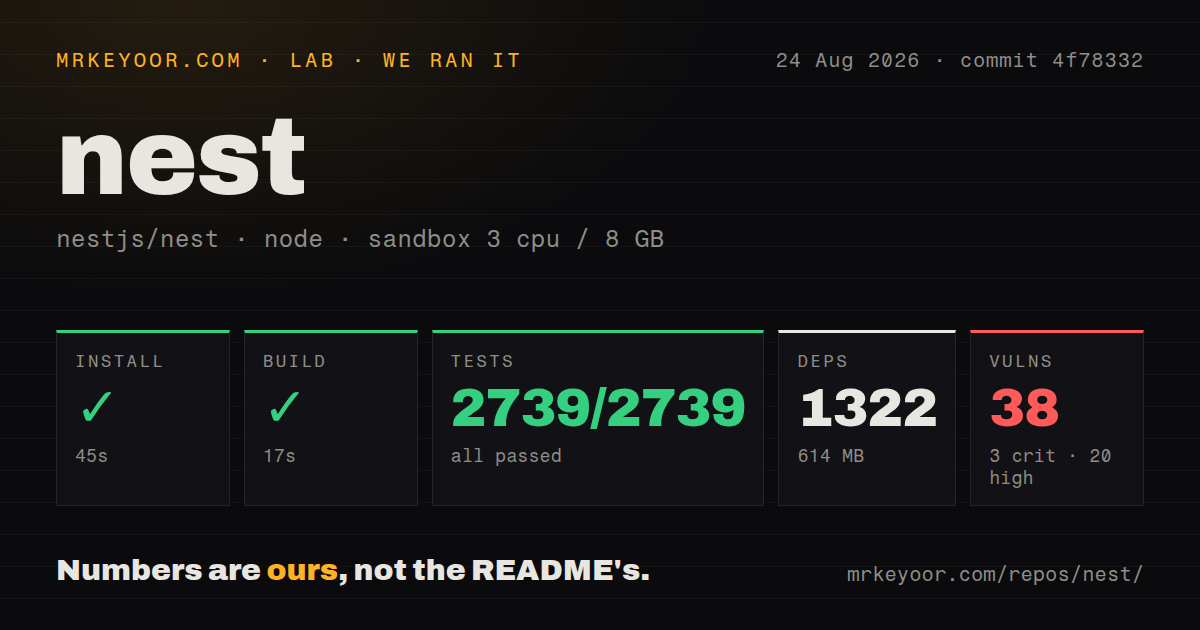
Our sandbox installed 1,322 npm packages in 45 seconds, occupying 614 MB on disk. The TypeScript build completed in 17 seconds. Vitest then passed all 2,739 tests in 41 seconds, with 0 failures. The checkout at commit 4f78332 contained 2,297 files and about 133,426 lines of source.
The clean test result does not settle dependency risk. npm audit found 38 known vulnerabilities in the installed tree: 3 critical, 20 high, 11 moderate, and 4 low. The measurement does not show which packages reach a deployed NestJS application, because the repository workspace includes development tools and optional integrations. A team should inspect the audit paths, determine production exposure, and record any accepted findings.
Our test method ran the checkout in a Node 22 container with 3 CPUs and 8 GB of memory. The scan found 1 CI workflow, no Dockerfile, no top-level tests directory, and npm workspaces. Vitest found the 2,739 tests elsewhere, so the absent directory is only a layout signal. The missing Dockerfile is more practical: application owners must choose an image, process manager, health check, and secret strategy.
A NestJS app starts smaller than our 1,322-package contributor install
Our 1,322-package measurement covers the NestJS monorepo, not an application created by the CLI. The quick start installs the CLI, runs nest new, and starts the generated server. A basic HTTP service needs no external credentials. Databases, queues, authentication, GraphQL, and message brokers arrive through whichever modules the application chooses, each with its own configuration and operating cost.
Contributors see the larger side of NestJS: our install pulled 1,322 packages before a 17-second build. A framework wrapper also leaves transport choices with the operator. Open issue 13223 questions the Kafka transport's KafkaJS dependency and had 63 comments after an August 28, 2026 update. A common NestJS interface cannot remove the maintenance status or behavior of the client underneath.
NestJS v12.0.0 adds ESM packages and an upgrade command
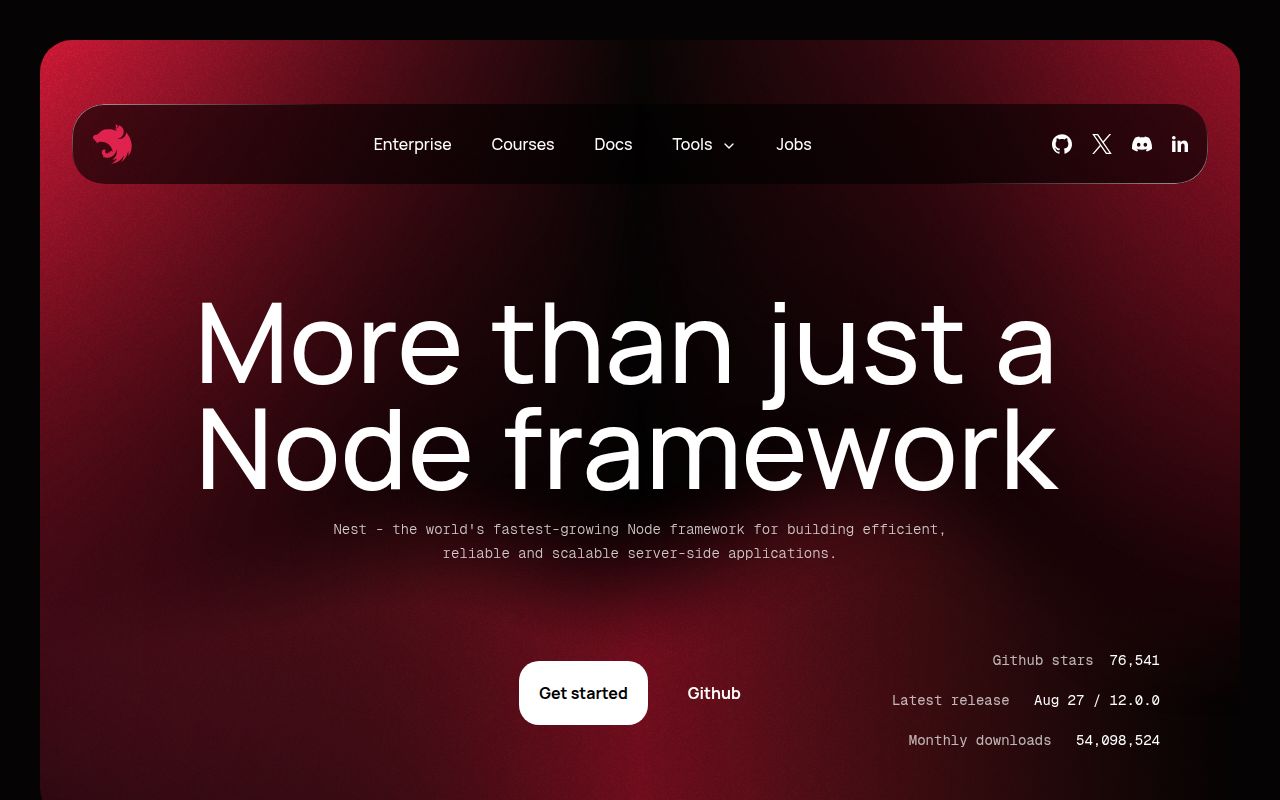
NestJS v12.0.0 shipped on August 27, 2026 with ESM-ready packages, Standard Schema support, a rebuilt CLI, and the new @nestjs/observe SDK. Existing CommonJS applications can keep working, while nest upgrade updates Nest packages and handles listed mechanical migrations. The release requires Node.js v20.19+ or v22.12+, and its upgrade command refuses older versions.
GitHub recorded 76,556 stars, 33 open issues and pull requests combined, and a September 2, 2026 push when fetched. That activity does not make every integration safe. Old open requests around uploads, Kafka, and WebSocket behavior still deserve a check when they touch a workload. Pin the packages an application uses and test those exact adapters during a v12 upgrade.
NestJS pays off when consistency already hurts
The 2,739 passing tests support NestJS as a company standard for a substantial TypeScript backend, while the 614 MB contributor install and 38 audit findings make it a framework to govern. Modules and dependency injection help when coordination across people or services already costs time. A five-route service rarely needs that machinery.
Express or Fastify will usually be easier to understand for a small service because the request path remains in ordinary functions and middleware. AdonisJS is the closer comparison when a team wants an opinionated TypeScript application stack rather than NestJS's broad server architecture. Choose NestJS for consistent structure, then budget time for adapter behavior, dependency review, and major-version migrations.