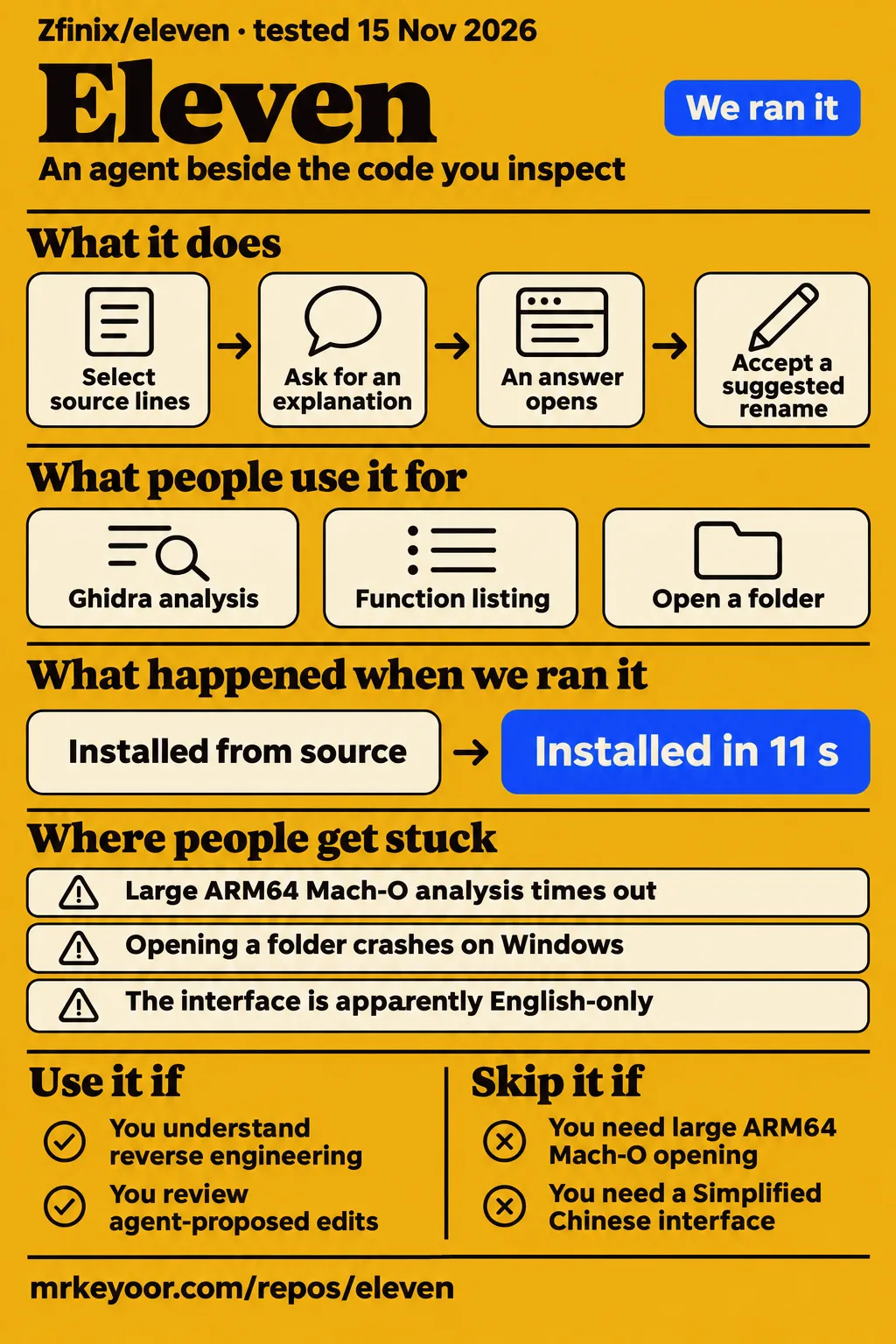
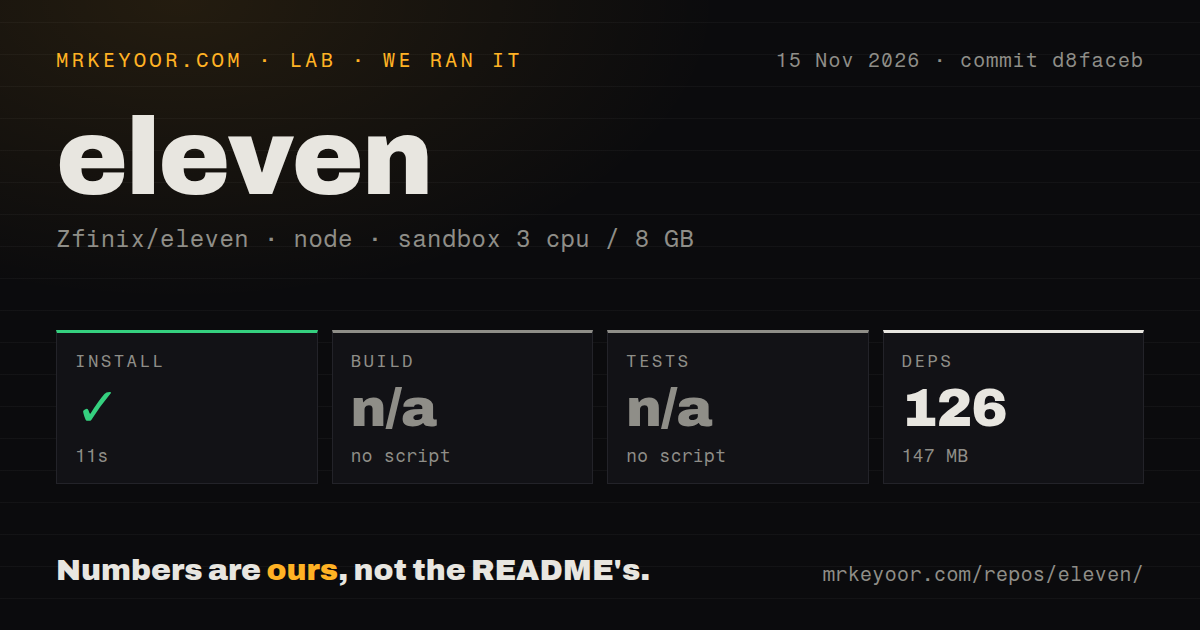
Our sandbox installed Eleven's dependencies in 11 seconds, recording 126 dependencies and 147 MB on disk. Use Zfinix/eleven if you already understand reverse engineering and want an agent beside the code you inspect. Avoid relying on it immediately for large ARM64 Mach-O opening and function listing: issue #2 reports repeated failures in that workflow, including attempts where standalone Ghidra analysis succeeded.
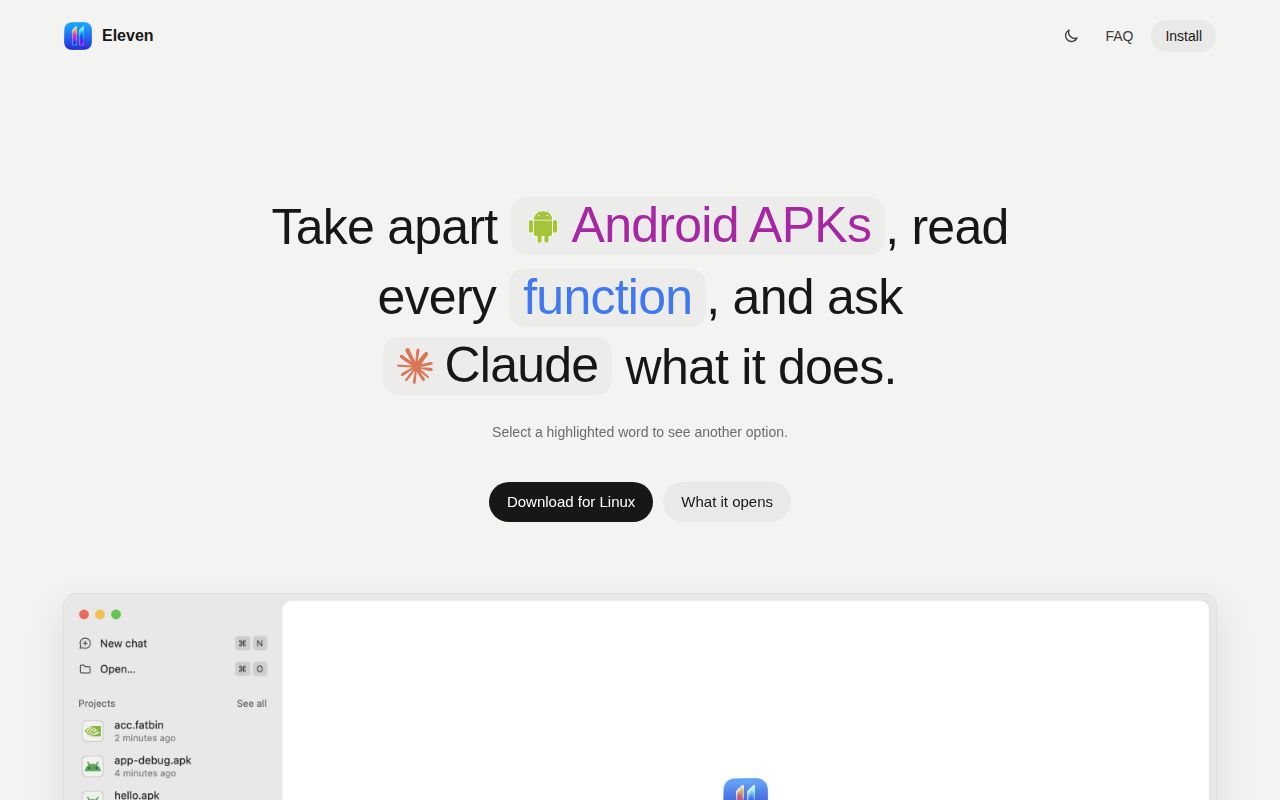
This eleven review concerns Zfinix's reverse-engineering application. Its proposed benefit is specific: an agent can discuss the function you are looking at, suggest a name and propose a patch inside the same project. The practical question is whether that shared workspace fits your investigation. The Eleven README describes the intended workflow; large-binary issue #2 supplies a concrete reason to test project opening separately from engine readiness.
Eleven puts an agent beside your analysis
Eleven's README describes native-code analysis through Ghidra and REA or Rizin, and Android analysis through jadx. The analysis engine and the agent have different jobs: the engine reads the target, while the agent helps interpret code and annotate the project. Keeping that distinction clear makes setup errors easier to investigate and gives an experienced analyst a practical way to assess the application's contribution. Eleven README.
The documented interface lets you select pseudocode, assembly or source lines and ask for an explanation. An answer opens beneath the selection, and a suggested rename arrives as a card you accept or decline. A project holds chats, agents, renames, bookmarks, notes and patches. The README says saving creates a shareable .eleven file, with nothing written there until you save. That puts the investigation's annotations beside the code rather than leaving their relationship in a separate conversation.
The README lists Claude, Codex, Gemini and other agents connected through the Agent Client Protocol. Eleven also serves MCP tools that let agents move around the window and make project edits. ACP connects the agent; MCP exposes operations such as opening a function, changing views and adding notes. For an initial evaluation, choose one agent and one analysis engine so a failed operation has fewer possible causes to investigate.
What people use eleven for
Issue #2 records attempted large-binary analysis and contributor work on the Ghidra bridge; issue #1 records a completed tutorial followed by a project-opening crash. These reports provide three concrete uses and their outcomes. They also suggest useful acceptance tasks: opening the target, listing functions and moving from the tutorial to a project of your own exercise different parts of the application.
| Who and task | Reported outcome | Source |
|---|---|---|
| The Apple Silicon reporter in issue #2 attempted Ghidra analysis and function listing for a large private ARM64 Mach-O executable. | Repeated timeouts or missing functions interrupted the workflow, although one standalone headless Ghidra analysis completed. | Large-binary report #2 |
| Contributor nanashili investigated and modified the Ghidra bridge after a large-binary failure. | The contributor described background analysis, responsive status checks, bounded decompilation and cheaper inventory paging. The maintainer confirmed the decompilation cap and described further work as pending. | Contributor and maintainer discussion #2 |
| The Windows reporter in issue #1 completed the Notepad tutorial, then tried opening a folder or creating a project. | An uncaught runtime error made the application unusable. | Windows project-opening report #1 |
The Notepad report makes the transition to your own project an important acceptance step. A tutorial can complete before the file picker takes a different path. Start with a target you can share, inspect its functions, add an annotation, then save and reopen the project. That sequence follows the reported failure boundaries and the README's project model, and gives you an outcome you can compare with your existing workflow.
What happened when we ran it
Our run installed dependencies at commit d8faceb on 2026-11-15 in 11 seconds. The sandbox configuration recorded 3 CPUs, 8 GB RAM and image label lab-node:22, with the project in ./app/. The repository harness and the separate Compose-based attempt produced different records: the first completed dependency installation, while the second stopped at its safety requirement before a desktop task.
| Repository-harness step | Recorded result | What it means |
|---|---|---|
| Dependency installation | Succeeded in 11 seconds; 126 dependencies; 147 MB on disk | The dependency-install step completed in our sandbox. |
| Build | Skipped: no build script or target detected | The harness skipped this step. |
| Tests | Skipped: no tests script or target detected | The harness skipped this step. |
| Repository scan | 698 files, approximately 48,335 source lines, 10 MB checked out | Checkout size and installed dependency size are separate measurements. |
| Supporting signals | Four CI workflow files, a tests directory, no Dockerfile | The scan detected these repository properties. |
The supplied README documents source-development and platform packaging commands, including ./script/test for running the suite one file at a time. The harness nevertheless recorded no detected build or test target. Both facts belong in the result: the documentation provides a route, and the recorded automation skipped those operations. A developer reproducing setup should start from the documented app directory and commands rather than treating the harness's discovery result as the repository's command reference. Eleven source instructions.
The separate hands-on attempt failed its safety step with: "unsafe repo: none of compose.yaml, compose.yml, docker-compose.yaml, docker-compose.yml exists (rule: a compose file is required)". The failure concerns that attempt's Compose requirement. Eleven's README instead documents native desktop installation and source development. The exact failure is retained here because it explains why this attempt stopped.
The hands-on summary says "deployed with its own docker compose", which conflicts with the failed safety step. The detailed step records the stopping point, so this review uses that outcome. The teardown record says "teardown: ok". Keeping the summary, failure and teardown together makes the discrepancy visible without turning a generic run description into a successful desktop session.
Where people get stuck: setup and analysis fail separately
The maintainer reports a Windows launcher fix in v0.1.10, while other reports concern a missing native decompiler, a file-picker crash and large-binary analysis. These symptoms arise at different steps. An agent failing to start calls for a different investigation from a project that opens but never lists functions. The map below keeps each reported symptom beside the action or status supplied for it.
| Symptom | Attributed finding | Reported action or status |
|---|---|---|
| Windows agent startup fails with spawn EINVAL | In #40, Zfinix identifies npx.cmd and batch-launcher handling. | Zfinix reports a v0.1.10 fix using node for npx and cmd.exe for .cmd/.bat launchers. |
| Apple Silicon setup reaches analysis with an incomplete environment | In #3, the reporter describes a missing native decompiler, an unhealthy REA Doctor result and stale or missing skills and client registrations. | The reporter manually compiled and installed the native decompiler before Ghidra passed health checks. |
| Opening a folder or project crashes after the tutorial | In #1, the picker combines file and directory selection on Windows. | The issue is closed. |
| Analysis times out or functions fail to appear | In #2, standalone Ghidra completed analysis once while Eleven's opening and function-listing workflow kept failing. | The maintainer reports bounded decompilation and identifies additional work as pending. |
Windows launcher issue #40 gives a specific first action for spawn EINVAL: update to v0.1.10, then reopen the report if the error persists. Apple Silicon setup issue #3 instead points to engine provisioning and health checks. Windows picker issue #1 records the error "Selecting files and directories together is only supported on macOS". Matching the exact operation and error keeps a troubleshooting report useful.
Large-binary trouble reaches beyond initial analysis
Contributor nanashili reports that a Ghidra decompilation could block the shared MCP bridge indefinitely, causing later inventory and reopen requests to time out. Their account explains why the visible failure could spread beyond the original slow function. The same discussion describes repeated validation of the full retained inventory on every page, adding work to large scans. These are the contributor's findings from their case. Bridge investigation in issue #2.
Zfinix reports a 30-second decompilation cap returning decompile_timeout. The maintainer says inventory validation caching would follow, with progress reporting, a lighter analysis profile and clearer errors next. That response separates a reported implemented change from planned improvements. For your own acceptance task, include a slow function and an attempt to reopen the project, then record whether the session continues responding after the original operation fails.
Agent permissions change how edits reach the project
Eleven's MCP documentation assigns tool calls Allow, Ask or Never permissions and makes byte patches suggestions that require acceptance. Ordinary project annotations have a separate review setting: enabling it files those edits as suggestions in the Changes tab. An analyst expecting every rename or note to wait for approval should inspect that setting before beginning the project. MCP tools and permissions.
The documentation says accepted patches write a patched copy rather than changing the original binary. It also describes hiding the home-folder name in tool responses and asking before a tool reads the entire open file. For an initial project, choose permission rows deliberately, enable review if you want suggested annotations, and ask for an explanation and rename before considering a byte patch. Compare the proposed interpretation with references and surrounding code before accepting it.
Translated documentation and interface language are separate
Issue #18 requests Simplified Chinese interface localization and reports an apparently English-only application. Its author identifies onboarding and workbench vocabulary, including pseudocode, cross-references, patches and bookmarks, as the surface a beginner needs to navigate. The supplied README links to Simplified Chinese and other documentation translations. Those translations and the requested application labels address different parts of learning the tool. Localization request #18, Eleven README.
For a class or colleague who needs Chinese interface text, inspect onboarding and the workbench together before choosing Eleven as the learning environment. Reading installation instructions and making decisions inside the application are separate tasks. The request is open and proposes locale infrastructure and translated labels; it gives a concrete checklist for that inspection rather than a reason to infer interface coverage from the README's language links.
Eleven vs Ghidra and Cutter
Ghidra documents interactive and automated analysis, while Cutter documents a graphical reverse-engineering platform powered by Rizin. Eleven's README centers its agent workspace and project annotations. These documented roles support a choice about how you want to work: directly in the analysis framework, in a Rizin-based interface, or with an agent sharing the inspection window and project context.
| Project | Documented role | Pick it when |
|---|---|---|
| Eleven | An agent-first reverse-engineering app with project annotations and patch suggestions. | You want an agent and code inspection in the same workspace. |
| Ghidra | A reverse-engineering framework supporting interactive and automated analysis. | You want direct access to the framework and Java or Python scripting and extensions. |
| Cutter | A free, open-source reverse-engineering platform powered by Rizin. | You want a Rizin-based graphical workspace with Python and native C++ plugins. |
Ghidra's README lists disassembly, assembly, decompilation, graphing and scripting. Cutter's README describes Python and native C++ plugins, including community integrations. Choose the interface around your actual investigation: compare how you reach a function, follow references and keep annotations. Eleven's agent-centered approach is the reason to evaluate it alongside those established analysis routes, rather than treating the presence of an agent as a performance result.
Which Eleven this review covers
Zfinix/eleven is a reverse-engineering application; the supplied accounting review and ElevenLabs page describe different products. The accounting article addresses firms and family offices, while ElevenLabs describes AI research and products. Both pages concern their own subjects. This review uses the repository identity Zfinix/eleven to keep installation instructions, issue reports and the recommendation attached to the application evaluated here. Accounting-product review, ElevenLabs about page, Zfinix/eleven README.
Questions people ask
Increasing timeouts and reducing analyzers did not resolve the large-binary failure reported in issue #2. The other supplied questions concern Windows agent startup, Apple Silicon engine setup, the post-tutorial picker crash and Chinese interface support. Each answer below stays attached to its report so a reader can distinguish an instruction from the maintainer, a reporter's workaround and an unresolved request. Large-binary discussion #2.
Why does Eleven time out or show no functions when opening a large ARM64 Mach-O binary on Apple Silicon?
Issue #2 reports analysis timeouts and the error "Couldn't read the functions in this file." Contributor nanashili describes a blocking decompilation in their case, and Zfinix reports a 30-second cap returning decompile_timeout. The practical next step is to record which operation fails on your target and whether later inventory or reopen requests still respond, matching the distinctions in that discussion. Large-binary report #2.
Will increasing Ghidra timeouts or reducing analyzers fix Eleven's large-binary failures?
The issue #2 reporter says extended timeouts and reduced analyzer configurations failed to resolve their problem. The thread instead discusses bridge responsiveness, bounded decompilation and inventory handling. Use the reported outcome when investigating the same symptom, and record any configuration changes with their results so a longer timeout is not mistaken for a completed opening or populated function list. Timeout attempts in issue #2.
How do I fix Claude or other Eleven agents failing to start with spawn EINVAL on Windows?
Zfinix says v0.1.10 fixes the Windows launcher failure and asks affected users to update. The maintainer describes running npx through node and .cmd/.bat launchers through cmd.exe. If the same failure persists after updating, the reply asks users to reopen the issue. This action concerns agent startup, a different step from opening a binary or reading its functions. Windows launcher fix #40.
How can I verify that Eleven's REA and Ghidra setup is fully functional on Apple Silicon?
Issue #3 reports that manually compiling and installing the missing native decompiler preceded successful Ghidra health checks. Check engine health, then open your target inside Eleven and inspect its functions. That sequence combines the setup finding in #3 with the separate opening failure in #2, giving each layer its own acceptance step and a specific operation to report if it fails. Engine setup report #3, Project-opening report #2.
Why does opening a folder or creating a project crash Eleven on Windows after the Notepad tutorial?
Issue #1 records a picker error saying combined file and directory selection is supported only on macOS. The reporter completed the tutorial before opening a folder or starting a project triggered the error screen. The issue is marked closed. If this matches your failure, keep the tutorial result and subsequent picker operation together in the report rather than describing the whole installation as unsuccessful. Post-tutorial crash #1.
Does Eleven support a Simplified Chinese interface, or only translated documentation?
The README links to Simplified Chinese documentation, while issue #18 reports an apparently English-only interface and requests localization. The author identifies onboarding and workbench terminology as the practical obstacle for beginners. Assess the interface labels you need to use, including engine selection and project annotations, separately from the translated installation material when deciding whether Eleven suits a learner. Eleven documentation, Chinese localization request #18.
What we have not tested yet
Our measurement covers dependency installation at d8faceb, not a working desktop analysis session. We did not exercise binary opening, agent authentication, decompilation accuracy, APK inspection, patch export, debugging, project persistence or permission controls. The blocked hands-on attempt produced no screenshots or known-answer desktop tasks. The supplied material includes no vulnerability count or security-audit result, and no benchmark comparing Eleven with Ghidra or Cutter.
The image label lab-node:22 is recorded configuration rather than an actual Node, Bun or operating-system version; raw toolchain logs would be needed for those versions. The 147 MB dependency footprint excludes unrecorded engine, JDK, adapter and model downloads. The supplied README is not identified as the exact README at d8faceb, and the latest-release metadata lists v0.1.13 separately from our measured commit. Its current setup instructions therefore remain documentation, not a reproduced exact-version installation procedure.
The issue sample leaves typical analysis speed, maximum binary size, failure rates, adoption and support capacity unknown. The private target's exact size is withheld. The v0.1.10 correction is a maintainer report without an independent retest here; issue #1's closed status supplies no documented implementation or successful retest, and #3 supplies a manual workaround rather than a documented shipped setup correction. Outbound agent traffic, provider policies and privacy defaults also fall outside this review's checks.
The next useful result is a recorded desktop acceptance task on a shareable binary. Record the Eleven, engine and agent versions, open the target, inspect a function, add an annotation, then save and reopen the project. Keep the first failure and its exact operation. That would connect the measured 11-second dependency installation to the investigation an analyst needs to complete.