Echo fills the gap between net/http and a full framework
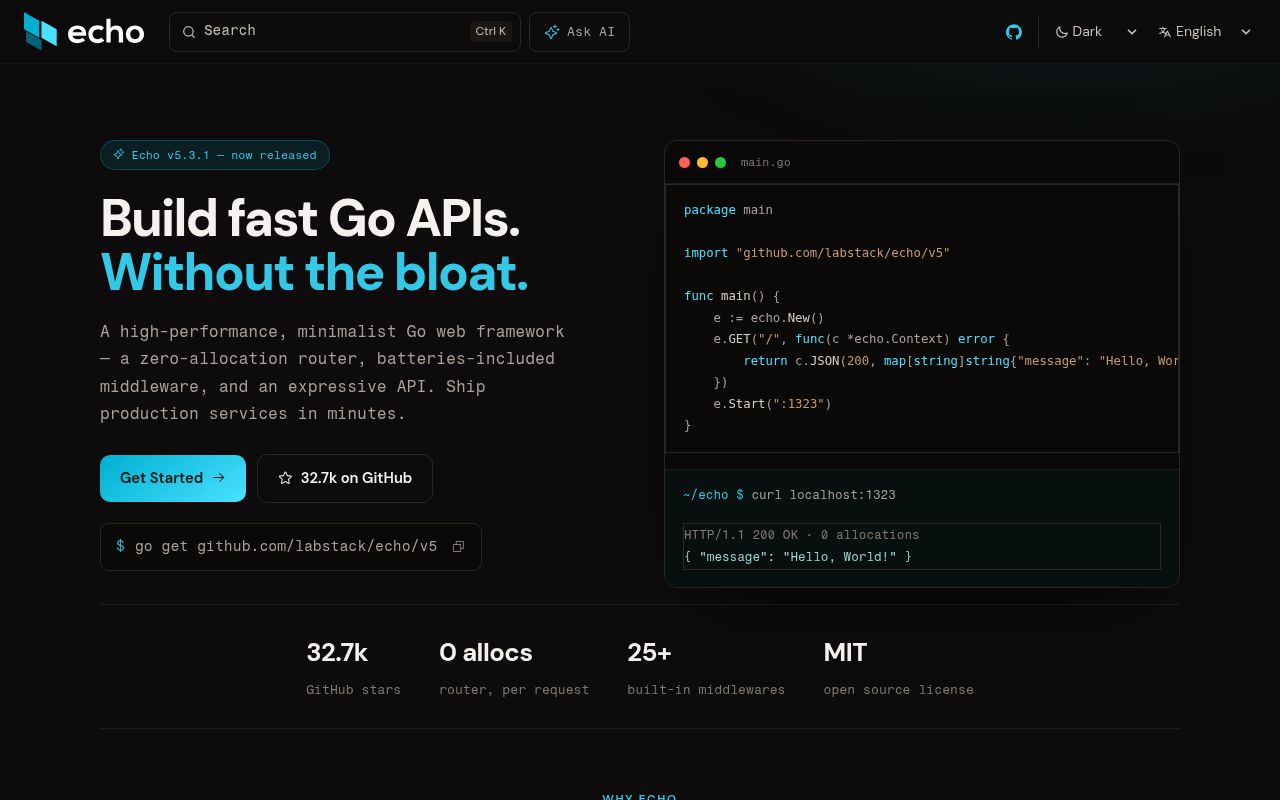
Echo starts with Go's standard HTTP server and adds the parts many API teams otherwise rebuild: a radix-tree router, route groups, request binding, pluggable validation, response helpers, centralized errors, and middleware at application, group, or route scope. Standard handlers and middleware can be wrapped instead of rewritten. That compatibility matters when a service already uses the Go ecosystem and does not want its framework to become an isolated runtime.
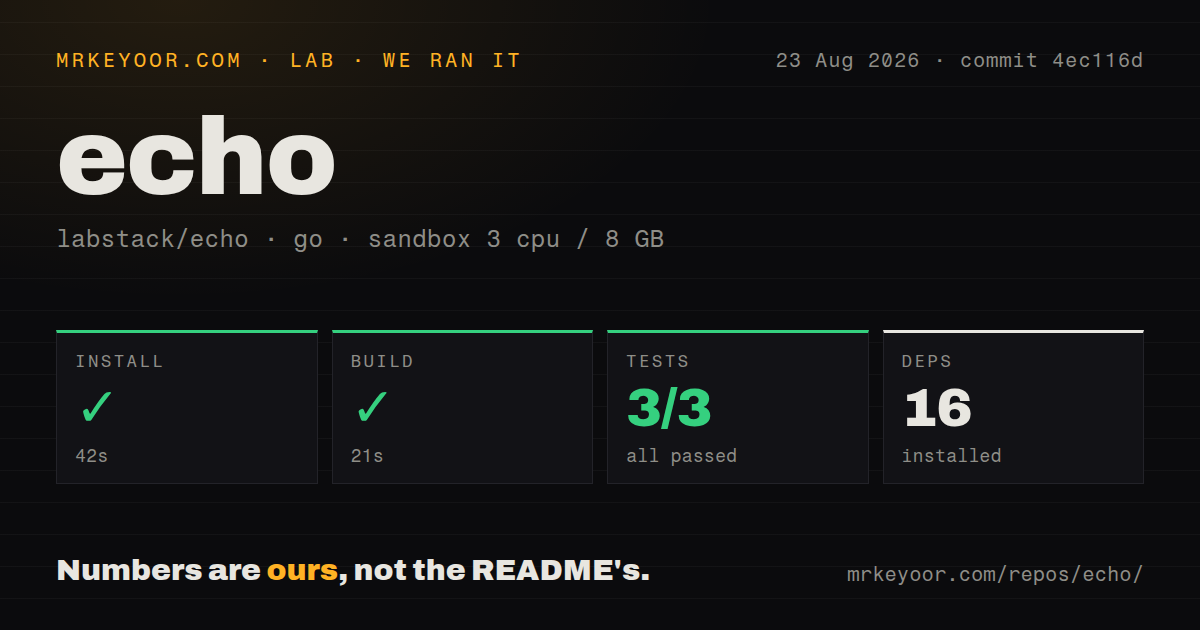
The measured source was compact: 137 files, roughly 41,536 lines, and a 1.6 MB checkout. Installing its Go dependencies added 16 packages. Echo does not include an ORM, database migration system, background workers, dependency injection container, or deployment service. For API-focused teams, that restraint is an advantage. For teams expecting a Rails-like application stack, every omitted layer becomes another choice and another package to maintain.
A minimal service remains readable. Create an Echo instance, attach request logging and panic recovery, register a GET handler, and start the server. The context can bind JSON, XML, or form data and return several response types. Templates are supported without prescribing a specific engine. Automatic TLS and HTTP/2 are available, although many production teams will terminate TLS at a reverse proxy or managed load balancer.
v5 is current, and v4 now has an exit date
The README identifies v5 as the current line and provides an API-change document for migration. v4 continues to receive security updates and bug fixes only through 2026-12-31. That is a clear policy, which is more useful than an indefinite compatibility promise. New services should use github.com/labstack/echo/v5; existing v4 services should inventory middleware and context API changes before the deadline.
Our run at commit 4ec116d installed 16 packages in 42 seconds, so dependency churn is unlikely to dominate a migration. Application code is the harder part. Middleware order, custom error handlers, binding behavior, and third-party integrations deserve specific tests. The framework team maintains JWT, OpenTelemetry, Prometheus, and a contribution repository separately. Other middleware listed in the README carries an explicit warning that Echo cannot guarantee its safety or quality.
The version policy also helps explain current issue traffic. A recent body-limit report reproduces against Echo v4.15.2 and describes oversized chunked input passing farther than its configured limit. A fix pull request was active during research. That report should not be silently applied to v5 without confirmation, but v4 operators using BodyLimit should read it and verify their deployed version rather than assuming the current major line covers them.
What happened when we ran it
Our Go dependency step succeeded in 42 seconds and installed 16 packages. Building Echo took 21 seconds in a fresh Debian container with 3 CPUs and 8 GB of RAM. The build passed without requiring a database, code generator, system package, or credential. The repository itself was only 1.6 MB at the measured commit.
Tests finished successfully in 17 seconds. Go reported 3 passing packages and 0 failures out of 3 discovered tests. The signal scan found no tests directory, which is normal for Go projects that keep _test.go files beside source, and 2 CI workflow files. The measured result is green, but the reported package count is not a claim about every assertion or every middleware behavior.
The lab block supplied no vulnerability-audit result, request-throughput benchmark, latency figure, or memory measurement, so none is inferred here. Echo describes itself as high performance, but our run only establishes dependency installation, compilation, and passing package tests. Teams choosing between routers should benchmark their own handler chain, JSON workload, tracing, and proxy arrangement instead of borrowing a framework headline.
Small HTTP details still belong to the application team
Echo removes boilerplate without resolving every protocol decision. Issue 2895 requests automatic HEAD handling because GET routes currently need matching HEAD registration. Issue 2961 says the rate-limit middleware does not set X-Rate-Limit-* or Retry-After headers and does not provide store metadata for an application to set them itself. Neither issue makes the router unusable. Both can affect API contracts if a team assumes the framework supplies common behavior automatically.
The 21-second build also does not package a production service. Echo's repository has no Dockerfile, appropriately leaving base image, non-root user, health check, certificates, and shutdown policy to each application. Behind a proxy, client-IP trust and forwarded-header behavior need deliberate configuration. Authentication is likewise an application choice, whether through the official JWT middleware or another reviewed component. Minimal frameworks make these boundaries visible; they do not make them disappear.
Error handling is one place Echo earns its dependency. Handlers return errors, and a centralized handler can convert them into consistent responses and logging. Recovery middleware turns panics into that error path. This pattern keeps route functions short and creates one place to enforce an API error shape. It is still up to the service to prevent internal details from reaching clients and to attach correlation IDs or tracing data.
The project is active with a manageable queue
GitHub showed 32,658 stars, 28 open issues and pull requests combined, a push on 2026-08-24, and v5.3.1 released on 2026-07-21. The release fixed static-handler and route-group behavior, while recent work covers newer Go APIs, middleware limits, compression, and routing. Last-push and issue activity both indicate current maintenance; the release tag does not have to carry that conclusion alone.
Echo is best when a team wants more speed of development than raw net/http provides and less policy than a full stack imposes. Our 16-package install and fully passing 17-second test run support that recommendation. The trade is ownership: database patterns, deployment, API documentation, authentication choices, and protocol details remain yours. For an experienced Go team, that is usually the right division of responsibility.