mrkeyoor.com_
Wed 30 Sept 20:44 UTC
Webevaluationupdated 30 Sept 2026

human-atlas review

Human Atlas is a browser-based 3D anatomy viewer built around the BodyParts3D adult male reference model. It lets students and curious readers search, isolate, rotate, and separate 2,234 anatomical meshes, but the project explicitly rules out diagnostic and surgical use.

Verdict

Our Human Atlas install pulled 570 packages and 696 MB, then produced a build in 18 seconds but offered no test target and reported 11 audit findings. It is a strong fit for an educational static site that needs a searchable adult-male reference model and can accept a 33 MB geometry download. Do not treat it as clinical software, a complete anatomy curriculum, or a dependency-light embed.

We ran it

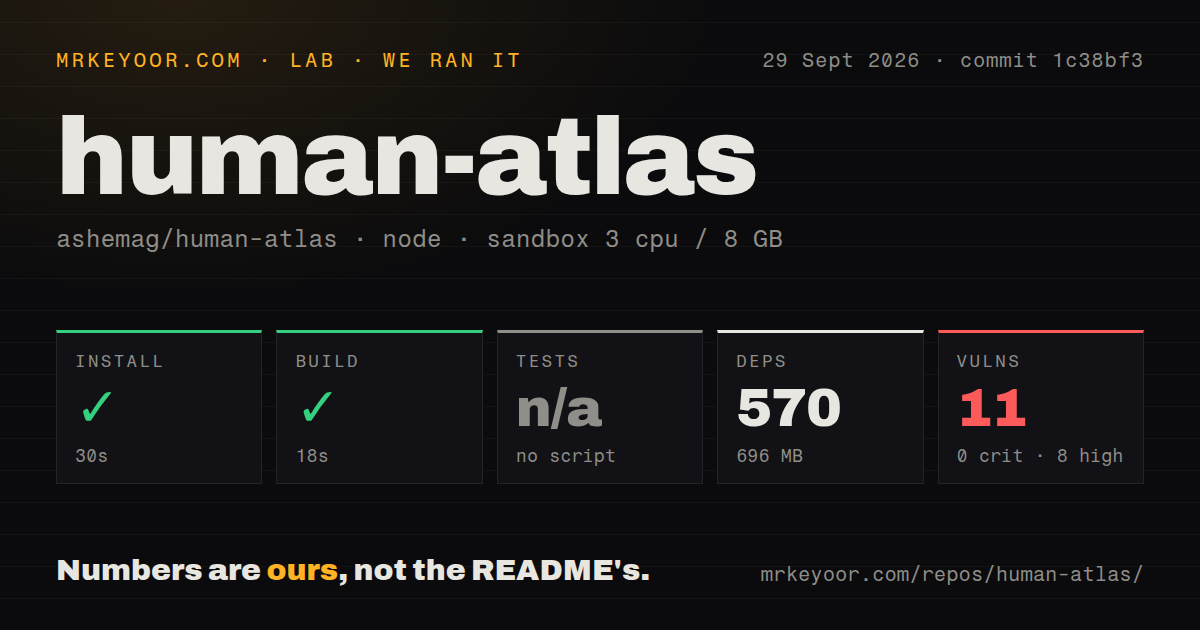
Lab card: what happened when we ran human-atlasScreenshot of human-atlas (human-atlas-seven.vercel.app)
Install✓ · 30s570 packages · 696 MB
Build✓ · 18s
Testsn/ano test script
Known vulns110 critical · 8 high · 2 moderate · 1 low (npm audit)
Repo118 files~8,105 lines of source · 94.5 MB · 0 CI workflows

Answers from our run

Does human-atlas build from source?

Dependencies installed in 30 seconds (570 packages), and the build succeeded in 18 seconds. We cloned commit 1c38bf3 into a clean Debian container with 3 CPUs and no project-specific setup.

Does human-atlas have tests you can run?

Not through a standard command: the project exposes no test script or target that our harness could run.

Does human-atlas have known vulnerabilities in its dependencies?

npm audit flagged 11 known advisories in the dependency tree at the time of our run.

Who should not use human-atlas?

Clinical, diagnostic, or surgical workflows: the README says the viewer is educational and does not represent every structure or variation.

What are the alternatives to human-atlas?

Z-Anatomy, 3D Slicer, OHIF Viewer. Our Human Atlas install pulled 570 packages and 696 MB, then produced a build in 18 seconds but offered no test target and reported 11 audit findings.

Setup3/518-second build, but 570 packages and 696 MB installed
Docs5/5Clear local, data, validation, deployment, and license guidance
Community4/53,976 stars and active September issue and PR activity
Maturity3/5No test target or release, with 11 audit findings

Discussed on

  1. hnOpen-source 3D anatomy explorer: 2,234 selectable BodyParts3D meshes86 points

Who it’s for

Teachers who want an interactive reference model they can host as a static site.
Students who need searchable anatomical names, system filters, and an exploded view.
Front-end developers studying how to render thousands of selectable structures without thousands of draw calls.
Museums or learning projects willing to preserve the BodyParts3D attribution.

Who it’s NOT for

Clinical, diagnostic, or surgical workflows: the README says the viewer is educational and does not represent every structure or variation.
Courses that require a current female reference body: the packaged atlas is an adult male model, and issue 427 asks when female anatomy will return.
Teams that require a clean dependency audit: our npm audit found 11 known vulnerabilities, including 8 high-severity advisories.
Release processes that require automated regression tests and visible CI: the package has no test script, and our scan found no CI workflow or tests directory.
Users who need verified touch performance on physical phones: the README says real multitouch hardware and physical-device performance have not been tested.

Setup reality

Our run installed 570 packages in 30 seconds and occupied 696 MB. The production build passed in 18 seconds. There was no test script or target, so the test step was skipped. Npm audit reported 11 known vulnerabilities: 8 high, 2 moderate, and 1 low.

Local use needs Node.js 22.13 or newer and no API key. The browser-ready anatomy files are included, so rebuilding geometry is optional. A static deployment must serve the generated dist/ directory and preserve the separate CC BY 4.0 attribution for the anatomy data.

The checkout is 94.5 MB before dependencies, and the compressed geometry download is about 33 MB. The repository has no Dockerfile. The README documents extra type, data, interaction, and build checks, but package.json does not combine them into a test target.

One adult-male model contains 2,234 selectable meshes

Human Atlas turns BodyParts3D 4.0 into an interactive browser model with 2,234 selectable meshes, 15 anatomical systems, and 3,432 named concepts. You can orbit the body, search names and identifiers, isolate a structure, toggle systems, or pull the visible pieces into an exploded inventory. The interface includes mobile controls, and optional WebMCP tools expose search and inspection to compatible browsers. The visible viewer does not depend on WebMCP.

The model's scope matters more than the smooth camera. BodyParts3D is an adult male reference anatomy, and the README says it does not cover every structure or human variation. The included attribution file says earlier revisions contained a female reference assembly, but those assets are historical and absent from the current release. Open issue 427 asks when female anatomy and ligaments will be included. A teacher should inspect coverage before making this the class's only model.

What happened when we ran it

Our sandbox installed commit 1c38bf3 in 30 seconds, pulling 570 packages and using 696 MB on disk. The production build succeeded in 18 seconds. The container had 3 CPUs, 8 GB of RAM, Node 22, no secrets, and no elevated privileges. The 94.5 MB checkout held 118 files and about 8,105 lines of source.

The standard test step did not run because package.json has no test script or target. Our scan also found no CI workflow, Dockerfile, or tests directory. The README documents separate type checking, atlas validation, interaction validation, and build commands. Those instructions are useful, but they are not wired into one test target that a default automation run can discover. We did not convert the documented commands into a substitute suite.

Npm audit reported 11 known vulnerabilities: 8 high, 2 moderate, and 1 low. That count does not establish that the static site exposes every affected code path, and our supplied result does not name the packages. It is still a release-gate problem. A team adopting the viewer should inspect the audit tree, decide which packages ship to browsers, and record any accepted advisories rather than treating a successful Vite build as a security check.

A 33 MB geometry download buys complete source-mesh coverage

The packaged model contains about 33 MB of compressed geometry and 2,288,268 triangles. Human Atlas keeps every source mesh while simplifying geometry for browser delivery. Its attribution file describes coordinate conversion, per-structure simplification, normal quantization, and binary chunk packing. The source identity remains in the manifest, while one named concept may group several meshes. That distinction explains why the concept count exceeds the mesh count.

Rendering is designed around the scale of the data. Geometry is merged into batches, while GPU textures hold per-structure translation, visibility, and selection state. Component geometry remains available for accurate picking. The scene updates when something changes instead of redrawing thousands of separate objects continuously. Those choices make the project more useful as a WebGL reference implementation than a page that merely embeds one large model.

Thirty-three megabytes is still a meaningful first visit on mobile or a school network. The README says browser interaction checks have covered 390 by 844, 320 by 568, and 844 by 390 layouts, but physical-device performance and real multitouch hardware remain untested. If phones are the primary classroom device, test download time, memory use, tap accuracy, and rotation on the actual hardware before deployment.

System toggles do not solve every visibility problem

Open issue 258 describes a user unable to see smaller internal muscle groups because external obliques remain in the way. The request asks for per-structure hiding instead of only system-level control. That is a concrete limit of the current exploration model: isolation helps after you find a structure, but studying relationships between a few internal and external pieces can require finer visibility control.

Coverage has similar boundaries. Open issue 233 says the nervous system appears limited mainly to brain structures and asks for a whole-body nervous system. A later pull request proposes adding peripheral nerves, but an open proposal is not shipped behavior. Human Atlas is most honest when treated as a viewer for the packaged BodyParts3D selection, not a promise that every anatomical teaching objective is represented.

The app is MIT, while the anatomy data is CC BY 4.0

Human Atlas separates its licensing clearly. The application code uses MIT, while BodyParts3D geometry and metadata use CC BY 4.0. Redistributors must keep the anatomy attribution, source links, and adaptation details. The included ATTRIBUTION.md already records the dataset, publication, license, and transformations, which makes the compliance work visible instead of leaving it to a vague README note.

GitHub showed 3,976 stars and 42 open issues and pull requests on September 30, 2026. The default branch was last pushed on September 6, while issue and pull-request activity continued through September 27. There is no tagged release. That combination suggests an active contribution queue around a young project, with no stable release line yet. Pin commit 1c38bf3 or another reviewed revision if classroom material depends on labels, counts, or interface behavior staying fixed.

Alternatives

ProjectWhat it isPick it when
Z-AnatomyA Unity-based open anatomy application with its own 3D model and desktop workflow.pick this instead when you want a dedicated application and editable Unity project rather than a static browser viewer.
3D SlicerA desktop platform for medical-image visualization, segmentation, and analysis.pick this instead when you need to work with patient imaging or research data rather than a fixed educational atlas.
OHIF ViewerA web viewer centered on DICOM studies and extensible clinical imaging workflows.pick this instead when browser-based DICOM viewing matters more than a prepackaged reference body.

What people are saying

  1. [hackernews] Open-source 3D anatomy explorer: 2,234 selectable BodyParts3D meshes
  2. [velocity-scout] ashemag/human-atlas

Sources

  1. Human Atlas README
  2. Human Atlas repository
  3. BodyParts3D attribution and adaptation notes
  4. Missing whole body nervous system issue
  5. Individual structure visibility request
  6. Female anatomy request

More web reviews

chi · youtube-ambilight · hyalite--liquid-glass · liquid-glass-screens · echarts · react-three-fiber · the whole board →