Fiber gives Go an Express-shaped API on fasthttp
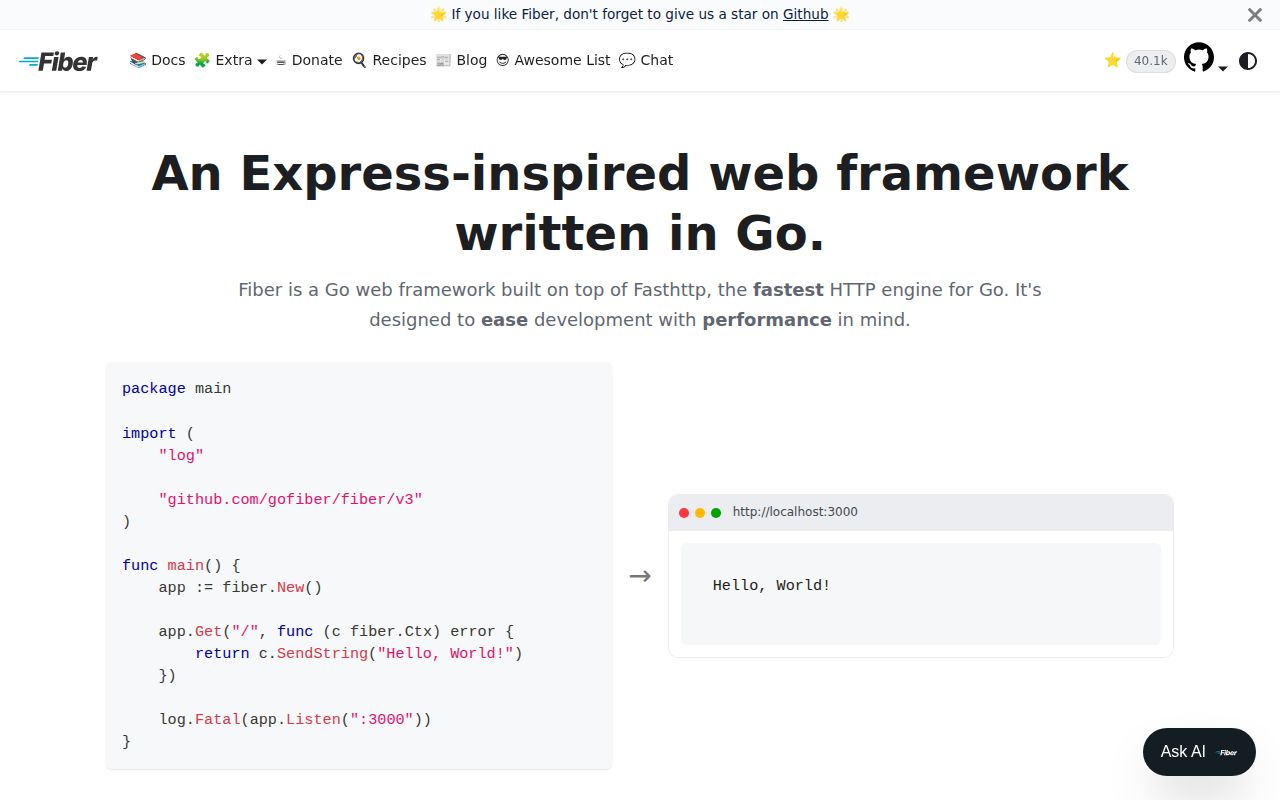
Fiber puts familiar route methods, middleware chains, parameter access, static serving, templates, and response helpers around fasthttp. A developer coming from Express can recognize Get, Post, Use, grouped routes, and a context passed into each handler. That familiarity is the main reason to choose it. Go already has capable HTTP primitives, so a framework earns its place by making a team faster and giving related packages a common shape. Fiber does that without asking an application to adopt a separate runtime or hosted control plane.
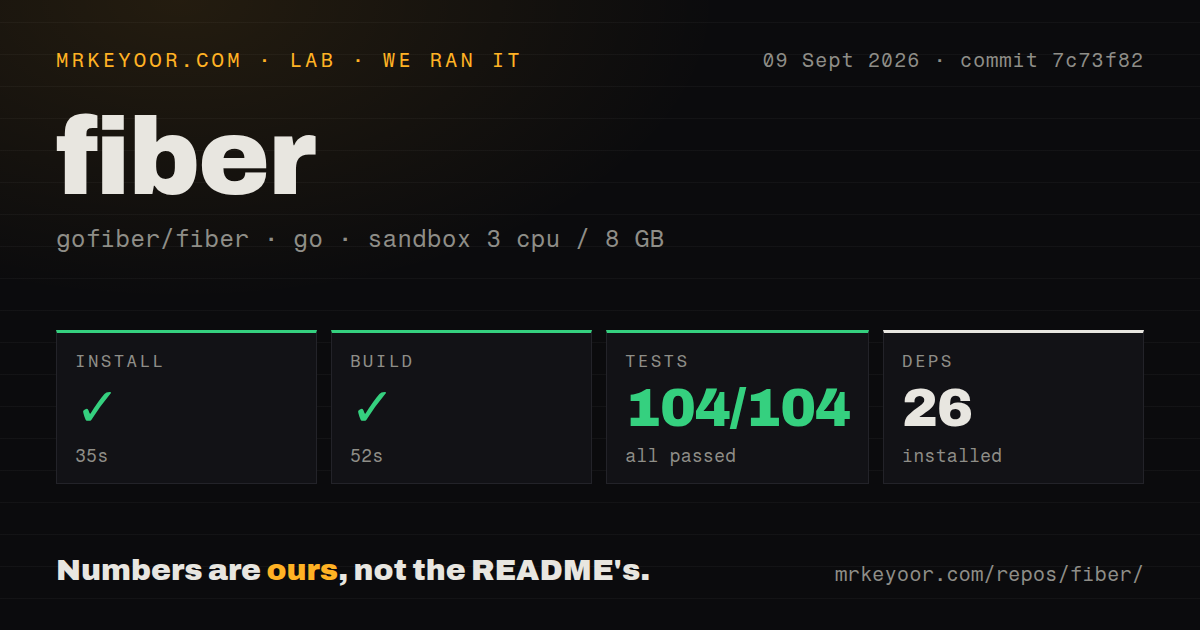
The repository is substantial despite the tiny dependency result in our lab. commit 7c73f82 contained 467 files and about 162,678 lines of source in a 6 MB checkout, yet installation added only 26 packages. That balance is appealing for an application framework: much of the behavior is visible in Go source, and the module tree did not balloon during our clean install. The MIT license also leaves commercial use and modification straightforward.
Reused context values are a rule your handlers cannot ignore
Fiber's speed-oriented API comes with a sharp lifetime rule. Values returned from fiber.Ctx are reused across requests, and the README tells developers not to retain those references after the handler returns. If a background job, cache, or goroutine needs request data, copy it first. This is easy to follow in a small endpoint. It becomes a review concern in a larger service where helper functions can hide when a string or byte slice escapes the request.
The current README requires Go 1.26 or newer and says Fiber's use of unsafe can affect compatibility with a new Go release. Our 2026-09-09 sandbox result describes an earlier point in that moving line: commit 7c73f82 built successfully inside golang:1.24-bookworm. A buyer should follow the requirement attached to the version being adopted instead of treating our successful Go 1.24 build as permission to ignore today's minimum.
What happened when we ran it
Our sandbox installed 26 packages in 35 seconds, then completed the build in 52 seconds. The full Go test step finished in 79 seconds with 104 passed and 0 failed. Those results came from commit 7c73f82 in an unprivileged Debian container with 3 CPUs, 8 GB of RAM, no secrets, and the Go 1.24 Bookworm image. The clean pass is useful evidence that the measured checkout can be worked on without a hidden database, browser, or cloud account.
Repository signals matched that result. We found 21 CI workflow files, no Dockerfile, and no separate tests directory. Go projects commonly keep _test.go files beside the code they exercise, so the missing directory does not imply missing tests; the 104 passing cases settle that question for our run. The absent Dockerfile matters differently. Fiber is a library, and each application still owns its base image, user, certificates, ports, and shutdown behavior.
Native handlers get Fiber features; adapted handlers keep net/http semantics
Fiber v3 can register standard net/http handlers directly, and it can bridge whole applications or middleware through its adaptor package. That lowers the cost of carrying an existing endpoint into a Fiber service. The README is also candid about the boundary: adapted handlers keep standard-library semantics, cannot access fiber.Ctx features, and incur compatibility overhead. Native Fiber handlers remain the intended route when the framework's request API and fasthttp behavior are the reasons for adopting it.
That split deserves an architectural decision before a 162,678-line framework enters a shared service. If most dependencies expose net/http middleware, repeated adaptation can erase the simplicity Fiber promised. If the service is new and its handlers stay native, the included router and middleware cover a lot of ordinary API work. Our 52-second build gives teams a cheap way to prototype both paths and inspect the resulting code before standardizing.
Fiber v3 is a migration project for an existing v2 service
The v3 migration material describes changes beyond an import suffix. Collection APIs use Go iterators, several byte-oriented helpers disappeared, middleware data moved behind typed accessors, and multiple middleware configurations changed shape or defaults. Cache behavior, CORS lists, timeout configuration, sessions, authentication, redirects, and CSRF handling all receive specific migration notes. That documentation is unusually useful, but its length is also evidence that an established v2 service needs tests around behavior rather than a mechanical package rename.
Our run's 104 passing tests cover Fiber itself at commit 7c73f82, not your middleware order or v2 assumptions. Session cookies, cache limits, redirect rules, and timeout cancellation sit close to security and production behavior, so migration checks should use requests copied from the application. The project provides make test, lint, audit, coverage, and benchmark targets for contributors. We measured only the supplied install, build, and test steps, and make no throughput claim from them.
A September push and 21 workflows show active maintenance
GitHub recorded the last push on September 9, 2026, and open pull requests were still receiving updates that day. The repository had 40,136 stars and 37 combined issues and pull requests when fetched. Release v3.5.0 arrived on August 13 with proxy security defaults, routing work, and fixes across redirects, negotiation, caching, and request handling. That is current maintenance by both push activity and issue work, rather than a judgment based only on a release tag.
Release activity also shows why version pinning matters. The 21 workflow files and clean 79-second test run are reassuring, while v3.5.0 contains behavior and security changes that application owners should read before upgrading. Fiber is a sensible choice for teams that want its API on purpose. Teams whose dependencies and operating habits already center on net/http will usually get a calmer codebase from a router that stays inside those interfaces.