Python control comes with a 6,380 MB environment
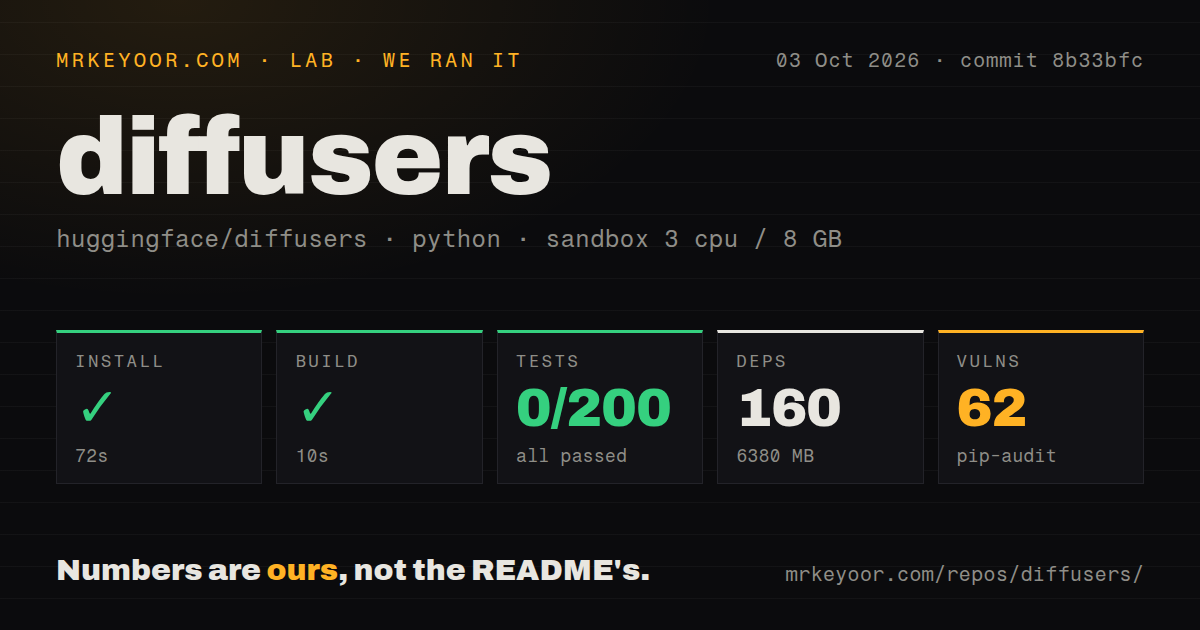
Installing Diffusers took 72 seconds in our sandbox and left an environment occupying 6,380 MB. That's a substantial commitment for someone who only wants to generate a picture. For a Python developer who needs to change how a model runs, the trade can make sense: the README exposes ready-made generation pipelines alongside the individual model components you can rearrange. Choose it because you need that control.
A scheduler determines how generation removes noise at each step. Diffusers lets you exchange schedulers or use model components directly, so your application can own the generation loop. The checkout we measured contained 2,854 files. That breadth serves developers working across model families, including image editing and audio generation, though it gives someone maintaining a single image pipeline plenty of code they won't use. The README shows both approaches.
What happened when we ran it
Our run installed 160 packages in 72 seconds and completed the build in 10 seconds. We cloned commit 8b33bfc on October 3, 2026, into an unprivileged Debian container with 3 CPUs, 8 GB of RAM, and no secrets. The image was ghcr.io/astral-sh/uv:python3.12-bookworm. These are repository setup results. This run establishes no image-quality result or generation speed.
Pytest exited with code 1 after a 96-second test step: 0 passed, 0 failed, and 200 collection/setup errors. The log repeatedly says that importing the Stable Diffusion XL pipeline failed because libGL.so.1 could not be opened. Files for Sana Video, Shap-E, and SkyReels appear in the tail. Collection stopped at the 200-error limit, before test assertions could establish whether those pipelines work. The pytest summary itself reports 57.09 seconds, a separate duration from the enclosing step.
Pip-audit reported 62 known vulnerabilities in the environment from this run. The audit count alone doesn't identify affected packages, severities, or whether a generation service would expose the vulnerable paths. Treat that count as a reason to inspect the dependency versions you intend to ship. Calling every finding a remotely exploitable Diffusers defect would go beyond the evidence.
Our checkout occupied 52.3 MB and contained approximately 1,036,810 source lines. The scan found a tests directory and 35 CI workflow files, with no Dockerfile. The missing shared library is a concrete fresh-container obstacle. We haven't established which package introduced the requirement or whether supplying that library would let the full suite finish.
Model downloads and GPU memory remain your responsibility
The README's first generation example loads a checkpoint with from_pretrained and moves the pipeline to CUDA. You must choose model files and a compatible PyTorch runtime as well as installing Diffusers. The loading guide also supports a local model directory. That suits deployments where you want to cache approved weights and control updates. The library provides generation machinery, while your application still handles incoming jobs and saves the results.
Our 8 GB sandbox result doesn't tell you how much GPU memory your chosen checkpoint needs. Apple Silicon has separate guidance linked from the README. The memory guide explains CPU offloading and warns that sequential offloading can be extremely slow. These choices vary by model. Check the exact pipeline and hardware before promising response times, and treat model access requirements separately from the Python package: private or restricted Hub repositories can require Hub authentication.
ONNX deployments face a documented change of direction
Release v0.41.0, published October 6, 2026, deprecates ONNX support and directs ONNX Runtime users to Optimum. It also removes the LuminaText2ImgPipeline and Lumina2Text2ImgPipeline aliases, naming replacements. That's enough reason for an ONNX-focused team to choose another path, or for an existing integration to postpone an upgrade until its imports are checked. The same release notes add Qwen-Image 2.1 generation, editing, transparency, and LoRA training.
Our 10-second successful build belongs to the October 3 commit, before that release. It cannot validate the newer features or removals. Separately, open issue 15018 reports that UNet2DModel loading with offload_state_dict=True can leave weights unusable, while the same checkpoint works with the option disabled. The report includes a small local reproduction. It's a user-reported loading problem, distinct from our missing-library collection errors, and a reason to verify that option before relying on it.
October activity shows maintenance, while the scope demands care
The last push was October 12, 2026, and GitHub listed 34,704 stars plus 1,476 open issues and PRs. The October 6 release and an October 12 issue update show current activity together. The combined queue isn't a count of confirmed bugs. Diffusers earns consideration because its documentation explains component loading and hardware options, and its releases keep integrating models. Activity doesn't guarantee that your particular combination is reliable.
The 35 CI workflow files we found show that upstream automation exists. Our container still stopped during collection. For adoption, narrow the question to the pipeline you will actually operate: can it load the pinned checkpoint, generate a usable output, and repeat that job on your deployment hardware? Record the model revision alongside the library version. A library spanning roughly 1,036,810 source lines needs that focused check more than another quick-start screenshot.
Choose a visual editor when editing is the job
ComfyUI provides a node graph for reusable generation workflows. Pick it when collaborators need to see and change the workflow without editing Python. InvokeAI adds a local web interface and a canvas with brush tools and inpainting. I'd choose it for an artist working on images. Neither choice establishes a smaller environment or avoids the need to select suitable models and hardware.
stable-diffusion.cpp is the alternative I'd examine for a C/C++ inference application with a supported model, especially when a Python environment like the 160-package one we measured is unwelcome. Diffusers remains my choice when the product needs Python-level access to the model's components. Before putting it behind a service, resolve the shared-library failure and audit the pinned environment. Make the first successful generation happen inside the container you intend to ship.