mrkeyoor.com_
Mon 07 Sept 07:51 UTC
AI Toolsevaluationupdated 07 Sept 2026

DeepSpeed review

DeepSpeed is a Python library for training and serving models that are too large or too slow for one accelerator. It divides model data and computation across GPUs, CPUs, and storage, then lets PyTorch applications control that work through a configuration file and a small training API.

Verdict

Our DeepSpeed install consumed 6,106 MB, and its test command stopped with 4 collection/setup errors before any test passed or failed. Use it when ZeRO, offload, or multi-node training solves a measured memory or scale problem and your platform team can test the exact accelerator path. A smaller training layer is the better default for one machine or a straightforward fine-tune.

We ran it

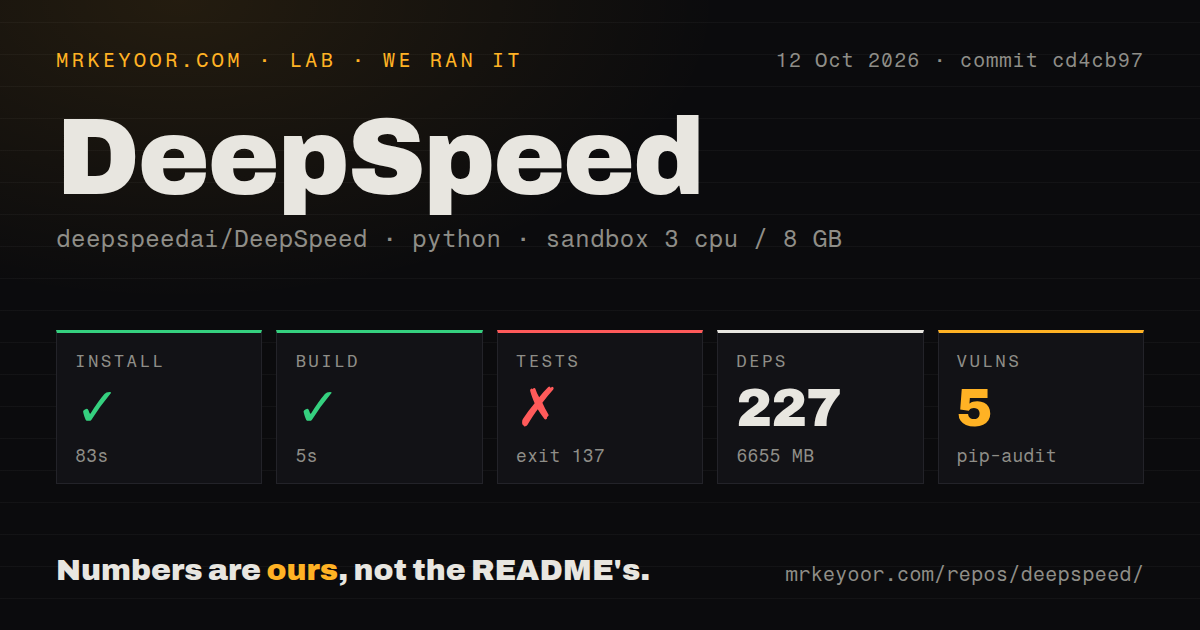
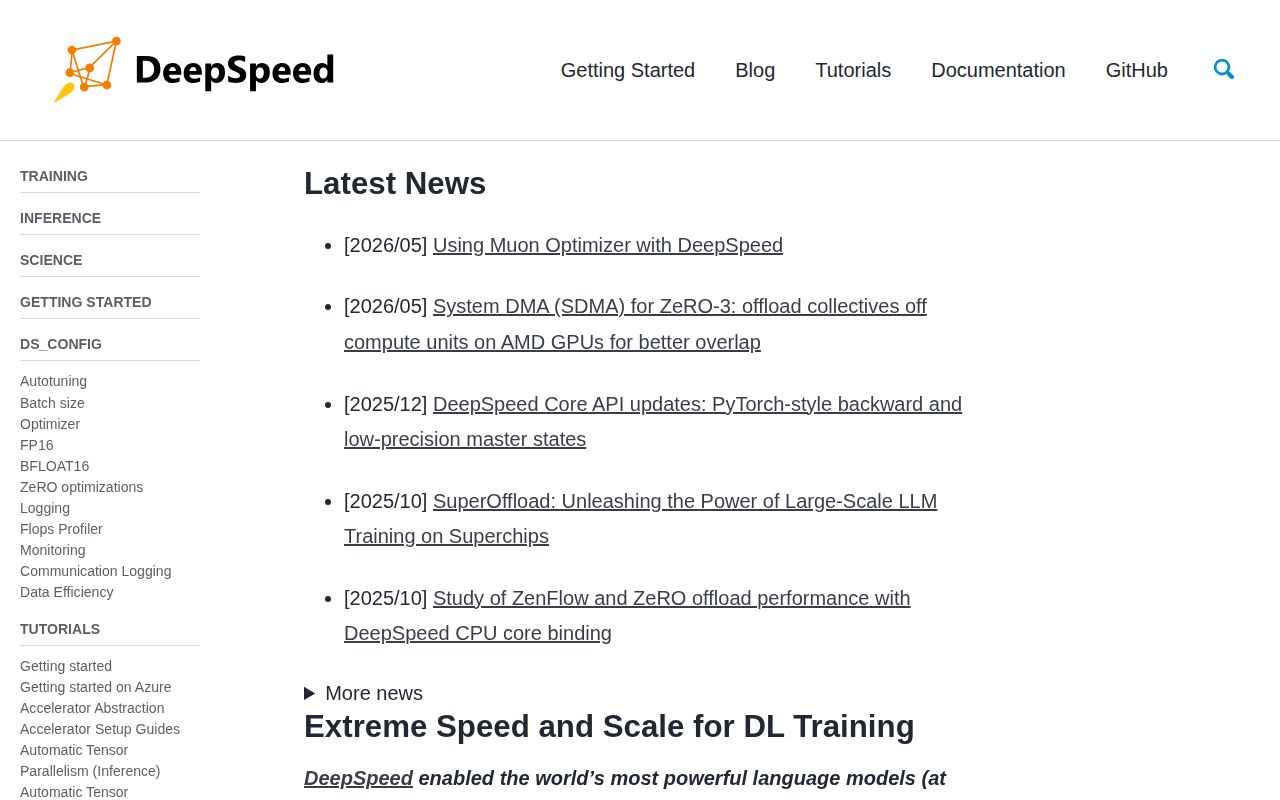
Lab card: what happened when we ran DeepSpeedScreenshot of DeepSpeed (www.deepspeed.ai)
Install✓ · 110s162 packages · 6106 MB
Build✓ · 13s
Tests✗ · 28s0 passed · 0 failed · 4 errors of 4 (pytest)
Known vulns1(pip-audit)
Repo2105 files~255,524 lines of source · 257.5 MB · 30 CI workflows · tests dir

Answers from our run

Does DeepSpeed build from source?

Dependencies installed in 110 seconds (162 packages), and the build succeeded in 13 seconds. We cloned commit 32110a9 into a clean Debian container with 3 CPUs and no project-specific setup.

Do DeepSpeed's tests pass?

Yes: 0 of 4 passed when we ran the project's own test command (pytest), with 4 collection errors. Some failures need services or credentials a bare container does not have.

Does DeepSpeed have known vulnerabilities in its dependencies?

pip-audit flagged 1 known advisory in the dependency tree at the time of our run.

Who should not use DeepSpeed?

Developers seeking a light CPU-only helper: our install pulled 162 packages and occupied 6,106 MB before model weights or compiled runtime ops.

What are the alternatives to DeepSpeed?

Hugging Face Accelerate, TorchTitan, Megatron-LM. Our DeepSpeed install consumed 6,106 MB, and its test command stopped with 4 collection/setup errors before any test passed or failed.

Setup2/56,106 MB install; generic tests stopped during collection
Docs5/5Install, launch, config, hardware, and ZeRO guides are detailed
Community5/543,069 stars, a September 7 push, and active issue work
Maturity4/5v0.19.6 is active, but hardware paths need their own validation

Who it’s for

Platform teams prepared to own a 6,106 MB Python environment while training models that do not fit on one accelerator.
PyTorch developers who need ZeRO state partitioning, CPU or NVMe offload, mixed precision, or several forms of parallel training.
Cluster operators with the compilers, launchers, networking, and hardware-specific test capacity needed for distributed jobs.
Teams already using Transformers, Accelerate, Lightning, or another documented DeepSpeed integration.

Who it’s NOT for

Developers seeking a light CPU-only helper: our install pulled 162 packages and occupied 6,106 MB before model weights or compiled runtime ops.
Windows operators who require asynchronous I/O or GPUDirect Storage: the README explicitly says AIO and GDS are unsupported there.
Muon users who cannot verify optimizer behavior before training: open issue 8441 reports that the default ZeRO stage 0 path performs an SGD update, and its proposed fix is still under review.
Teams that treat a generic pytest invocation as proof of readiness: our run stopped with 4 collection/setup errors and executed no passing or failing tests.

Setup reality

Our commit 32110a9 install succeeded in 110 seconds, adding 162 packages and using 6,106 MB. The build passed in 13 seconds. Tests exited 3 after 28 seconds with 0 passed, 0 failed, and 4 collection/setup errors out of 4; pip-audit found 1 known vulnerability.

The basic path needs Python, PyTorch, and a DeepSpeed JSON configuration, but no hosted credential. Full accelerator support can require CUDA or ROCm compilers. Multi-node use needs a hostfile plus passwordless SSH, or coordinated per-node launches with ranks, a leader address, and a port.

Most C++ and accelerator ops compile on first use through PyTorch and ninja unless you build them ahead of time. The README recommends ds_report to check compatibility. Windows lacks AIO and GDS, and cached extensions can collide across virtual environments unless each environment uses its own cache directory.

DeepSpeed v0.19.6 is built around ZeRO and distributed PyTorch

DeepSpeed v0.19.6 wraps a PyTorch model in an engine that handles distributed setup, backward passes, optimizer steps, scheduling, and checkpoints. Its best-known feature is ZeRO: stage 1 partitions optimizer state, stage 2 also partitions gradients, and stage 3 partitions model parameters. CPU and NVMe offload can move state away from accelerator memory. The project also documents tensor, pipeline, sequence, and expert parallel paths, so it addresses jobs where memory placement and communication are part of the model design.

That range explains the 255,524 lines of source in the checkout we measured. A team can enable features through JSON and keep a familiar PyTorch loop, but each switch changes runtime assumptions. ZeRO-3 checkpoints, for example, require every process to participate in saving, and ordinary state dictionaries hold placeholders while parameters are partitioned. DeepSpeed hides boilerplate, while rank and checkpoint semantics remain yours.

A 110-second install does not configure a cluster

Our sandbox installed 162 packages in 110 seconds, which is the easy part of a real deployment. The documented single-node launcher can discover local GPUs, while multi-node jobs use an OpenMPI-style hostfile. The normal route expects passwordless SSH between listed machines. A no-SSH mode exists, but every node must be started separately with a unique rank plus the leader's address and port. Cluster networking, NCCL settings, and failure recovery remain the operator's responsibility.

The 6,106 MB environment also precedes model weights and runtime caches. DeepSpeed normally compiles required C++ or accelerator ops on first use through PyTorch's extension loader and ninja. Operators can prebuild selected ops or a wheel for machines with matching Python, PyTorch, CUDA, and GPU environments. The advanced installation guide warns that one shared extension cache can break across virtual environments with different toolchains, so production images should pin versions and isolate that cache.

What happened when we ran it

Our sandbox installed commit 32110a9 in 110 seconds, adding 162 packages and occupying 6,106 MB. The source checkout itself contained 2,105 files, about 255,524 lines, and 257.5 MB. Installation succeeded, and the build completed successfully in 13 seconds. We used an unprivileged Python 3.12 Bookworm container with 3 CPUs, 8 GB of RAM, and no secrets.

The test command exited with status 3 after 28 seconds. Pytest reported 0 passed, 0 failed, and 4 collection/setup errors out of 4, while its summary said 123 items were collected before the errors. The log tail shows an internal argparse failure ending in SystemExit: 2, plus 1 warning. It does not identify the unsupported argument or prove a root cause, so the sound conclusion is limited: this command did not reach a completed test result in our environment.

Pip-audit found 1 known vulnerability in the 162-package environment. The supplied result does not name the package, advisory, severity, or reachable code path. Our scan also found 30 CI workflow files, no Dockerfile, and a tests directory. Those are repository signals, not substitutes for the failed run. A buyer should reproduce the audit and run the intended hardware-specific suite before training data or paid accelerator time enters the system.

Thirty workflows reveal how many hardware paths need testing

Our scan found 30 files for CI workflows covering NVIDIA, AMD, CPU, Intel Gaudi, Intel XPU, integrations, and other checks. The README also lists contributed support for Huawei Ascend and another accelerator. That is useful breadth, yet the support table distinguishes contributor validation from upstream validation. A passing wheel build on our 3-CPU sandbox says nothing about a CUDA kernel, ROCm collective, offload drive, or multi-node network. Match the acceptance test to the exact hardware and feature combination you plan to run.

Windows support has a similarly clear boundary. The README says many training and inference features work there, but asynchronous I/O and GDS do not. Building requires Visual C++ tools, and the documented process uses an administrator console to create symlink folders. Teams buying DeepSpeed mainly for NVMe offload should treat those omissions as an architecture constraint.

The September Muon report makes configuration testing mandatory

Open issue 8441, filed September 6 after v0.19.6, reports that a Muon optimizer configuration without a zero_optimization block takes the default stage 0 path and applies an SGD-style update without a warning. The report includes a reproducer and says existing Muon tests cover ZeRO stages 1 through 3. Pull request 8442 proposes running the missing update and remained under review on September 7. Muon users should confirm the final disposition and test their chosen stage before committing a training run.

That active discussion is both reassuring and cautionary. A contributor supplied measurements, a focused fix, and review traffic within 1 day, but the report concerns silent optimizer semantics rather than a cosmetic failure. Our own 4 setup errors also show why a green upstream matrix cannot replace a local acceptance suite. Save a tiny reference run, compare updates and checkpoints across the exact precision and ZeRO settings, then promote the configuration only after those checks pass.

A September 7 push shows maintenance, not effortless adoption

GitHub recorded 43,069 stars, 1,381 open issues and pull requests combined, and a last push on September 7, 2026. Release v0.19.6 arrived August 27 with fixes across checkpoints, ZeRO, AutoTP, DeepCompile, Apple Silicon, and accelerator memory handling. The same-day issue and pull request traffic shows active maintenance. The large combined queue also means adopters should search by hardware, optimizer, precision, and integration before deciding that a current release covers their case.

DeepSpeed earns its place when a model's memory footprint or distributed shape has already forced a platform decision. The library offers mature concepts, detailed docs, and integrations that spare teams from writing every distributed mechanism themselves. Our 6,106 MB install and collection failure make a poor case for adding it speculatively. Start with the smallest configuration that solves a measured limit, run ds_report, pin the toolchain, and make a real checkpoint restore part of the acceptance test.

Alternatives

ProjectWhat it isPick it when
Hugging Face AccelerateA thinner PyTorch launcher for common distributed backends.pick this instead when DeepSpeed's measured 6,106 MB install is too much and you mainly need simpler multi-device orchestration.
TorchTitanPyTorch-native training recipes and distributed building blocks for large models.pick this instead when you want an opinionated PyTorch reference stack and prefer native distributed components over DeepSpeed's engine.
Megatron-LM gh↗NVIDIA's framework for training large transformer models with several parallelism strategies.pick this instead when NVIDIA-focused transformer training is the whole job and its model architecture fits your workload.

What people are saying

  1. [velocity-scout] deepspeedai/DeepSpeed

Sources

  1. DeepSpeed repository and README
  2. DeepSpeed repository metadata
  3. DeepSpeed getting started guide
  4. DeepSpeed advanced installation guide
  5. DeepSpeed v0.19.6 release notes
  6. Muon ZeRO stage 0 optimizer report
  7. Muon ZeRO stage 0 proposed fix

More ai tools reviews

Konnect · whisper · METATRON · openmed · open-science · VoxCPM · the whole board →