mrkeyoor.com_
Tue 01 Sept 17:45 UTC
LLM Toolsevaluationupdated 25 Aug 2026

Megatron-LM review

Megatron-LM is NVIDIA's reference framework for training very large transformer models across many GPUs. Its Megatron Core library supplies reusable model components and several ways to split training work across devices, while the repository adds scripts and examples for researchers running full training jobs.

+93stars / 7d
Verdict

Megatron-LM belongs on the shortlist for teams with NVIDIA clusters and engineers who understand distributed training failures. Megatron Core offers unusual control over parallelism and model construction, but that control carries a large configuration and operations bill. Use a smaller PyTorch-native framework for modest jobs; choose Megatron when scale and NVIDIA-specific execution paths justify dedicated platform work.

We ran it

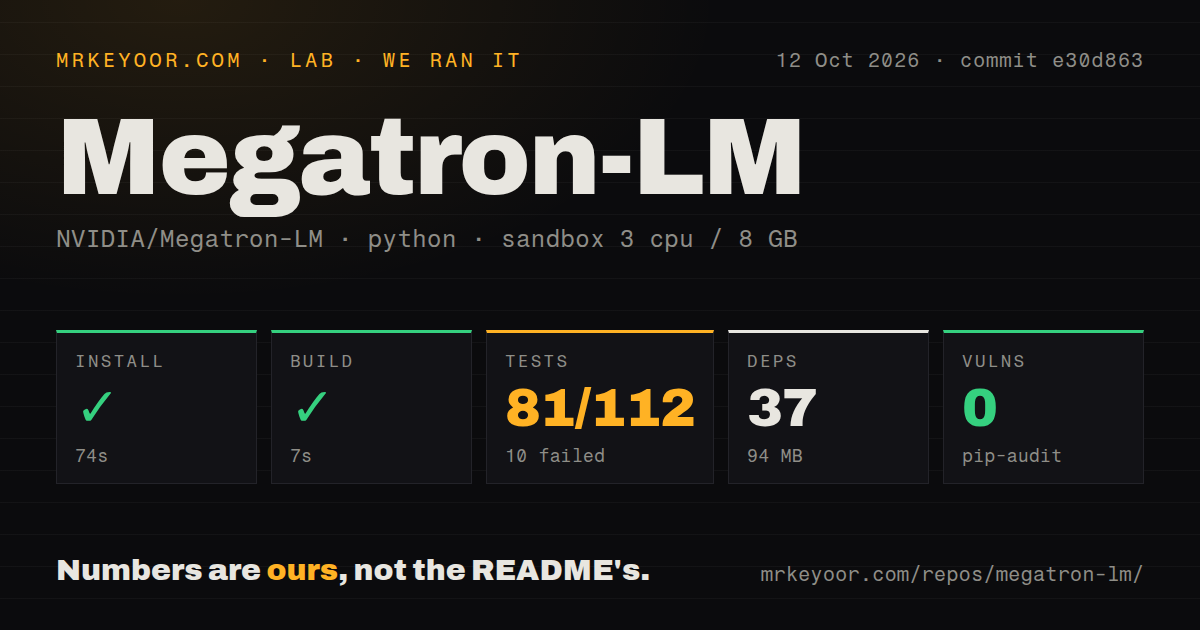
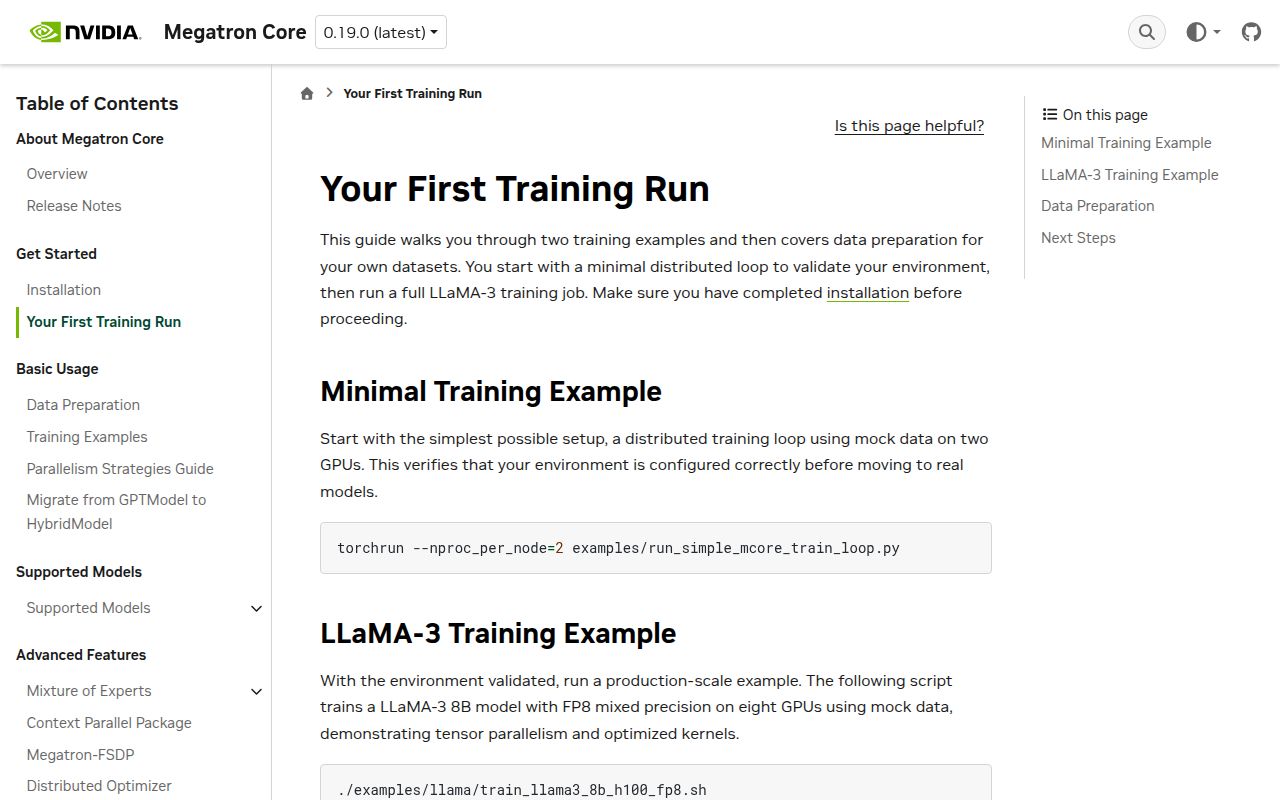
Lab card: what happened when we ran Megatron-LMScreenshot of Megatron-LM (docs.nvidia.com/megatron-core/developer-guide/latest/get-started/quickstart.html)
Install✓ · 71s37 packages · 94 MB
Build✓ · 6s
Tests✗ · 7s34 passed · 1 failed · 18 errors of 53 (pytest)
Known vulns0(pip-audit)
Repo3138 files~510,030 lines of source · 63.3 MB · 36 CI workflows · tests dir

Answers from our run

Does Megatron-LM build from source?

Dependencies installed in 71 seconds (37 packages), and the build succeeded in 6 seconds. We cloned commit ff8c0f8 into a clean Debian container with 3 CPUs and no project-specific setup.

Do Megatron-LM's tests pass?

Not all of them: 34 of 53 passed and 1 failed when we ran the project's own test command (pytest), with 18 collection errors. Some failures need services or credentials a bare container does not have.

Does Megatron-LM have known vulnerabilities in its dependencies?

pip-audit found none in the dependency tree at the time of our run.

Who should not use Megatron-LM?

Developers looking for a CPU-first training library or a useful laptop demo: the installation guide recommends NVIDIA Turing or later, and the project is designed around GPU-distributed work.

What are the alternatives to Megatron-LM?

DeepSpeed, TorchTitan, Nanotron. Megatron-LM belongs on the shortlist for teams with NVIDIA clusters and engineers who understand distributed training failures.

Setup2/5Package build passed; useful training needs an NVIDIA cluster stack
Docs4/5Deep guides and examples, with a Python-version mismatch to resolve
Community5/5Same-day pushes and issue activity around a large contributor queue
Maturity4/5Established training core, though APIs move and our test slice failed

Discussed on

  1. hnMegatron-LM: Nvidia's 8.3B Parameter GPT-2 Transformer9 points

Who it’s for

ML infrastructure teams training transformer or mixture-of-experts models on NVIDIA GPU clusters.
Researchers who need tensor, pipeline, data, expert, or context parallel training in one codebase.
Framework engineers who want Megatron Core components inside a custom PyTorch training system.
Teams already using NVIDIA NGC, CUDA, NCCL, and Transformer Engine and able to debug distributed jobs.

Who it’s NOT for

Developers looking for a CPU-first training library or a useful laptop demo: the installation guide recommends NVIDIA Turing or later, and the project is designed around GPU-distributed work.
Small teams that want one stable training command without topology planning: useful runs require decisions about datasets, checkpoints, precision, and several parallelism dimensions.
Projects that need the repository's generic test selection to pass in a fresh Python container: our run ended with 1 failed test and 18 collection/setup errors.
Teams needing direct Hugging Face checkpoint interchange in this package alone: the README points to the separate NVIDIA-NeMo/Megatron-Bridge project for conversion and recipes.
Users who cannot absorb API migration work: release 0.19.0 announces GPTModel deprecation and directs users toward HybridModel.

Setup reality

Our fresh container installed the project successfully in 71 seconds, adding 37 packages and using 94 MB on disk. The build succeeded in 6 seconds. Tests failed with exit 1 after 7 seconds: pytest recorded 34 passed, 1 failed, and 18 collection/setup errors out of 53. pip-audit found 0 known vulnerabilities.

The error tail names ModuleNotFoundError: No module named 'github_slack_utils' for the on-call manager tests. The separate secret-redaction test ran run_training.sh, received exit code 127 instead of 0, and failed its assertion. The shown log does not establish why that shell script returned 127.

A usable training environment is much heavier than this package check. The guide recommends an NVIDIA Turing or newer GPU, with newer architectures required for FP8, plus PyTorch and CUDA. NVIDIA's NGC container is the documented route for preinstalled CUDA, cuDNN, NCCL, and Transformer Engine; the repository itself has no Dockerfile.

Two projects under one name

Megatron-LM now describes both a reference training framework and Megatron Core, the library underneath it. The reference side supplies configured training scripts and examples. Core exposes transformer layers, distributed optimizers, dataset code, checkpointing, inference pieces, and the machinery for splitting a model and its work across GPUs. NVIDIA positions the first for research and experimentation, and the second for engineers building their own training framework.

That distinction matters when deciding whether to adopt it. A lab can begin with an example and learn how a distributed run is assembled. A platform team can import only the Core pieces it needs. Neither route turns large-model training into a one-command job. The user still owns data preparation, checkpoint storage, cluster launch, failure recovery, and a parallelism layout suited to the model and network.

Megatron's attraction is control. It supports tensor, pipeline, data, expert, and context parallelism, along with mixed precision and mixture-of-experts components. Those options let experienced teams map different parts of a training workload onto their hardware. They also create a wide configuration surface where a valid-looking choice can fail late. Open issue #5755 gives a small example: an invalid grouped-query attention relationship passes configuration and then reaches a cryptic tensor shape error during the forward pass.

Hardware is part of the software decision

The installation guide recommends NVIDIA Turing or newer GPUs. FP8 requires Hopper, Ada, or Blackwell hardware. PyTorch and a current CUDA toolkit sit underneath the package, while the fuller development path can add Transformer Engine and packages that compile CUDA kernels. Teams already standardized on NVIDIA infrastructure will recognize this stack. Everyone else should price the hardware and operator time before comparing Python APIs.

NVIDIA recommends its NGC PyTorch container for a configured environment containing CUDA, cuDNN, NCCL, and Transformer Engine. The guide tells users to choose the previous month's image for compatibility with the current Megatron Core release. That is a useful warning about the pace of the dependency matrix. The repository has no Dockerfile, so rebuilding the documented environment from this source tree alone is not the supported shortcut.

There is also a documentation wrinkle. The current package metadata requires Python 3.12 or newer, and the README says support for 3.10 was dropped. The installation guide still lists Python 3.10 or newer, with 3.12 recommended. Follow the package metadata for a fresh environment and treat the older lower bound in the guide as stale until NVIDIA reconciles it.

What happened when we ran it

We cloned commit ff8c0f8 into a fresh Debian container with 3 CPUs, 8 GB of RAM, Python 3.12, no secrets, and no elevated privileges. The checkout contained 3,138 files, about 510,030 lines of source, and occupied 63.3 MB. Installation succeeded in 71 seconds, adding 37 packages and consuming 94 MB on disk. The package build then succeeded in 6 seconds. pip-audit found no known vulnerabilities.

The selected test run did not pass. After 7 seconds, pytest reported 34 passed, 1 failed, and 18 collection/setup errors out of 53. The collection errors shown at the end came from on-call manager tests that could not import github_slack_utils. That module name is the evidence we have; the log excerpt does not say whether it should come from an optional dependency, a path adjustment, or another source.

The lone failure was in the training-script secret-redaction test. Its generated run_training.sh process returned 127, while the assertion expected 0. The excerpt does not show the command responsible for that return code, so assigning a cause would be guesswork. These results assess install, build, and a generic pytest selection. They do not measure GPU training throughput, convergence, or multi-node correctness.

A large, moving engineering surface

Megatron-LM's size is partly the point. The tree includes legacy code, post-training features, reinforcement learning, export paths, multiple distributed strategies, and model-specific work. Its dev branch carries early features, while main is the steadier target. Release 0.19.0, published August 19, 2026, adds substantial mixture-of-experts and model architecture work while announcing GPTModel deprecation. A migration guide exists for HybridModel, but adopters still need to budget for code changes.

Hugging Face interoperability also lives across a project boundary. The README directs checkpoint conversion and prepared recipes to Megatron Bridge. That separation can be healthy for maintainers, though a team expecting one repository to cover model import, training, and export must operate and version both projects. DeepSpeed, TorchTitan, and Nanotron each offer a different trade: less NVIDIA-specific depth, a closer relationship to upstream PyTorch, or a smaller training codebase.

Health and the recommendation

The repository was pushed on August 25, 2026, and pull requests plus issues were updated throughout that day. GitHub showed 1,218 open issues and pull requests combined. The number reflects both the codebase's size and a very active development queue; it should not be reported as 1,218 bugs. Release 0.19.0 arrived six days earlier, so a stale tag is not a concern here. The source declares Apache 2.0 in its README, license file, and package metadata.

Choose Megatron-LM when the team already has NVIDIA GPU infrastructure and needs fine control over how a transformer training job is partitioned. Assign an owner for dependency images, configuration validation, checkpoint compatibility, and upgrades. For a smaller training job or a team without distributed-systems experience, TorchTitan or Nanotron will usually be easier to understand and maintain.

Alternatives

ProjectWhat it isPick it when
DeepSpeedA distributed deep learning system with training, inference, and ZeRO memory optimization.pick this instead when ZeRO-based memory scaling and broader PyTorch integration matter more than Megatron's model-parallel building blocks.
TorchTitanPyTorch-native large-model training examples built around current distributed APIs.pick this instead when staying close to upstream PyTorch abstractions is the main requirement.
NanotronA Hugging Face project for distributed pretraining with readable training code and recipes.pick this instead when a smaller codebase and Hugging Face ecosystem fit matter more than NVIDIA-specific optimization depth.
Megatron BridgeNVIDIA's companion project for Hugging Face checkpoint conversion and Megatron training recipes.pick this instead when conversion and recipe-driven training are the immediate job rather than framework development.

What people are saying

  1. [github-trending] NVIDIA/Megatron-LM

Sources

  1. Megatron-LM repository and README
  2. Megatron Core installation guide
  3. Megatron Core package metadata
  4. NVIDIA Megatron Core 0.19.0 release
  5. Issue 5755: grouped-query attention configuration error

More llm tools reviews

rig · open-knowledge · graphiti · cve-mcp-server · minimind · SillyTavern · the whole board →