DeepSeek Recipe translates protocols; it does not serve a model
The library sits between an API request and an inference backend. It accepts Anthropic-style Messages, OpenAI-style Chat Completions, or Responses input, converts each to a shared conversation, renders a DeepSeek V4 or V4.1 prompt, then turns backend chunks into the caller's response format. Rust crates hold the core types and encoders, while Python bindings expose the same path.
Three important pieces are deliberately absent: model inference, HTTP transport, and tool execution. The Rust and Python example servers use mock inference and listen on port 7777. They show JSON and server-sent event shapes, but they are not production serving stacks. A buyer still needs a model runtime, scheduling, authentication, request limits, observability, and an executor for client tool calls.
The supported surface is useful and deliberately incomplete
Requests can contain text, images, thinking content, generation controls, and client function tools. Output parsing understands reasoning, tool calls, JSON object output, stop sequences, complete responses, and streaming chunks. The Responses path also recognizes tool namespaces and the apply_patch custom tool. Tokenizers can be attached for prompt IDs and backend token decoding.
The README's exclusion list should decide adoption early. There is no support for log probabilities, audio or video input, document content, file_id retrieval, multiple Chat Completions choices, encrypted thinking, server-side web search, or strict JSON Schema and regex constraints. Previous-response storage is also outside scope. If an API contract depends on one of those fields, conversion will need application code or another layer.
What happened when we ran it
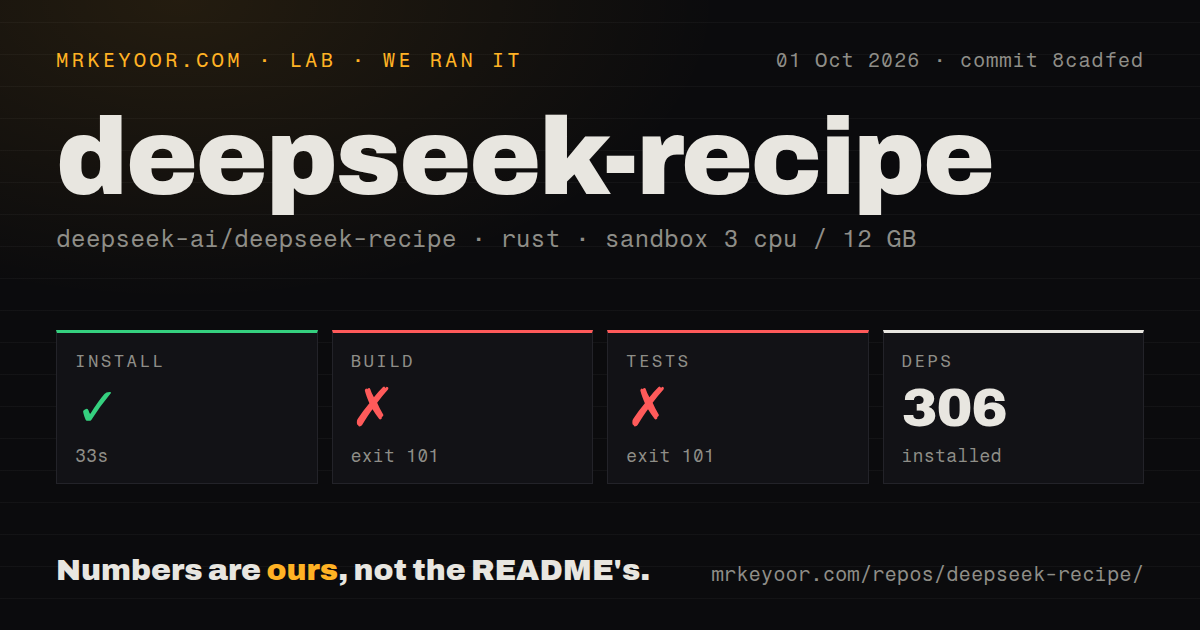
Our sandbox installed commit 8cadfed in 33 seconds and downloaded 306 Rust packages. The 13.5 MB checkout contained 125 files and about 14,690 source lines. We used the supplied Rust lab image in a fresh unprivileged container with 3 CPUs, 12 GB of RAM, and no secrets. The repository had 0 CI workflow files, no Dockerfile, and no tests directory.
The build exited with code 101 after 105 seconds. Its log shows the OpenCV Rust binding trying environment, pkg-config, CMake, and vcpkg discovery. CMake could not find an OpenCV package configuration, vcpkg had no installation tree, and the final error said no installed OpenCV package was found. The log does not show a Rust source error after that point.
Tests also exited with code 101 after 23 seconds at the same OpenCV discovery step. No test cases ran in the supplied summary. The fair conclusion is narrow: commit 8cadfed does not build in a plain Rust container without the native image prerequisites. We cannot turn that into a claim about passing or failing protocol behavior.
OpenCV is a default workspace dependency with an escape route
The development guide asks Debian 12 users to install a compiler, pkg-config, Clang, libclang, and libopencv-dev. It specifies OpenCV 4.x because the pinned Rust binding supports 3.4 and 4.x, not 5.x. Python source builds add Python headers and a virtual environment. This requirement is documented, though it sits behind a development-guide link rather than the shortest Rust example.
Image preprocessing and URL fetching are default features of the image crate. A caller providing its own preprocessor can compile that crate without default features, and the docs give a protocol-only test command that omits the OpenCV-dependent parts. That helps server authors who only need text conversion. It does not make the full workspace, demos, default bindings, or example servers compile in the environment we ran.
Python installation depends on your platform tag
The README offers pip install deepseek-recipe for Python 3.10 or newer. Open issue 1 records a narrower reality for version 0.1.1: wheels exist for Apple Silicon, x86_64 macOS, manylinux x86_64, and manylinux aarch64, but no source archive was published. The issue remained open while pull request 19 proposed publishing a Python source distribution.
A matching wheel can spare users the local Rust and OpenCV build. Windows, musl Linux, and other unmatched platforms have no source fallback from the package index according to that issue's September 19 verification. A Git checkout remains possible, but it returns the user to the native dependency path that stopped our build. Check your deployment image against the actual wheel tags before standardizing on the Python binding.
The example image fetcher is unsafe for an exposed service
Both server guides say the examples have no authentication. They also warn that the default URL fetcher follows redirects without blocking private, loopback, or link-local destinations. An untrusted image URL could therefore reach places an Internet-facing client should not access. Byte limits do not prevent that network path.
Keep the examples on loopback, as documented. A real service needs destination checks on the first request and every redirect, preferably backed by network policy. It also needs request authentication and rate limits before model costs enter the picture. This is one of the project's better documentation choices: it states the risky default instead of dressing a mock server as deployment guidance.
September pull requests matter more than the September 10 push
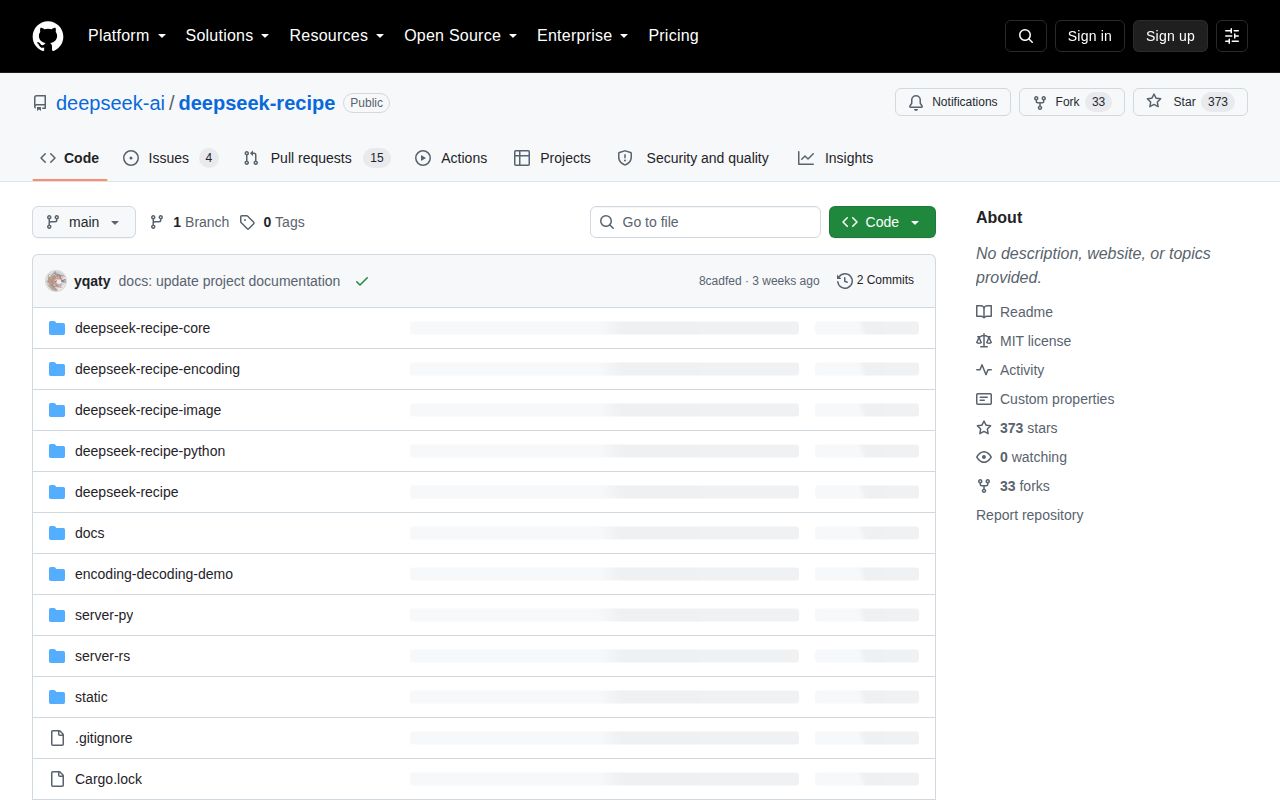
GitHub showed 373 stars, 19 combined issues and pull requests, and a last repository push on September 10, 2026. There was no tagged GitHub release. Pull-request work continued through September 29 on source packaging, streaming, encoding, image handling, and CI, so the push date alone would understate current interest. Several of those changes were still open rather than merged.
DeepSeek Recipe is a promising specialist library for teams already building an inference platform. Its boundary is honest, its docs are unusually specific, and its default source build is not lightweight. Install OpenCV before evaluating the complete workspace, or select the text-only crates on purpose. If you need a server rather than a conversion toolkit, start elsewhere.