mrkeyoor.com_
Tue 06 Oct 15:51 UTC
AI Toolsevaluationupdated 06 Oct 2026

DeepGEMM review

DeepGEMM is a CUDA kernel library for the matrix multiplication, mixture-of-experts, and attention work inside modern language models. It gives engineers optimized FP8, FP4, BF16, and TF32 operations for recent NVIDIA data-center GPUs, with kernels compiled at runtime through DeepJIT.

Verdict

Our DeepGEMM run installed 35 packages and built in 22 seconds combined, but all 24 test modules ended in collection/setup errors before one test ran. Use it if you have SM90 or SM100 hardware and an engineer who can validate its exact layouts against your model. Everyone else should choose the matrix backend already supported by their framework.

We ran it

Lab card: what happened when we ran DeepGEMMScreenshot of DeepGEMM (github.com/deepseek-ai/DeepGEMM)
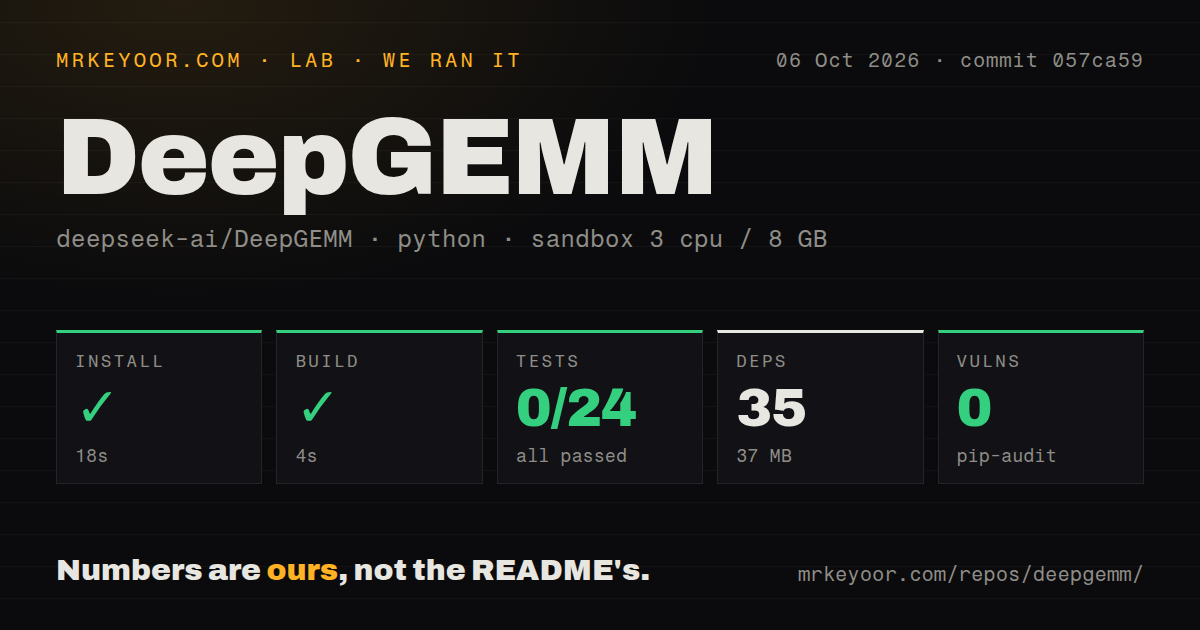
Install✓ · 18s35 packages · 37 MB
Build✓ · 4s
Tests✗ · 4s0 passed · 0 failed · 24 errors of 24 (pytest)
Known vulns0(pip-audit)
Repo6880 files~852,594 lines of source · 142.4 MB · 3 CI workflows · tests dir

Answers from our run

Does DeepGEMM build from source?

Dependencies installed in 18 seconds (35 packages), and the build succeeded in 4 seconds. We cloned commit 057ca59 into a clean Debian container with 3 CPUs and no project-specific setup.

Do DeepGEMM's tests pass?

Yes: 0 of 24 passed when we ran the project's own test command (pytest), with 24 collection errors. Some failures need services or credentials a bare container does not have.

Does DeepGEMM have known vulnerabilities in its dependencies?

pip-audit found none in the dependency tree at the time of our run.

Who should not use DeepGEMM?

CPU, AMD, or older NVIDIA deployments: the README requires an NVIDIA SM90 or SM100 GPU and CUDA Toolkit 12.9 or newer.

What are the alternatives to DeepGEMM?

CUTLASS, Triton. Our DeepGEMM run installed 35 packages and built in 22 seconds combined, but all 24 test modules ended in collection/setup errors before one test ran.

Setup2/5Build passed, but 24 test modules stopped during collection
Docs4/5Requirements, layouts, JIT controls, and kernel families are explicit
Community5/5September 30 push with 69 issues and 80 open pull requests
Maturity3/5Active specialist code with a hardware-bound validation path

Who it’s for

GPU engineers tuning model training or inference on NVIDIA SM90 or SM100 hardware.
Framework teams that need dense or grouped GEMM kernels for mixture-of-experts workloads.
CUDA developers who want readable kernel code and test cases to study alongside CUTLASS.
DeepSeek infrastructure users prepared to manage tensor layouts and runtime compilation.

Who it’s NOT for

CPU, AMD, or older NVIDIA deployments: the README requires an NVIDIA SM90 or SM100 GPU and CUDA Toolkit 12.9 or newer.
Teams seeking a drop-in NumPy-style matrix API: callers must handle input transposition, FP8 casting, scale layouts, and some alignment work themselves.
Developers who need a green generic pytest run in a plain Python container: our run stopped with 24 collection/setup errors before any test passed or failed.
Operators unwilling to own JIT cache and compiler behavior: kernels compile at runtime, and the README documents compiler, cache, PTX, SASS, and build controls.
Small projects that only need standard dense matrix multiplication: CUTLASS or a framework-provided backend may be a less specialized dependency.

Setup reality

Our fresh Debian sandbox installed commit 057ca59 in 18 seconds, adding 35 packages and 37 MB on disk. The build succeeded in 4 seconds. Pytest exited 1 after 4 seconds, with 0 passed, 0 failed, and 24 collection/setup errors across all 24 collected test modules. Pip-audit found 0 known vulnerabilities.

A working GPU path needs an NVIDIA SM90 or SM100 card, CUDA Toolkit 12.9 or newer, Python 3.8+, PyTorch 2.3+, a compiler with C++20 format support, and CUTLASS 4.0+ from the recursive submodule. It does not need an API credential or hosted service.

Installation builds a wheel, but the kernels themselves compile at runtime through DeepJIT. Callers also own input transposition, low-precision casting, architecture-specific scale formats, cache placement, and the layout rules for each kernel family.

DeepGEMM targets recent NVIDIA data-center GPUs

DeepGEMM puts four numeric families, FP8, FP4, BF16, and TF32, behind one CUDA library for dense layers, mixture-of-experts models, and parts of attention. The interfaces include grouped GEMMs and fused Mega MoE operations. Its audience is an engineer who already knows which tensor layout a model produces and wants control over the kernel that consumes it. This is infrastructure below an inference server, not an inference server itself.

The hardware boundary is firm. The README requires an NVIDIA SM90 or SM100 GPU, CUDA Toolkit 12.9 or newer, PyTorch 2.3+, and a compiler whose standard library supports C++20 format. Python 3.8 is the stated minimum. DeepGEMM also expects CUTLASS 4.0 or newer through a Git submodule, so the documented clone is recursive. A laptop GPU, AMD node, or CPU host cannot exercise the intended path.

Callers supply the layouts that the kernels expect

SM90 expects FP32 scale values, while SM100 packs four UE8M0 values into one integer. A dense FP8 call also distinguishes NT, NN, TN, and TT memory layouts, while grouped operations impose rules on which dimensions may vary. The API names reveal how close this code sits to the metal. Those details affect the tensors you prepare before the multiplication begins.

DeepGEMM leaves input transposition and FP8 casting to the caller. It provides utility functions for alignment and scale transformations, but the README warns that those helpers may be slower than folding the work into an earlier kernel. That is a sensible trade for a specialist library. It is also why adopting it means changing a model pipeline, measuring the result on your own shapes, and checking numerical output. Merely replacing a package name will not do the job.

What happened when we ran it

Our sandbox installed commit 057ca59 in 18 seconds, pulling 35 packages and using 37 MB on disk. The build completed in another 4 seconds. The container supplied 3 CPUs, 8 GB of RAM, Python 3.12 on Debian, no credentials, and no elevated privileges. Pip-audit reported 0 known vulnerabilities. These numbers describe repository setup only; we did not measure GPU throughput or kernel accuracy.

Pytest failed after 4 seconds. It reported 0 passed, 0 failed, and 24 collection/setup errors across all 24 test modules it tried to collect. The final lines named six PyCuTe tests under the vendored CUTLASS tree and three DeepJIT tests for Ascend, CUDA, and exceptions, then ended with 24 errors in 1.27s. The supplied log tail does not include the underlying exceptions, so it cannot support a claim about missing drivers, packages, or defects.

The distinction matters because the install and build both passed. A Python environment can accept the package while the broad repository test command still fails before executing one assertion. DeepGEMM has 3 CI workflow files and a tests directory, so testing is present, but our generic fresh-container result was not a usable release gate. A prospective adopter should run the project’s hardware-specific cases on the exact GPU and CUDA combination intended for production.

Runtime compilation moves work into deployment

DeepJIT compiles kernels at runtime with the CUDA 12.9+ toolchain instead of compiling CUDA during package installation. The README exposes controls for the compiler path, C++ standard, cache directory, forced builds, debug output, line information, and PTX or SASS dumps. The default cache lives under the user's home directory, and a cache miss compiles into the first configured cache path.

That design is useful when kernel shapes change, but it gives operators another stateful directory to size and persist. A read-only home, short-lived container, or fleet with mixed CUDA installations needs an explicit cache and compiler policy. Mega MoE raises the bar further: its example uses multiple processes, symmetric memory, NVLink communication, and PyTorch 2.9 or newer for the buffer API. Those requirements belong in capacity planning before any claimed kernel win matters.

Active code does not widen the supported hardware

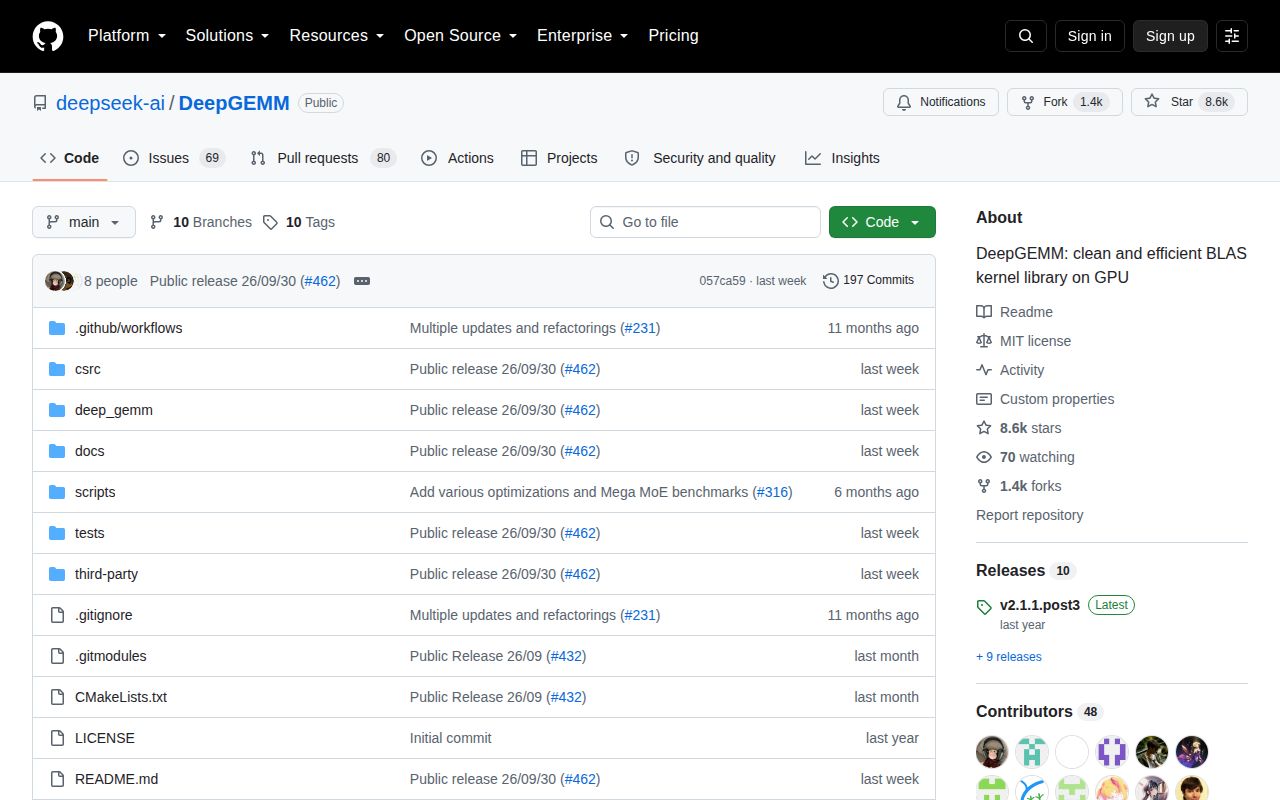
GitHub showed 8,576 stars and 149 open issues and pull requests on October 6, 2026. Search split that combined figure into 69 issues and 80 pull requests. The last push was September 30, the same date the README announced a separate DeepGEMM Ascend project and more locality work. The latest tagged GitHub release was v2.1.1.post3 from October 15, 2025, but the newer push and pull-request activity show that development continued after that tag.

DeepGEMM earns a trial when its exact kernel families match a production model on Hopper or Blackwell-class infrastructure. The 142.4 MB checkout, 6,880 files, and roughly 852,594 source lines in our snapshot also make clear that this is no tiny teaching sample, despite the focused public API. Start with one real tensor shape, compare outputs against the existing framework path, and keep that path available until the JIT cache and hardware-specific tests are repeatable.

Alternatives

ProjectWhat it isPick it when
CUTLASSNVIDIA's CUDA templates and Python DSLs for a wider range of linear-algebra kernels.pick this instead when hardware breadth and a general kernel toolkit matter more than DeepGEMM's focused interfaces.
Triton gh↗A language and compiler for writing custom parallel GPU programs from Python.pick this instead when you want to author and tune your own kernels rather than call a fixed CUDA library.

What people are saying

  1. [github-trending] deepseek-ai/DeepGEMM
  2. [velocity-scout] deepseek-ai/DeepGEMM-Ascend

Sources

  1. DeepGEMM repository and README
  2. DeepGEMM v2.1.1.post3 release
  3. DeepGEMM issues and pull requests

More ai tools reviews

agency-agents-app · guizang-product-video-skill · nimble · localjev · jev-visual · jev-review · the whole board →