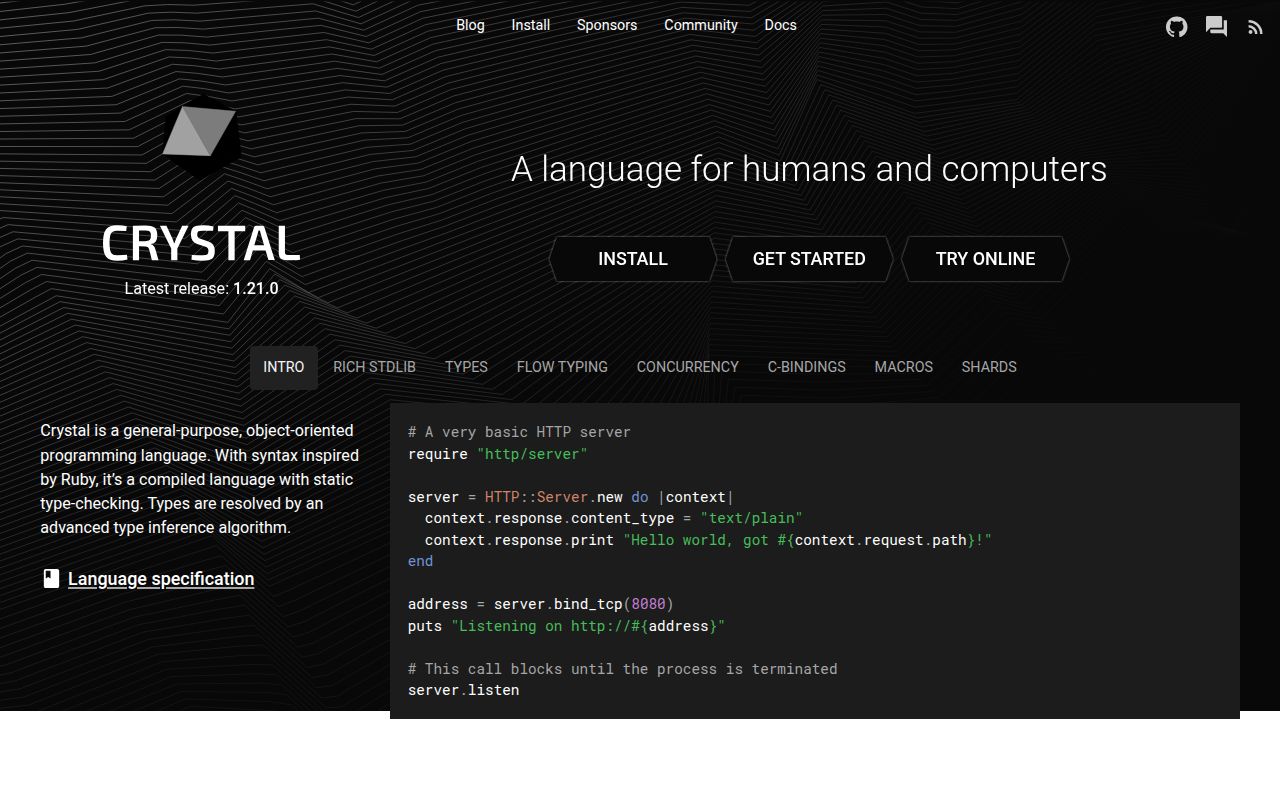
Crystal 1.21.0 is a separate language with Ruby-shaped syntax
Crystal 1.21.0 pairs Ruby-like syntax with inferred static types and native code generated through LLVM. The resemblance stops before compatibility. C bindings let Crystal call existing libraries, while macros generate code during compilation. The release also includes interpreter and REPL work alongside the ahead-of-time compiler. The attraction is a compact, expressive language that catches type mistakes before deployment without requiring a type annotation on every argument.
Existing Ruby applications do not move across unchanged. The README says compatibility is not a goal, which rules out treating Crystal as a different Ruby runtime. Gems, runtime metaprogramming, and code that depends on Ruby's object behavior need replacement or redesign in Crystal terms. That cost can be reasonable for a new service or command-line program. It is much harder to defend when a mature Ruby system already depends on a large web of framework and gem behavior.
Version 1.21.0 includes two documented breaking changes
The July 16, 2026 release introduces execution contexts and disables automatic fallback to legacy PCRE, both under the release's breaking-changes heading. It also adds OpenSSL 4.0 support, synchronous WebSocket receive, UUID version 6 and 8 generators, and more compiler diagnostics. This is active language and standard-library development rather than a maintenance-only stream. Teams should read the release notes before changing compiler versions, especially around concurrency, regular expressions, networking, and C-linked libraries.
Crystal's README promises that language features will not be removed or changed incompatibly within a major version. Release 1.21.0 shows why that promise should not be read as a guarantee that every upgrade is free of application work. Runtime and standard-library changes can still be marked breaking. Pinning the compiler in CI, testing the application against the new release, and checking UPGRADING.md are ordinary maintenance here, even while the core language remains within major version 1.
What happened when we ran it
There was no Crystal lab run on September 16, 2026. Our harness checked commit 59835a3 in an unprivileged sandbox with 3 CPUs and 8 GB of RAM, but it had no supported Crystal ecosystem. The repository also had no Dockerfile that the harness could use as a project-defined environment. We therefore have no measured installation time, dependency footprint, build result, test result, audit result, or runtime figure for this checkout.
That missing result limits the claims we can make. We did not compile a sample, run the repository specs, compare binary size, or measure startup and request speed. The official project supplies packages and Linux Docker images outside the repository's own Dockerfile, so our pipeline limitation does not mean Crystal is impossible to install. It means this review cannot use a green lab run as evidence for setup ease or performance. Try the current compiler on your own target before choosing it.
Compiler work starts with an existing Crystal compiler and LLVM
The Crystal compiler is written in Crystal, and its documented build needs an installed compiler, LLVM, and other system libraries. make crystal produces the compiler under .build/compiler, while the bin/crystal wrapper points it at the checked-out standard library. Separate make targets cover compiler specs, standard-library specs, and primitive specs. This is a credible contributor path, but it asks for more system preparation than building an application from a release package.
Application setup is friendlier. The official page lists DEB and RPM packages, Linux tarballs, Homebrew, universal macOS archives, FreeBSD and OpenBSD packages, and Windows installers for 1.21.0. Windows remains labeled preview and not yet complete. Shards uses shard.yml and shard.lock for application dependencies. Teams should pin the compiler and shard graph together, because compiler, standard-library, native-library, and package changes can all affect one build.
A September 16 push and issue update show current maintenance
The repository was pushed on September 16, 2026, and issue 17408 was updated the same day. GitHub listed 20,410 stars, 1,730 open issues, and 309 open pull requests when fetched. That is a large queue, not a count of unresolved bugs. It spans language proposals, support questions, compiler work, and old discussions. The same-day code and issue activity, plus release 1.21.0 from July, provide stronger health evidence than the queue size alone.
Toolchain edges still deserve attention on master. Issue 17376 reports a code-generation regression with LLVM versions below 15, even though the report says support technically reaches version 8. Issue 17413 records release-mode programs aborting when a development compiler was linked against LLVM 23.1.1, which the reporter notes is unsupported. These issues sit on opposite ends of the LLVM range. A production team should use the project's supported versions instead of assuming any locally available LLVM will work.
Native code and C interop make the strongest greenfield case
Crystal 1.21.0 compiles through LLVM and can call C libraries through bindings. That makes it worth a trial when the application is new and the team likes Ruby's surface syntax. Static inference keeps most type declarations out of ordinary methods, while the compiler can still reject incompatible paths. Macros are available for repetitive framework code. None of that proves better performance on your workload, because our lab did not run it. The language design still needs local measurement.
Go is the safer comparison for teams that prize a conventional server toolchain and simple onboarding. Nim is closer when native compilation and heavy metaprogramming drive the choice. Ruby remains the right answer when existing gems and dynamic behavior are part of the product rather than historical baggage. Crystal sits between those choices with a clear personality, active 1.21.0 development, and a real bootstrap cost. Use it for a greenfield component before betting an existing Ruby estate on a rewrite.