Short answer: try a small rebuild before replacing your agent workflow
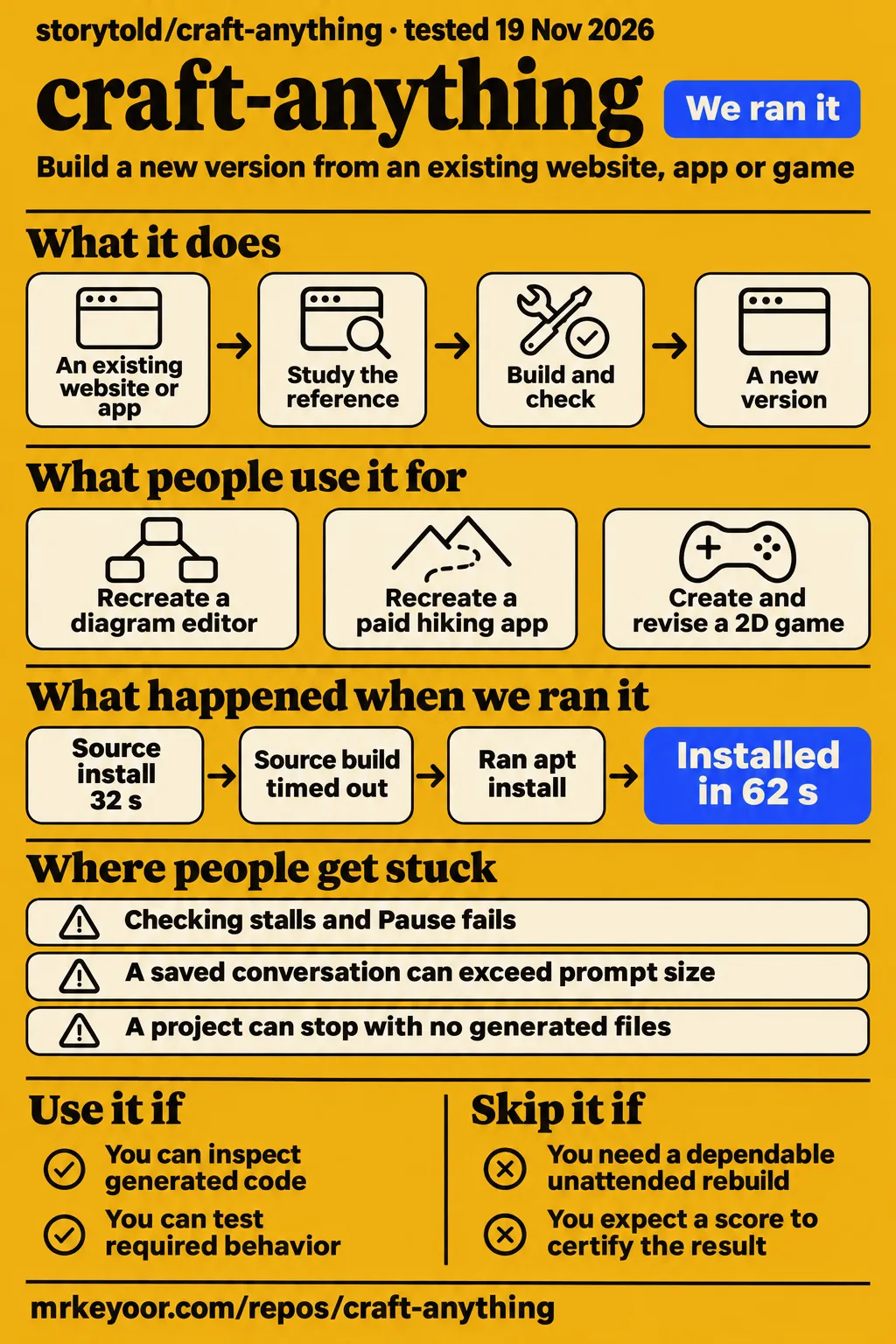
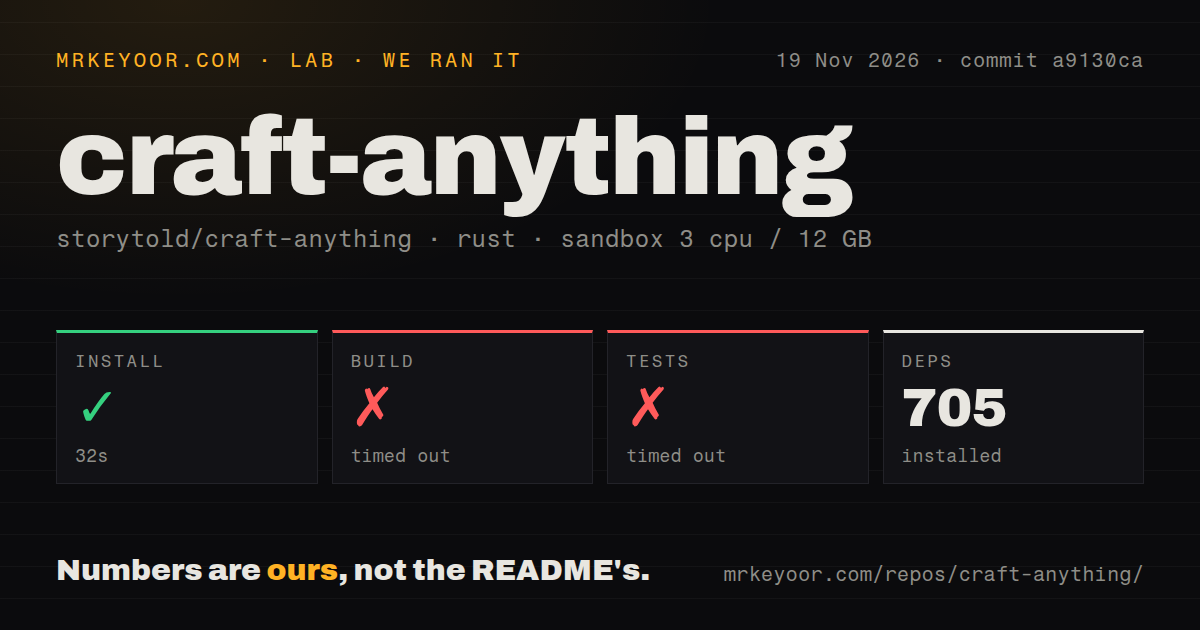
Our sandbox installed the dependencies in 32 seconds, but the build and tests each hit a 900-second timeout. Use craft-anything if you want to experiment with a reference-driven prototype and can inspect the generated code and behavior. Skip it if your next job needs a dependable unattended rebuild or you expect a likeness score to certify the result.
The strongest comparison in the research is GitTested's draw.io recreation: craft-anything and Claude Code alone both handled the same everyday actions. Craft-anything's output looked closer, at a higher reported time and token cost. That makes the added inspection loop worth a small comparison on your own target, rather than an automatic replacement for an agent you already know. GitTested's comparison.
Launch attention is easier to count than dependable replicas
ArtCraft's launch post had 142,517 views in the supplied X snapshot, a measure of attention rather than working deployments. Launch record.
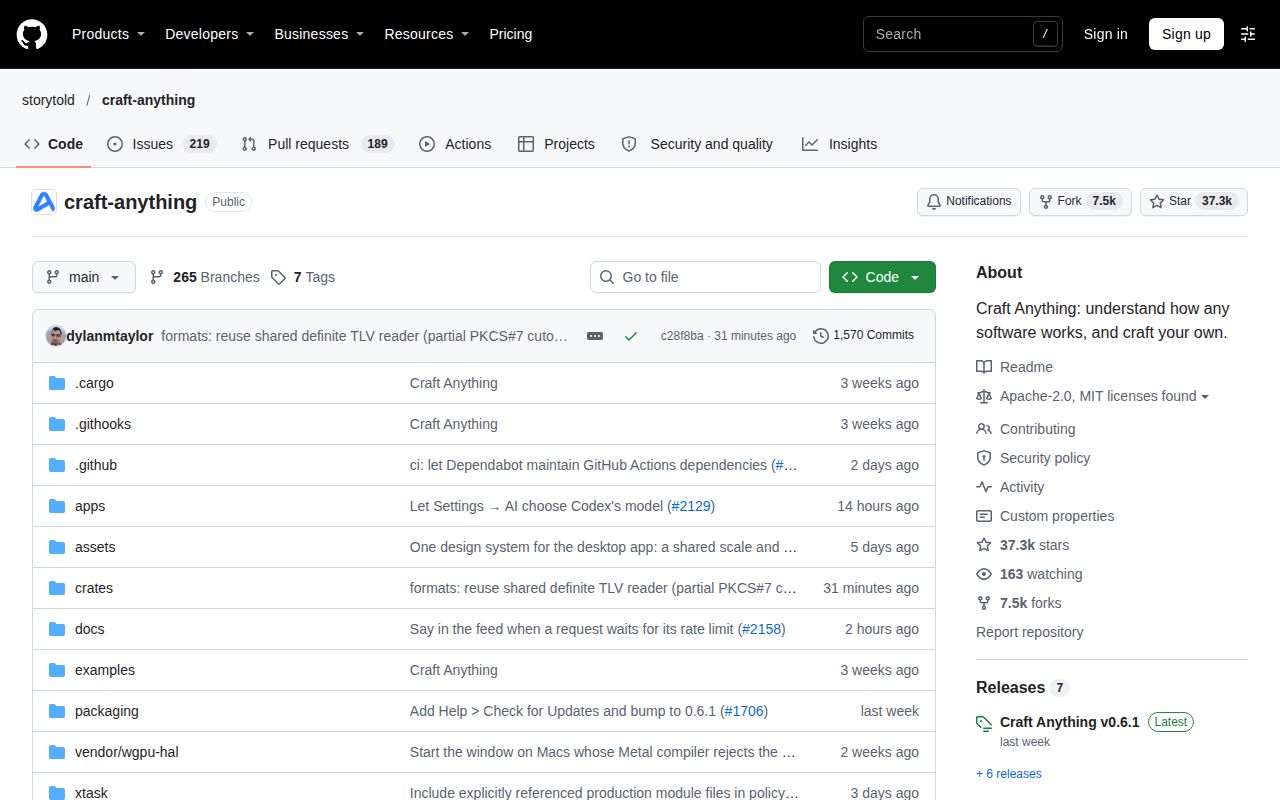
The public GitHub API recorded a push on November 19, 2026, while the latest-release endpoint returned v0.6.1, published November 12. Read those dates alongside the sampled issue activity: #1867 contains a confirmed configuration workaround, and #1434 distinguishes a merged improvement from a remaining model-selection problem. That is evidence of ongoing work, with open recovery questions. A release tag alone would tell you less. Repository facts, latest release, #1867, #1434.
What people use craft-anything for
Reported successes include a diagram editor, a personal hiking app and a small game that remained playable even when its checking stage stalled.
| Who used it | What they attempted | What came out |
|---|---|---|
| GitTested, on Ubuntu at commit 1f8508a104134c436cbba5ea2f675619ef47702f, November 7, 2026 | Recreate draw.io in Clean room mode and compare with Claude Code alone | Both produced simpler editors that completed 20 everyday actions. Craft-anything looked closer. Their report. |
| sixteenpoundblanket on r/hermesagent | Ask Hermes to install craft-anything as a skill, then recreate a paid hiking app for web and Android | The poster reported basic working versions with nearly identical appearance, followed by personal changes. This is the poster's account of a subset, not a replacement-product audit. Their post. |
| marconm59, reporting through the issue tracker on Windows 11 | Create and revise a small 2D game | Requested changes appeared and the game was playable after reopening, despite a checking hang and failed Pause. Issue #981. |
| The creator of “I Tested 'Craft Anything' and It Did Something Weird” | Recreate the Chrome dinosaur runner and 2048 | The creator reported working runner behavior and 2048 controls, combinations and scoring. The runner initially used a robot, and its perfect comparison covered the home screen. Video transcript. |
The hiking-app post is appealing because the user wanted changes the commercial original did not offer. The poster reported about 12 minutes and $0.62 of direct DeepSeek Flash usage for the basic versions. Those figures describe that person's attempt. Maintaining your own application is a separate commitment, and another commenter in the same thread preferred continuing to pay for software. Reddit discussion.
A contrasting attempt appears in #1169: noveltomatillo8 asked for a Sega Genesis game's level editor, tried Unity and Godot, and ended with an empty app directory. Target choice and the selected builder matter more than the word “anything” in the name. Issue #1169.
What happened when we ran it
Our source run installed dependencies in 32 seconds and recorded 705 dependencies; the build and tests each timed out at 900 seconds.
The November 19, 2026 sandbox used commit a9130ca, 3 CPUs, 12 GB of RAM and image label lab-rust:1. That label identifies the configured image, not the actual Rust or operating-system version.
| Repository check | Our result | What it tells you |
|---|---|---|
| Install | Succeeded in 32 seconds; 705 dependencies recorded | The recorded dependency step completed. |
| Build | Timed out at 900 seconds | This run produced no completed build result. |
| Tests | Timed out at 900 seconds | This run produced no completed test-suite result. |
| Checkout | 1,098 files, approximately 292,561 source lines, 21.7 MB | This is a substantial source tree to work in. |
| Repository signals | Six CI workflow files, no Dockerfile and no tests directory detected | These are scan findings, not a verdict on embedded tests or CI outcomes. |
The test log ended with compilation messages, including ctrlc, time, rcgen, craft-anything v0.6.1, syn, xtask v0.6.1 and craft-anything-web v0.6.1. It shows compilation still appearing at the tail, without an assertion failure or completed test summary. The timeout is a finding about this run. It supplies no diagnosis of missing system packages, insufficient RAM or a broken application.
A separate hands-on record in the research pack stopped before exercising Craft Anything. Its quickstart-cli recipe treated the prerequisite package build-essential as the project to locate. The identity step explicitly said that identification was unverified; the find-binary step then failed because no executable was found for build-essential. The finding also records that it put no executable on PATH.
That recipe tested the wrong thing. The README names craft-anything-cli as the command, while build-essential appears among Linux prerequisites. The hands-on run's Debian container configuration belongs to that separate attempt, not the source harness above. Teardown completed. upstream README.
Where people get stuck: checking, credentials and saved sessions
The sampled issues distinguish a generated project that works from an orchestration stage that never finishes.
| Symptom and attributed report | What the thread supports | Recovery or status |
|---|---|---|
| Checking stalls and Pause fails, reported by marconm59 in #981 | The reporter could reopen and play the revised game. A later reporter still hung at app-screenshot on 0.6.0. | #1287 added check deadlines and progress labels. The thread stays open. |
| A stopped checking process holds up the run, discussed by a maintainer in #1438 | The maintainer identified an unlimited wait after stopping a program as a likely cause. | #1454 bounded that wait on main. The extract does not show all reported freezes resolved. |
| app/ stays empty, reported by noveltomatillo8 in #1169 | The maintainer says the stop follows two builder turns without changes to app/. | Supply the exact model ID, builder feed and tool-call errors. The thread leaves the cause open. |
| An obsolete OpenAI key is used, reported in #1358 | The maintainer says a saved key takes precedence over the environment variable. | Replace or remove the saved key. The reporter instead succeeded using a different provider entry. |
| Codex refuses build_command_run although setup is current, reported in #1867 | Noninteractive approval and the existing TOML tools table mattered. | Two commenters confirmed the inline-table change described below. |
| Claude Code immediately returns “Prompt is too long,” reported in #2042 | Reconnecting did not help; the oversized saved conversation was reused. | Switching to Kimi through an API worked for the reporter. Automatic conversation renewal was identified as a needed fix. |
Codex: change the existing table, not a second section
The #1867 reporter followed the app's setup advice and got already_current, yet command refusals continued. A suggested standalone TOML section then failed with “cannot extend value of type inline table with a dotted key.” The maintainer corrected the advice: add build_command_run inside the existing tools = { ... } braces under the Craft Anything MCP server entry. This approves a command-running tool, so make that decision for a project you trust. Issue #1867.
tools = { rebuild_start = { approval_mode = "approve" }, build_command_run = { approval_mode = "approve" } }
Preserve any other existing tool entries. wtigero reported reaching Ready through the desktop UI after changing the Workbench copy's configuration and approving the first project prompt. Access-Abraxas also confirmed that editing the inline table worked. This is useful evidence of a specific working Codex route. It is no promise that every Codex configuration behaves alike. Confirmed workaround.
Claude Code: reconnecting does not clear an oversized conversation
In #2042, the reporter could continue with Kimi through an API but returned to the same error with Claude Code. The maintainer described the saved conversation as the problem and said the app should renew it automatically. A subsequent attempt to set agent_session to null produced a command containing --resume null. Treating that edit as a recovery recipe would contradict the log. Keep the project files and error record when reporting this failure. Issue #2042.
An older Windows startup workaround had a confirmed outcome
Straconis reported that version 0.2.0 failed before showing a window with an Intel HD Graphics 620 driver. The final update confirmed that setting WGPU_BACKEND to dx12, signing out and back in, then relaunching produced a visible window. An earlier temporary-environment attempt was inconclusive. The maintainer described #198 as avoiding OpenGL startup on Windows, but the supplied extract gives no released-version boundary for that change. Issue #196.
Local models can change the workload before a rebuild starts
Adding a server by address selected an unwanted model in #1434, triggering a download and unloading the model the user intended to use.
The reporter's FastFlowLM server exposed a catalogue of downloadable models through /v1/models. Craft Anything picked its first chat-capable entry rather than the already loaded model. The thread describes an unwanted 5.5 GB download. #1435 merged a preference for loaded models from /api/ps, but the discussion keeps the issue open for servers without that endpoint or with nothing loaded. Name the model explicitly and inspect the saved choice before starting work. Issue #1434.
Long context also needs attention. In #1820, the maintainer explained that 0.6.1 gives local or network models a fixed 24,000-token conversation budget. Server context-window discovery merged after 0.6.1. A manual context_tokens setting drew conflicting reports: one Windows user still saw the smaller budget on Continue, while a Linux reproduction honored the setting. A server's advertised large context alone does not settle the application's effective budget. Issue #1820.
Reasoning controls differ by backend too. In #1813, a later response corrected the initial advice: the API effort control appeared for Claude API and Claude Code, not the reporter's OpenAI-compatible backend. A model name ending in :max says nothing by itself about the server's interpretation. The same thread explains that messages within a project intentionally continue that project; start another project for an independent task. Issue #1813.
Clean room leaves the coding agent's permissions in your hands
The upstream README explicitly says Clean room is not an operating-system sandbox.
Clean room limits the evidence Craft Anything offers its builder: visible pages, screenshots and measurements rather than source files. Deep mode permits internal inspection. The agent still acts with its own permissions on your computer. Letting it run arbitrary commands can permit reads that the reference-study rules would refuse. The README's distinction is a reason to use a separate project folder and review command permissions before introducing valuable local files. Upstream mode and permission notes.
The README also warns that generated projects' dependency installation can execute package code. “Always allow” for a command family broadens later permissions. Use software you own or are permitted to examine, and keep permission to reuse names, images and text separate from permission to inspect behavior. Those are upstream responsible-use instructions, not a legal clearance supplied by Clean room. Upstream README.
craft-anything vs Claude Code, REA, open-lovable and v0
GitTested's matched draw.io attempt found the same 20 working actions with craft-anything and Claude Code alone, with closer appearance at a higher time and token cost for craft-anything.
| Choice | Evidence behind the choice | Pick it when |
|---|---|---|
| Claude Code alone | GitTested reported 9 minutes and 62,000 Claude tokens, versus 11.5 minutes and 64,000 with craft-anything. Both handled 20 actions. | You already know the agent and want to see whether direct prompting covers the target. Comparison. |
| Craft Anything | The same report found 5.8% differing pixels versus 7.7% for Claude Code alone. | Reference study and visual refinement matter enough to justify another tool. Comparison. |
| REA | Reddit commenters frame REA around investigation and craft-anything around producing a reimplementation. | Understanding internals is the main job. This is the commenters' workflow distinction. Discussion. |
| open-lovable | Its README requires Firecrawl, a chosen AI provider and a Vercel or E2B sandbox route. | You want its React-app workflow and accept those service requirements. Primary README. |
| Vercel v0 | GitTested describes a hosted screenshot-to-interface route. | You prefer a hosted starting point for a web interface. Reported alternative. |
The draw.io results describe one target, not a ranking across software categories. They are also a better buying signal than a generic claim that another agent layer must improve the output. Ask craft-anything and your current agent to recreate the same small workflow, then compare the behavior you care about.
Ready and a high likeness score are prompts to inspect the result. GitTested found a rebuild rated 98% alike with the shape panel hidden until View → Shapes was selected. The official troubleshooting page adds a more basic check: open the captured reference. A 403 page, login screen or wrong state makes the score about that image. Draw.io finding, reference troubleshooting.
What the other reviews get wrong
ReviewRamble's categorical statement that only Claude Code has been verified live as a builder is too broad for the collected evidence.
The andrew.ooo review records DeepSeek Harness runs, and #1867 contains a user-confirmed Codex route to Ready. That corrects “only Claude Code” without claiming equal reliability for all builders. ReviewRamble is right to call the project early alpha. ReviewRamble, andrew.ooo, Codex outcome.
Kristopher Dunham's November 2 Medium article says the safe default mode had no live build. GitTested subsequently reports a November 7 Clean room draw.io run. Read the earlier statement as dated coverage. The andrew.ooo review's assurance about Claude Code approval keeping the agent out of original folders also needs the README's permission caveat: Clean room does not isolate the machine. Medium article, later test, permission boundary.
Other stale claims appear outside reviews. The older SatriaBagusNurhadianto fork README says the first public release is forthcoming; upstream says public installers have shipped and remain alpha. silvanrec's Spanish-language X promotion says the user approves every step, while the setup guide describes autonomous choices and andrew.ooo describes Auto mode as enabled by default with exceptions. Approval depends on the rules. Older fork, upstream, X promotion, setup guide.
A video also presents app recreation as completely free. The code is free; the builder uses your coding-agent account, paid API usage or local compute. Generated assets can require an optional fal.ai key. The recorded Claude token usage is a concrete reason to distinguish free software from a free task. Video claim, upstream requirements, usage comparison.
Questions people ask
Craft Anything is aimed at producing a reimplementation; the sampled Reddit discussion frames REA around investigating how the original works. Workflow discussion.
What is the difference between craft-anything and REA, and which should I use?
The Reddit discussion distinguishes REA's investigation focus from craft-anything's reimplementation workflow. Choose by the work you need to do: investigate internals or produce and compare a new implementation. That distinction comes from commenters, including one who explicitly said they had not used REA. Discussion.
Can craft-anything really recreate any software?
No universal result follows from these reports: the pack includes functioning small recreations and a level-editor attempt that left app/ empty. Its name is broader than the demonstrated outcomes. Working examples, empty project.
How good is the generated copy, and how easy is it to obtain?
In GitTested's draw.io comparison, both routes produced simpler working editors, and craft-anything looked closer. Its own high likeness score still missed a hidden shape panel. Expect to inspect the reference, open the result and exercise required actions. Reported comparison.
Can craft-anything reproduce game rules correctly?
The creator of “I Tested 'Craft Anything' and It Did Something Weird” reported functioning 2048 arrow controls, tile combinations, scoring and a saved best score. The same creator said the runner's perfect comparison covered the home screen rather than gameplay. Judge rules by playing the result. Video transcript.
What does craft-anything do, and how does its underlying workflow work?
The documented sequence is Study, Build, Check and Ready. Clean room uses visible evidence; Deep permits inspection of code and files. The desktop app, CLI and MCP tools expose the engine to different workflows. Upstream README.
Why does craft-anything freeze while checking its work, and why does Pause stop responding?
The #981 discussion explains that a blocking check could prevent Pause from being handled between tool calls. #1287 added limits and labels; #1438 later describes a bounded wait for stopped processes. The threads still contain unresolved reports, so record the named check and activity log rather than attributing every freeze to the AI provider. #981, #1438.
Is app-screenshot hanging for the same reason as the other verification freezes?
The supplied threads do not settle a common cause. Reports name app-screenshot, and #1438 includes a later account of a hang after successful process exit. A shared stage label is insufficient to collapse those reports into one diagnosed defect. #981, #1438.
Could a Claude Code skill cause the plan to finish while the run remains stuck?
A #1438 commenter asked whether the “superpower” skill was involved. The extract contains the question, not a demonstrated causal link. Keep the skill name with the reproduction details rather than removing skills on that evidence alone. Issue #1438.
What we have not tested yet
Our source harness stopped at build and test timeouts, and the separate hands-on recipe never reached the Craft Anything executable. We have not tested a working desktop session, a complete reference-to-Ready run, generated-project behavior, resource use during recreation or current installers. The configured image does not establish actual toolchain or operating-system versions; those require raw logs.
We did not reproduce the reported draw.io, hiking-app or game outcomes, the Codex workaround, Windows graphics recovery or saved-session failure. The video record does not supply a complete game-rule audit. No matched v0 or REA result here supports a speed, cost or quality ranking. We have no production adoption, maintenance-cost, sustained-load or security-audit measurement. Open issue extracts and changes on main cannot confirm what every released installer fixes.
For a first attempt, choose a small reference you are allowed to examine and write down the actions that must work before pressing Start. Include saving and reopening if those matter. Keep the captured reference beside your acceptance list when the app says Ready.