CowAgent combines 10+ tools with 12 chat channels
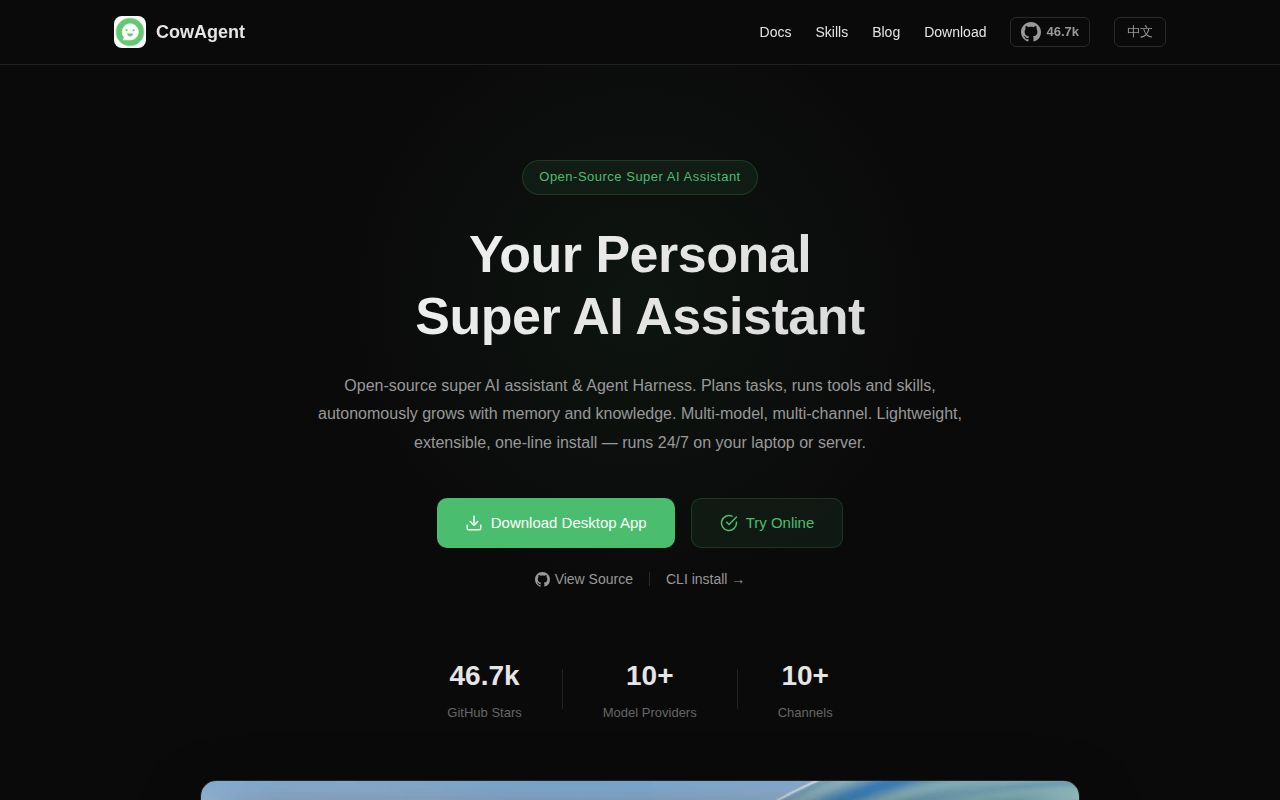
CowAgent puts file access, shell commands, browser control, scheduling, memory retrieval, web search, and other tools behind one agent core. Its README lists 10+ built-in tools and 12 chat surfaces alongside the web console, including Telegram, Slack, Discord, WeChat, Feishu, DingTalk, WeCom, and QQ variants. MCP servers can be added through one configuration file, while skills package several tool calls into reusable jobs. This is closer to an always-on personal operator than a chat page with a few plugins.
Release 2.1.7 makes that scope easier to manage by adding multiple workspaces and a separate model and permission mode for each session. Memory, installed skills, and the knowledge base remain shared system resources, while generated files can stay inside the selected project workspace. That is a sensible split for someone running coding, research, and messaging tasks side by side. It also means CowAgent holds durable state that deserves backups and access rules, especially when the same instance runs 24/7.
CowAgent can route 6 kinds of model work separately: chat, vision, image generation, speech recognition, speech synthesis, and embeddings. The provider table covers hosted vendors and custom endpoints, and the web console handles selection without requiring manual edits for each switch. This flexibility is useful when one vendor has the best chat model and another handles speech. It also multiplies the credentials, billing accounts, and failure modes an operator must track. A single-provider setup is the sensible first test.
What happened when we ran it
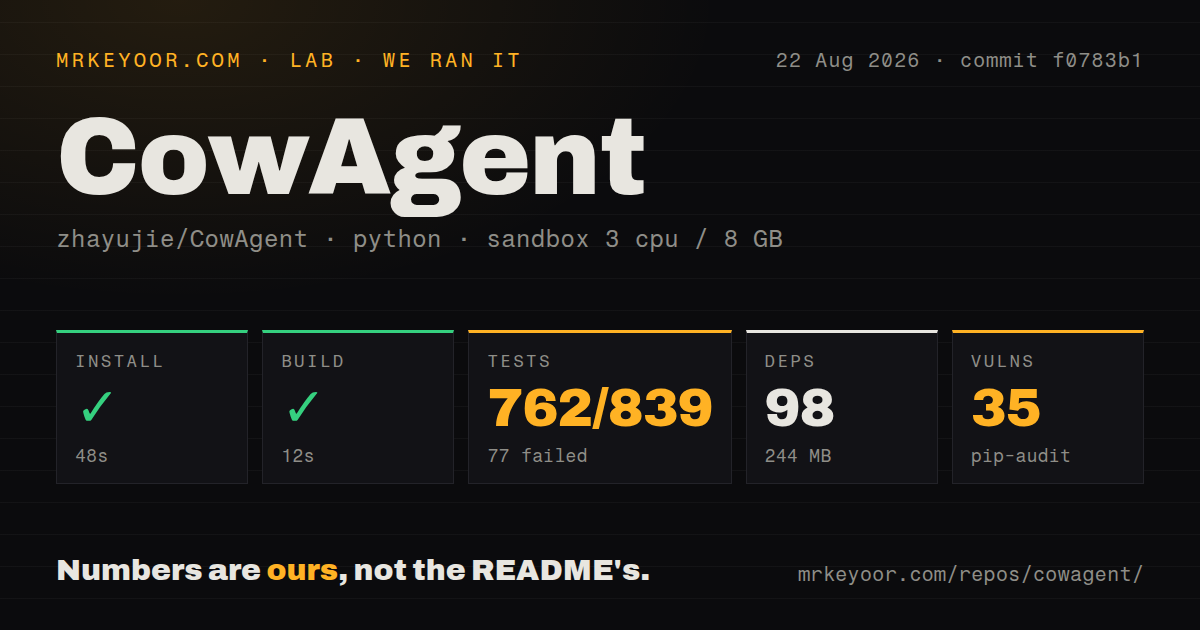
Our run cloned commit f0783b1 into an unprivileged Debian container with 3 CPUs, 8 GB of RAM, Python 3.12, and no secrets. The repository contained 860 files and about 134,621 lines of source in an 8.3 MB checkout. Installation succeeded in 48 seconds, added 98 packages, and occupied 244 MB on disk. The build also succeeded, taking 12 seconds. Those results make the README's quick start credible at the packaging level.
The test result changed the buying decision. Pytest exited with failure after 284 seconds: 762 tests passed, 77 failed, and 4 were skipped. The log tail shows subagent tests receiving _FakeParent objects without project_dir, expected conclusions never appearing, and a reporting-trouble case returning error where the test expected success. That is all the tail establishes, so we are not assigning a cause. Pip-audit also reported 35 known vulnerabilities in the installed environment.
Version 2.1.7 adds three permission modes for a reason
CowAgent sessions can run read-only, workspace-write, or full-access. That choice matters because the same agent can read files, execute bash, control a browser, send messages, and call MCP tools. An open issue, number 2998, reports that a Feishu group request caused local documents to be sent into the group. Follow-up work describes sender checks, workspace confinement, denials for unknown tools, and confirmation for irreversible commands; the current release also exposes the three session modes.
Treat those controls as the start of a deployment policy. A model-provider key gives CowAgent reasoning, while every connected chat or external service creates another identity and credential boundary. On a server, the README tells operators to expose the console by setting web_host to 0.0.0.0, protect it with web_password, and open port 9899. Put the service behind your own network controls, begin with read-only sessions, and test group-message identity handling before adding private files.
Extensions widen that boundary again. CowAgent accepts skills from its Skill Hub, GitHub, ClawHub, and URLs, while mcp.json can start external servers over stdio or SSE. That is 4 broad acquisition paths for code or tool definitions that may eventually reach local resources. Review the source and requested capabilities before installation, pin what you can, and grant workspace-write only to sessions that need it. Convenience is high here because the console can install skills in one click; the trust decision still belongs to the operator.
The project was pushed four days after release 2.1.7
The latest release was published on August 21, 2026, and the repository was pushed again on August 25. GitHub showed 46,674 stars and 39 open issues and pull requests when we fetched it, while the repository includes 8 CI workflow files, a Dockerfile, and a dedicated tests directory. That combination shows active development and serious engineering investment. It does not cancel our failed test run, but it gives maintainers a live codebase in which to address failures.
Choose CowAgent only if its breadth replaces real integration work
The 35 vulnerability findings and 77 failed tests make unrestricted deployment a poor first move. CowAgent still earns a trial for a technical user who needs one agent to carry memory across 12 channels, run scheduled tasks, switch model providers, and install skills or MCP servers from a central console. Start in a disposable workspace with one low-risk channel and one provider key. A team that mainly needs private model chat should choose Open WebUI, while nanobot is the better comparison when code size and inspectability matter more than CowAgent's larger product surface.