The SDK packages Copilot CLI as an agent runtime
Copilot SDK is not a collection of direct model API wrappers. Each language client talks JSON-RPC to Copilot CLI running in server mode. The CLI owns the agent loop, planning, tool invocation, file edits, and model access, while the SDK manages sessions and exposes application hooks. That design gives an embedded product behavior close to GitHub's command-line agent without requiring every team to rebuild orchestration.
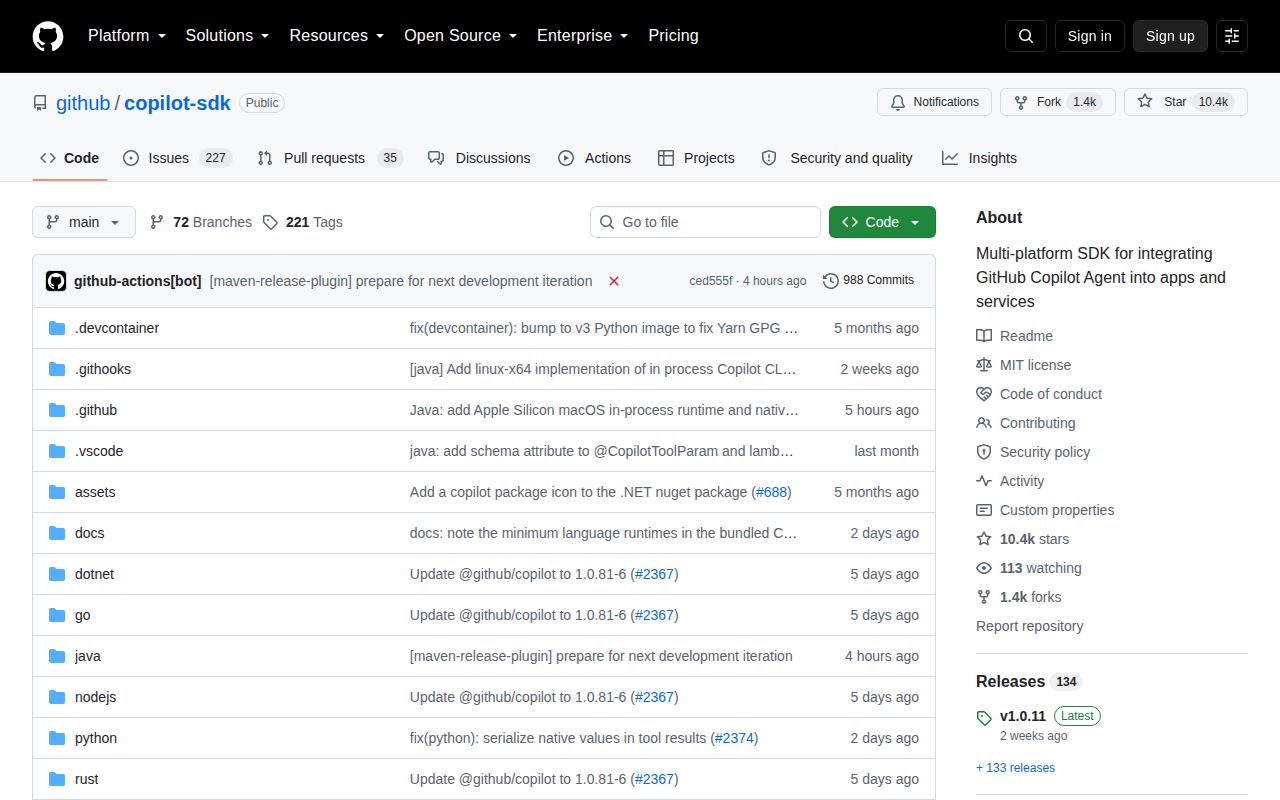
Official SDKs cover Node.js and TypeScript, Python, Go, .NET, Java, and Rust. GitHub reported 10,437 stars and 262 open issues and pull requests combined. The repository contains 3,019 files and about 583,188 source lines across those implementations. That breadth is useful for companies with several application stacks, but it also creates a compatibility job: common concepts must behave consistently through 6 language APIs and one moving CLI protocol.
Bundled CLI support differs by language
Node.js, Python, and .NET packages bundle Copilot CLI, so the SDK can start its managed server without a separate installation. Go, Java, and Rust do not bundle it by default. Their applications need copilot available on PATH or must use the available bundling mechanisms. An external server option separates the application from the CLI process, which can help centralized deployment but adds another endpoint to secure and monitor.
The latest release was v1.0.11, published on 2026-08-14. The README calls the SDK generally available and says it follows semantic versioning. That is a stronger stability statement than an experimental agent library usually offers. Still, recent pull requests cover model discovery, managed server launching through the Rust wrapper, .NET callback lifetime, MCP policy, and session shutdown behavior. Pin both SDK and CLI versions, then test upgrades together.
Authentication offers choice with real constraints
Standard use authenticates a signed-in GitHub user or accepts a GitHub token from an OAuth app or environment variable. It requires a Copilot subscription, with prompts counted against the same usage allowance as Copilot CLI. BYOK allows supported OpenAI, Microsoft Foundry, or Anthropic keys without GitHub authentication. The README explicitly says BYOK does not support Microsoft Entra ID, managed identities, or third-party identity providers.
That limitation matters in enterprise clouds where workload identity is preferred over long-lived secrets. A service may be able to use Copilot through a user token but fail an internal requirement against stored provider keys. Decide the identity model before building agent features. Six SDKs do not mean 6 independent backends: authentication, models, and agent behavior still converge on the Copilot CLI runtime and its supported provider routes.
Tool permissions decide whether embedding is safe
The SDK exposes first-party Copilot CLI tools by default in a configuration the README compares with --allow-all. Each SDK has a permission handler that can approve, deny, or customize tool calls. That handler is not optional security polish. An embedded agent may see repository files, invoke shells, edit content, or call custom tools with access to company systems. The host application must enforce the user's authority at every boundary.
Recent work includes a sandbox configuration and a Rust API for sandbox bypass, which shows the project is still refining this layer. Start with denied execution, allow narrow tools by name, restrict filesystem roots, and separate read from write operations. A model request that looks harmless can trigger several tool calls. Log approvals and outcomes without recording secrets, and test rejected calls as carefully as successful ones.
What happened when we ran it
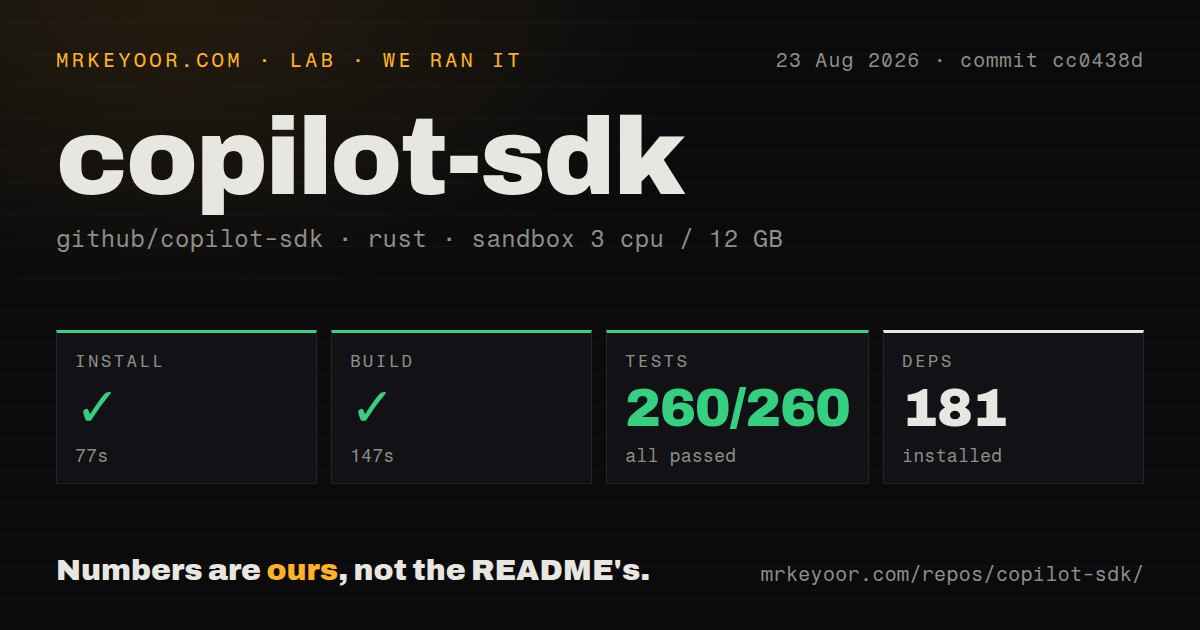
Our sandbox entered the Rust SDK under ./rust/ and installed 181 packages in 77 seconds. The build succeeded in 147 seconds. Cargo then ran 260 tests in 187 seconds, and all 260 passed. The unprivileged container had 3 CPUs and 12 GB of RAM and used commit cc0438d. Among these 7 reviewed projects, that is the clearest measured test result.
The repository also has 34 CI workflow files and a tests directory. Our result applies to the Rust project selected by the harness, not every Node.js, Python, Go, .NET, and Java package in the monorepo. It also did not make an authenticated model call, exercise a paid Copilot allowance, or run an agent against real files. Passing 260 Rust tests supports confidence in that binding's code; production safety still depends on CLI integration and permission policy.
MCP and custom tools prevent a closed stack
Applications can add custom tools, custom agents, skills, hooks, and MCP servers. That gives product teams a path to connect internal APIs without forking the runtime. MCP support also lets an existing tool server work across clients that understand the protocol. The application remains responsible for credentials and tenant isolation because the agent can only be as constrained as the tools it receives.
The project has 1 shared runtime but many extension points, so governance should happen above individual prompts. Maintain a tool registry, document data access, cap arguments, and require confirmation for consequential writes. Recent work on exposing MCP server instruction policy in Node.js is relevant because a connected server can provide instructions as well as functions. Treat those instructions as untrusted input from the server boundary.
Choose runtime consistency over minimal architecture
Copilot SDK is compelling when a company already trusts Copilot CLI and wants that same agent inside several applications. The multi-language surface, GA status, MIT license, current release cadence, and our 260-test Rust run are concrete advantages. The process boundary also keeps agent logic centralized instead of duplicating it in each binding.
A smaller application that needs one model call and 2 explicit functions may be better served by a direct provider SDK. Copilot SDK earns its extra CLI process when sessions, planning, file work, MCP, and custom agents are core requirements. Before release, prove authentication renewal, process recovery, tool denial, sandbox isolation, and version compatibility. The agent loop is already built; responsibility for what it can touch stays with you.