Claude Code gets plugins; Gemini installs the whole collection
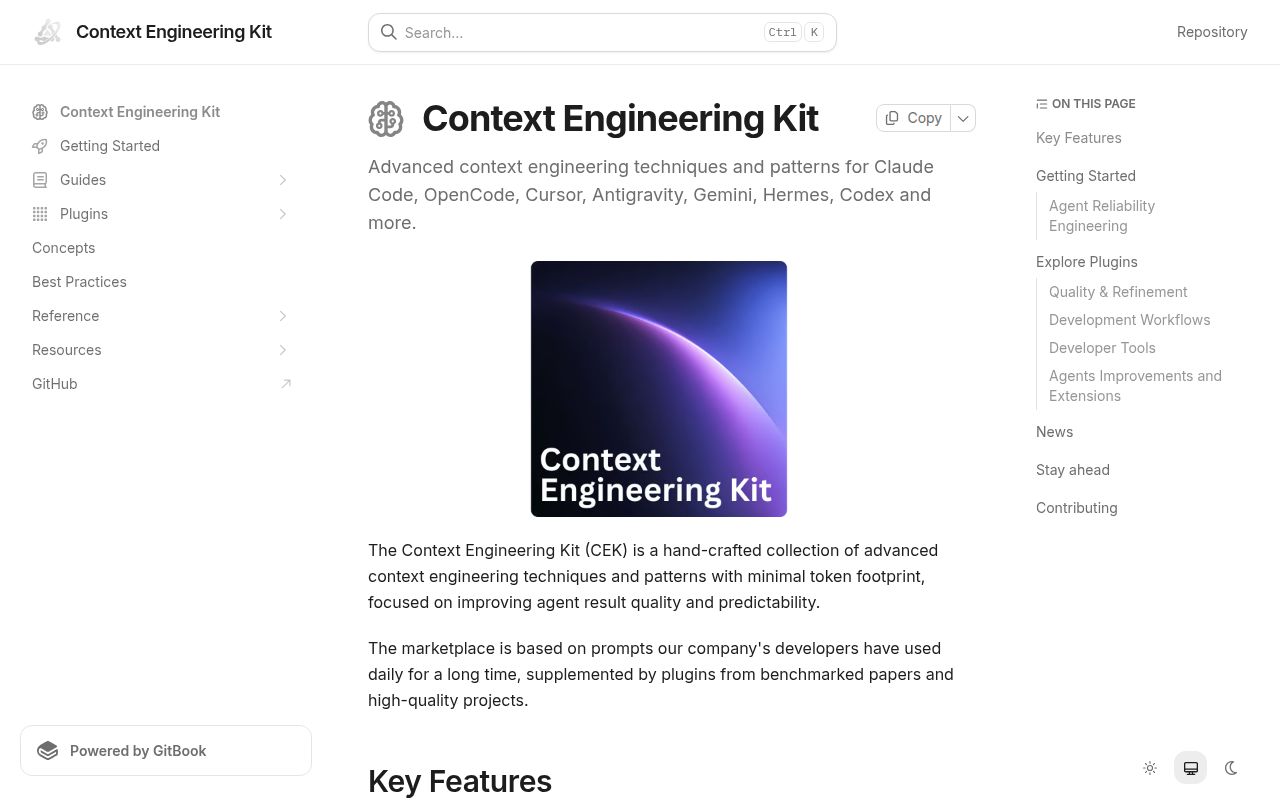
Context Engineering Kit is a marketplace of instruction-driven development workflows. Its catalog includes reflection, specification-led development, code review, testing, Git help, documentation, architecture guidance, and MCP setup. Claude Code can add the marketplace and install one plugin at a time. That is the cleanest route because each choice loads only its own commands, agents, and skills into the working context.
Other clients receive a different product. Gemini CLI and Antigravity install every plugin as one bundle, with deletion offered as the way to remove unwanted material. Cursor, Codex, and OpenCode can select skills through npx skills, but the README says that route does not carry subagents. The repository had 513 files and a 15.3 MB checkout, yet context cost depends on the client and selected instructions rather than repository size alone.
The Reflexion hook turns one prompt word into another pass
The most concrete automation is the Reflexion hook. It records user prompts in a temporary session file. When Claude reaches its stop event, the hook checks whether the last prompt contained reflect as a complete word. If so, it blocks the stop and directs Claude to run the reflection command. A consecutive-stop check is meant to prevent that cycle from repeating forever.
This behavior is easy to understand and easy to trigger unintentionally if a team uses that exact word in ordinary instructions. Session records live under /tmp/claude-hooks-sessions/, and debug mode includes the stored session data in hook responses. Those are operational details worth reviewing on shared machines. The code exposes 8 supported hook types, including pre-tool and post-tool events, though the documented Reflexion flow centers on prompt submission and stop.
What happened when we ran it
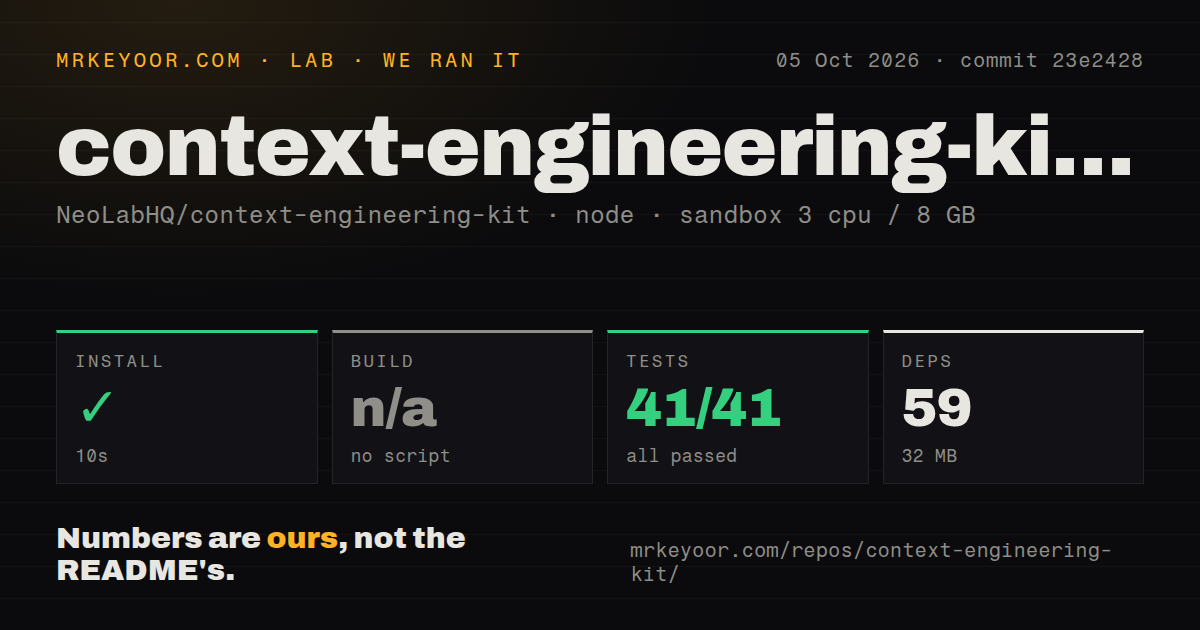
Our sandbox measured the Bun package under plugins/reflexion/hooks/ at commit 23e2428. Installation succeeded in 35 seconds, pulling 59 packages and using 32 MB on disk. The project had no build script or target, so the build step was skipped. Vitest then completed in 7 seconds with 41 passed and 0 failed out of 41.
That passing result applies to the hook code, not every instruction or agent in the marketplace. The repository had 1 CI workflow, no Dockerfile, and no conventional tests directory. The Reflexion tests sit beside the TypeScript source, which explains how the measured package can pass 41 cases while the repository scanner still reports no tests folder. We did not measure whether a reflection improved generated code, reduced hallucinations, or saved review time.
The setup needs no hosted service credential for the hook itself. It does require Bun for installation and execution, a writable temporary directory for session records, and a compatible Claude Code hook interface. Basic commands and skills do not require Bun. A team adopting the automatic path should test stop handling, temp-file cleanup, concurrent sessions, and prompts containing the trigger word before enabling it across many repositories.
The reliability table is a claim, not our benchmark
The README gives precise accuracy ranges and token multipliers for several workflows. It says the figures come from more than a year of development use on production projects. It also makes a 99% claim for spec work with human review in several task-size bands. The page does not turn our 41 hook tests into evidence for those percentages, and neither should a reviewer. The tests show that the hook logic behaved as expected in our sandbox.
Extra judges and subagents can still be useful. A fresh reviewer may find a missed requirement or question an assumption the implementing agent repeated. The cost is more model calls, more generated material to inspect, and another instruction layer that can conflict with repository rules. Pick one recurring failure, such as incomplete local-change reviews, then compare results with and without the relevant plugin on the same kind of task.
GPL terms and prompt changes belong in the adoption review
The repository uses GPL-3.0, so organizations with restrictive rules for copied or modified development assets should have their normal license review before distributing an adapted bundle. The kit is mostly instructions and agent definitions, but that does not make its license disappear. Installation also gives model-facing text a role in how code is planned, reviewed, and changed. Pinning a release makes those instructions reviewable like any other dependency.
Release v3.10.0 was published August 26, 2026, the same date as the repository's last push. Its notes cover 4 merged changes, including a retired model identifier, an Antigravity workaround, and a technical-writing agent edit. GitHub listed 1,416 stars and 6 combined issues and pull requests when fetched. The small queue plus same-day release and push indicate current maintenance, though they say nothing about how each plugin performs on your codebase.
Start with one command whose result a human can judge
Installing the complete catalog first makes it hard to tell which instruction changed an outcome. Claude Code's granular path is the strongest fit: try Reflexion on a reviewable change, or the review plugin on a pull request where a maintainer already knows the risky files. Record whether it found a real defect, produced noise, or changed token use enough to matter.
Our measured hook is a credible executable component because 41 tests passed after a 35-second install. The broader marketplace remains a set of opinions about good agent work, even when papers or internal experience inspired those opinions. Teams that treat prompts as versioned code, inspect updates, and keep humans at approval points can evaluate it sensibly. Teams looking for a universal accuracy upgrade should not read the README's percentage table as an independent result.