33 skills impose a six-step engineering loop
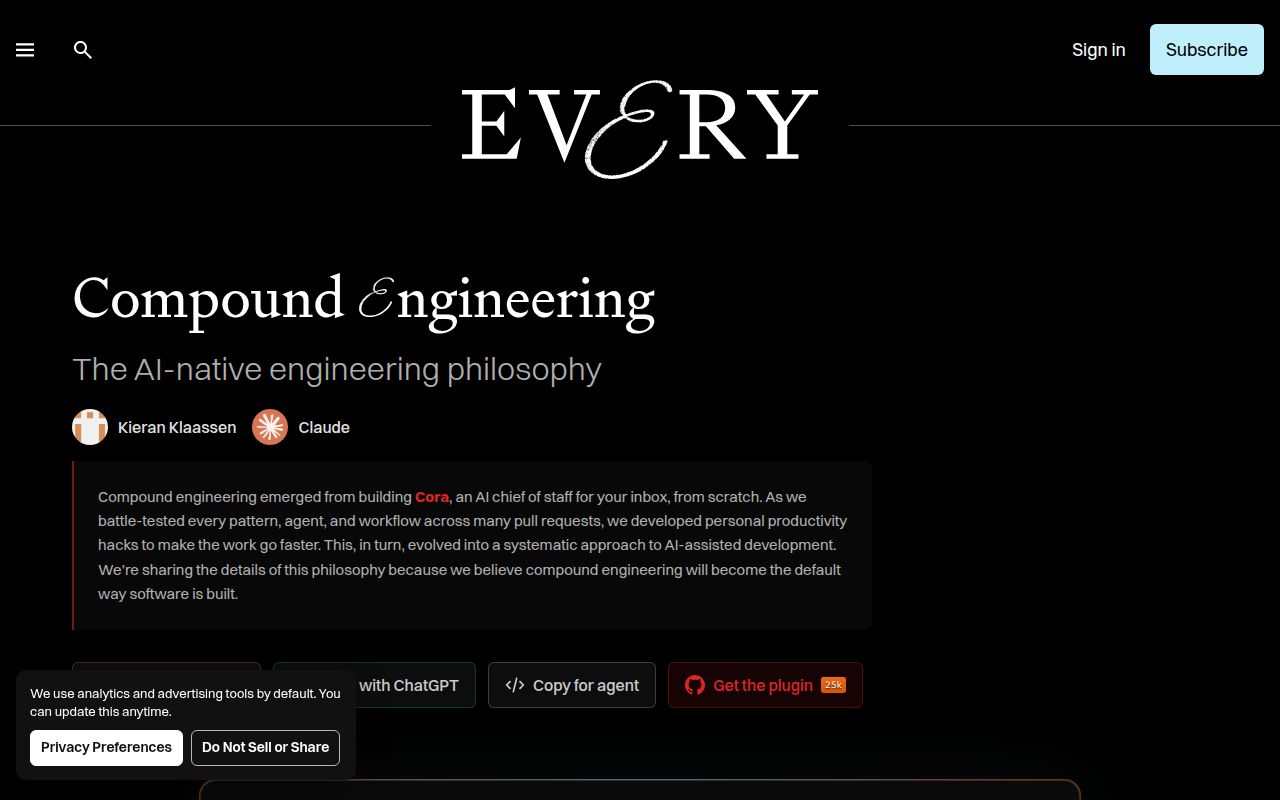
Compound Engineering packages 33 skills around a simple idea: an agent should brainstorm, plan, work, simplify, review, and record what it learned. The saved plans and solution notes give later sessions repository-specific context. That is more useful than a bag of clever prompts when a team wants consistent behavior across repeated changes. It also means adopting a method, including its files and vocabulary, rather than installing an invisible helper.
The README says 80% of the method goes into planning and review and 20% into execution. That ratio tells you who will enjoy it. A developer who wants the agent to patch a small bug immediately may find the loop heavy. A team dealing with long-lived code, repeated mistakes, or handoffs between agent sessions has a clearer reason to accept the ceremony.
The autonomous workflow can push, so permission review comes first
The /lfg skill runs the sequence without waiting between every stage. According to the README, it plans, implements, simplifies, reviews, applies fixes, runs browser tests, and commits. If the checkout has a remote, it can also push, open a pull request, and watch CI through a bounded repair loop. It does not merge, and the repair loop may stop with work left over.
That behavior can save attention, but the boundary matters more than the feature count. Run it first in a disposable repository or a branch protected by normal review rules. Check which shell and Git actions the chosen host permits. A plugin that writes a plan is low risk; the same plugin holding credentials that can push a branch deserves the controls you would apply to any automated contributor.
What happened when we ran it
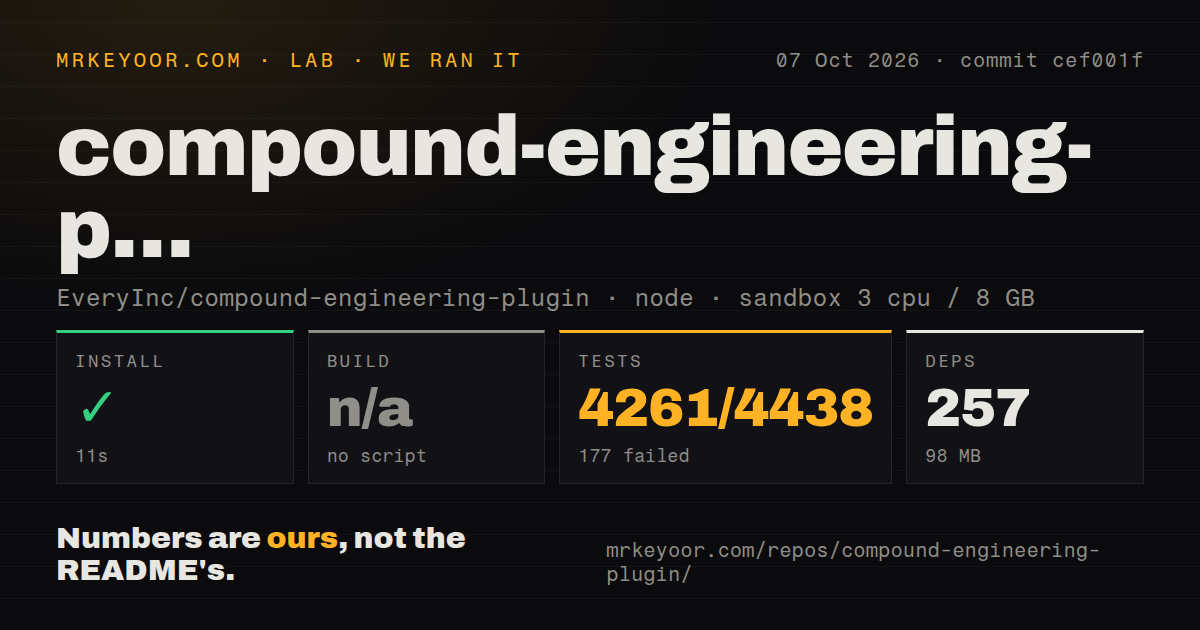
Our sandbox installed commit 26bf5b1 in 47 seconds. Bun added 256 packages, and dependencies occupied 75 MB on disk. The checkout itself was 15 MB, with 1,031 files and roughly 109,569 lines of source. There was no build script or target, so the build step was skipped rather than counted as a pass.
Tests were the serious finding. bun test ran for 455 seconds and exited with code 1. The supplied result listed 3,447 passed, 177 failed, and 1 skipped out of 3,624. Its final lines show passing checks around review wording, setup health, PR snapshots, and skill evaluation. The next visible test name is cut off, then the runner reports 177 failures across 139 files. That excerpt does not identify one shared cause, so we cannot responsibly reduce the result to a missing package or container quirk.
Three CI workflow files and a tests directory are present, while no Dockerfile was found. A fresh Debian container is not every supported editor environment, but a failed full suite is still a buying signal. Before enabling write-capable skills, reproduce the relevant host path and run the checks that cover the workflow you intend to use.
Fourteen hosts bring reach and setup differences
The project says it runs on 14 agent hosts, including Claude Code, Cursor, Codex, Pi, OpenCode, and several other CLIs. Normal users do not need Bun. Most hosts load skills through a plugin marketplace or directly from the GitHub repository, while repository contributors use Bun for tests and conversion work. The README gives separate commands because there is no single installation contract across all 14.
Codex users register a custom marketplace, install the plugin, and restart. Pi users install the repository plus pi-subagents when workflows dispatch reviewer, research, or implementation agents. Open issue 1507 says Pi's native extension exposed skills but did not register CE agent definitions, producing an Unknown agent error for paths such as ce-work and lfg. That issue was updated on August 26, 2026, so Pi adopters should verify their exact workflow rather than assuming skill discovery proves subagent discovery.
Repository memory is useful only if the team keeps it clean
The distinguishing feature is the return path from a completed change to the next one. /ce-compound writes lessons under docs/solutions/, while brainstorm and planning skills read prior material as grounding. Plans also live in the repository by default. A configuration file can relocate these artifacts when docs/ already contains product documentation.
This can turn an environment-specific fix into guidance that the next agent sees. It can also fill a repository with stale explanations if nobody reviews them. The project includes ce-compound-refresh and setup checks, but ownership stays with the team. Treat generated knowledge like code comments: keep claims tied to current files, remove obsolete advice, and make its review part of the pull request.
August 2026 activity is fast, while the measured suite is red
GitHub recorded the last push on August 27, 2026. The repository had 24,582 stars, an MIT license, and 85 combined open issues and pull requests when fetched. Release v3.23.4 was published on August 25, the same day as our sandbox run, with fixes for review configuration, skill behavior, retained concepts, Windows process handling, and cross-model cleanup. Those dates show active maintenance, not whether every host path works.
Compound Engineering is worth trying when a team wants one opinionated process across several coding agents. Start with the planning and review skills, inspect the files they add, and keep Git permissions narrow. The 47-second install makes that experiment cheap. The 177 failed tests make an unattended rollout hard to justify until your own chosen host and workflow pass the checks you depend on.