mrkeyoor.com_
Wed 30 Sept 06:12 UTC
LLM Toolsevaluationupdated 30 Sept 2026

codex-astra-luna-orchestrator review

Codex Astra Luna Orchestrator is a set of project-scoped Codex configurations, custom agents, and a skill that divides repository work among an orchestrator, execution agents, a tester, and a reviewer. It saves you from writing that setup yourself, but it also installs a strong opinion about when Codex should delegate.

Verdict

Our run installed 35 packages and passed all 9 tests in 38 seconds across install, build, and test, so the small configuration bundle is easy to check before adoption. Use it when your work is routinely large enough to justify role separation and you want Astra or Sol directing Luna workers. Keep it out of small-task repositories until you soften the binary delegation rule, because the included historical sample shows how quickly an orchestrated run can consume attention and quota.

We ran it

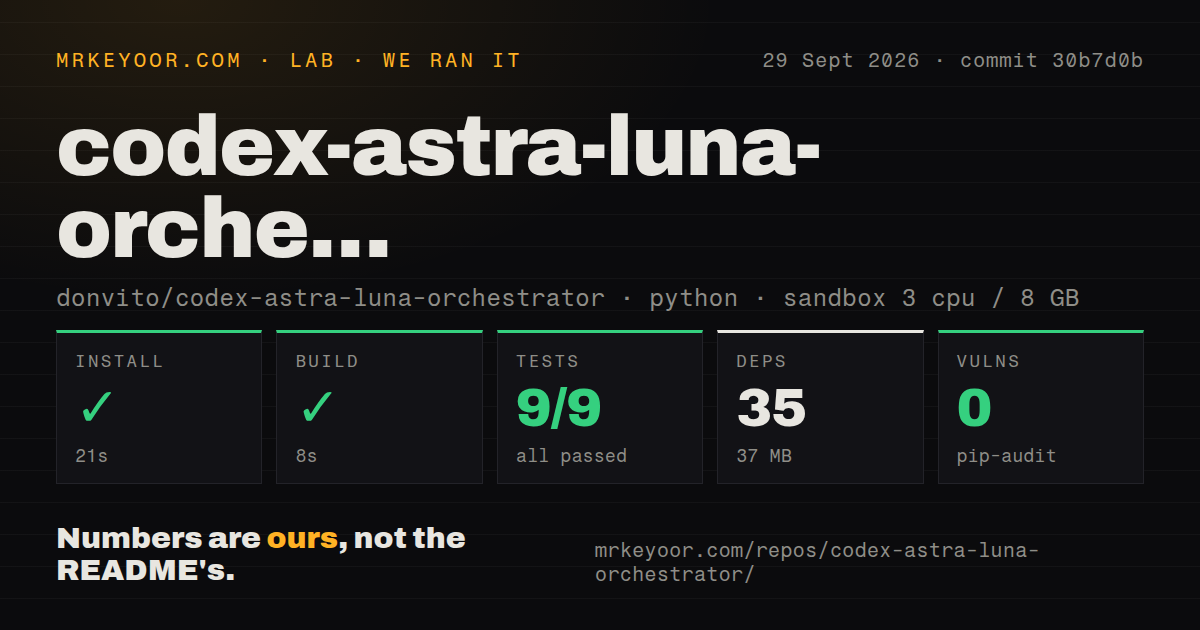
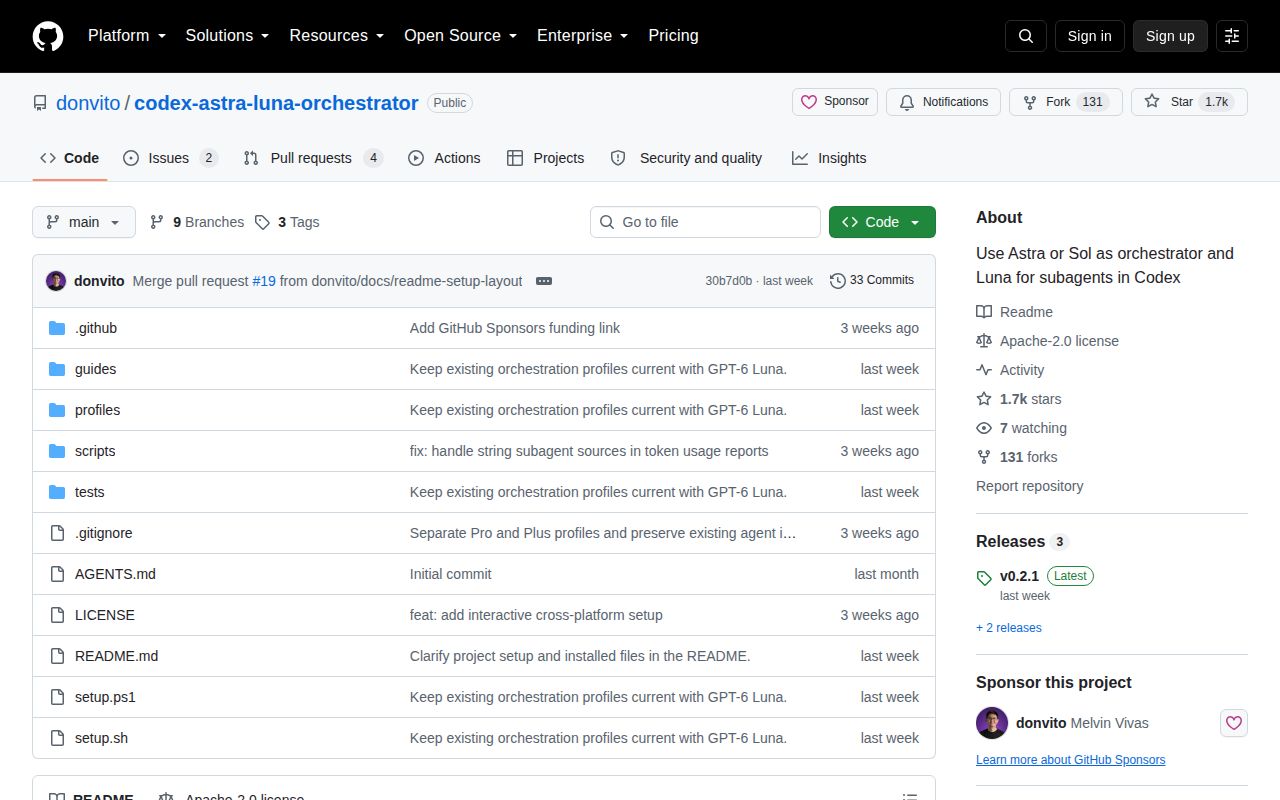
Lab card: what happened when we ran codex-astra-luna-orchestratorScreenshot of codex-astra-luna-orchestrator (github.com/donvito/codex-astra-luna-orchestrator)
Install✓ · 21s35 packages · 37 MB
Build✓ · 8s
Tests✓ · 9s9 passed · 0 failed of 9 (pytest)
Known vulns0(pip-audit)
Repo58 files~871 lines of source · 0.2 MB · 0 CI workflows · tests dir

Answers from our run

Does codex-astra-luna-orchestrator build from source?

Dependencies installed in 21 seconds (35 packages), and the build succeeded in 8 seconds. We cloned commit 30b7d0b into a clean Debian container with 3 CPUs and no project-specific setup.

Do codex-astra-luna-orchestrator's tests pass?

Yes: 9 of 9 passed when we ran the project's own test command (pytest). Some failures need services or credentials a bare container does not have.

Does codex-astra-luna-orchestrator have known vulnerabilities in its dependencies?

pip-audit found none in the dependency tree at the time of our run.

Who should not use codex-astra-luna-orchestrator?

People without access to the profile's named models: official OpenAI documentation says model availability depends on the signed-in account or workspace.

What are the alternatives to codex-astra-luna-orchestrator?

Codex, Superpowers. Our run installed 35 packages and passed all 9 tests in 38 seconds across install, build, and test, so the small configuration bundle is easy to check before adoption.

Setup4/5Interactive installers are guarded; model access remains external
Docs5/5Profiles, installed layout, workflows, and token measurement are clear
Community4/51,657 stars, 6 open issues and PRs, September 23 push
Maturity3/5v0.2.1 and 9 passing tests, but no repository CI workflow

Who it’s for

Codex users who regularly handle multi-file or cross-component repository work.
Teams that want named explorer, worker, tester, researcher, and reviewer roles checked into each project.
Pro or Plus users who can access the Astra, Sol, and Luna models selected by a chosen profile.
Developers willing to inspect token use and tune concurrency after real tasks.

Who it’s NOT for

People without access to the profile's named models: official OpenAI documentation says model availability depends on the signed-in account or workspace.
Developers doing mostly one-file fixes: issue 5 reports eager delegation adding context use and slowing straightforward work.
Existing chats where you expect a newly installed model choice to appear immediately: issue 11 reports that selection applying only to new conversations.
Repositories whose .codex, .agents, or AGENTS.md policy cannot be changed by an interactive installer.
Teams seeking measured savings from the current six profiles: the included token example is historical and explicitly not a benchmark for them.

Setup reality

Our run installed 35 packages in 21 seconds and occupied 37 MB. The build succeeded in 8 seconds, then all 9 pytest cases passed in 9 seconds. Pip-audit reported 0 known vulnerabilities.

Installation is interactive. You need an existing target repository, a current Codex client, access to the models in your chosen profile, and enough confidence to trust the project so Codex loads .codex/config.toml. The shell and PowerShell installers can copy .codex, .agents, and AGENTS.md.

Existing component files are listed and changed only after confirmation, while existing AGENTS.md text is appended to rather than replaced. The repository has no Dockerfile and no CI workflow, so its local passing suite is the clearest automated evidence in the checkout.

Six profiles assign the root, workers, and reviewer

Version 0.2.1 ships 6 profiles. Four use the original Pro or Plus arrangement, with variants capped at 2 or 4 concurrent subagents. Two newer profiles use GPT-6 Sol at medium or max effort as root and reviewer, while GPT-6 Luna handles execution. The Pro default puts GPT-6 Astra at the root, Luna on explorer, worker, tester, and researcher roles, and Astra on review.

The split is concrete rather than decorative. Each role has its own TOML file with a model, reasoning effort, description, sandbox setting, and developer instructions. The worker is told to stay inside a bounded implementation scope. The explorer is read-heavy, the tester validates, and the reviewer reports findings back to the root. One astra-orchestrator skill defines how the root should decide, spawn, wait, integrate, and verify.

What happened when we ran it

Our sandbox installed commit 30b7d0b in 21 seconds, pulling 35 packages and using 37 MB. The build passed in 8 seconds. Pytest completed in 9 seconds with 9 passed and 0 failed. Pip-audit reported 0 known vulnerabilities. The container had 3 CPUs, 8 GB of RAM, Python 3.12, no secrets, and no elevated privileges.

The repository is small: 58 files, about 871 lines of source, and a 0.2 MB checkout. It contains a tests directory, no Dockerfile, and no CI workflow. A green local suite therefore verifies the profile and token-script checks we ran, but GitHub is not automatically repeating that evidence on every push through a checked-in workflow.

The installer asks before replacing project files

The shell and PowerShell installers target a different, existing repository. After you choose 1 of 6 profiles, the script offers .codex, .agents, and AGENTS.md separately. It lists existing paths that would be replaced and defaults update confirmations to no. Existing AGENTS.md content is preserved and the orchestrator instructions are appended if they are not already present.

That is better than blindly copying a preset into a mature codebase. It still changes the rules that Codex reads whenever it works in the target project. Official OpenAI documentation says project .codex/config.toml files load only for trusted projects, and project config outranks user defaults. Review model choices, approval policy, sandbox mode, concurrency, and every custom-agent instruction before confirming the copy.

The global-install instructions need even more care because they tell you to merge selected settings into your personal Codex configuration. A project install is easier to audit, diff, and remove. Start there, then promote only settings that have proved useful across several repositories.

The binary delegation gate is too eager for modest work

Issue 5 reports that simple tasks expanded into explorer, worker, tester, reviewer, and extra-specialist cycles, increasing token use and making work slower. The installed skill at commit 30b7d0b still uses a binary gate: multiple files, external research, cross-component debugging, or useful independent review can make delegation mandatory. An open pull request proposes a 3-tier gate, but that change is not part of this reviewed commit.

Official OpenAI documentation makes the cost direction plain: each subagent performs its own model and tool work, so subagent workflows use more tokens than comparable single-agent runs. Parallel exploration can save wall time when tasks are independent. Parallel writing can create conflicts and coordination overhead. The repository's one-writer-per-file guidance helps, but the first decision remains whether the task needed extra threads at all.

One historical run used 9.3 million total tokens

The token guide includes a single historical cross-component bug fix with 4 spawned roles and a wall time of 13 minutes 49 seconds. It reports about 9.3 million total tokens, of which 96.3% of input tokens were cache hits. The guide correctly tells readers to focus on uncached input, output, and rate-window movement instead of treating the total as equivalent billable work.

That sample predates the current profiles, so it cannot prove that Pro, Plus, or either Sol profile is cheaper or better. It does show where overhead sits: the root stays alive, polls agents, and rereads its context. The bundled read-only token_usage.py groups Codex rollout files by root session and role, giving you a way to compare root-only work with the installed profile on your own tasks.

v0.2.1 is active, but model access is outside the repo

GitHub showed 1,657 stars, 6 open issues and pull requests, and a last push on September 23, 2026. Release v0.2.1 landed the same day and moved the original profiles to GPT-6 Luna while preserving their effort levels and subagent caps. Recent pull requests cover both shell and PowerShell installation paths, and our 9-case suite passed.

The repository cannot grant access to Astra, Sol, or Luna. Official OpenAI guidance says to choose a model available to your signed-in account or workspace, and custom agent files can override both model and reasoning effort. Issue 11 also reports that model selection is visible for new conversations but not existing conversations or branches. Install into a disposable project first, start a new Codex session, inspect every role, and compare one genuinely parallel task with a root-only baseline before standardizing the setup.

Alternatives

ProjectWhat it isPick it when
Codex gh↗The official coding agent already supports project config, custom agents, and subagent workflows.pick this instead when you want to define a few custom agents directly without adopting this repository's profiles and delegation rules.
Superpowers gh↗A broader skills-based development workflow with planning, testing, review, and agent coordination.pick this instead when you want a full development methodology rather than model-routing profiles for Codex.

What people are saying

  1. [velocity-scout] donvito/codex-astra-luna-orchestrator

Sources

  1. Codex Astra Luna Orchestrator README
  2. Codex Astra Luna Orchestrator v0.2.1
  3. Real project delegation feedback
  4. Model selection conversation issue
  5. Official OpenAI Codex subagent documentation
  6. Official OpenAI Codex configuration basics

More llm tools reviews

agent-memory · okf-agent-memory · mlc-llm · awesome-openclaw-skills · TensorFold · ai-evaluation-framework · the whole board →