What Cloudflare is trying to build
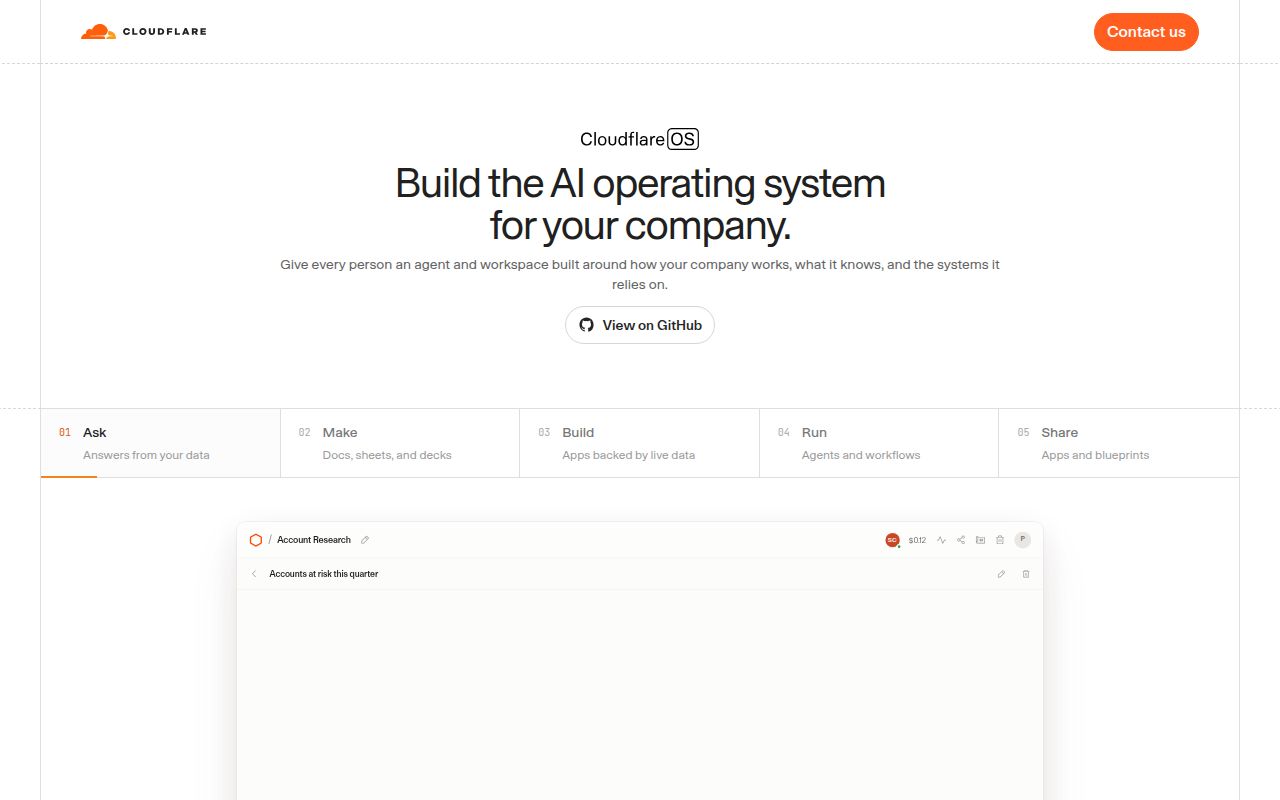
Cloudflare OS is not a desktop operating system. It is an internal AI productivity environment, originally built for Cloudflare employees, that combines agent chat, organizational context, and small applications generated for individual users. The open-source version is meant to be copied and customized into a company-specific system.
Its central idea is the Gadget. Instead of sending everyone to one shared application, Cloudflare OS creates a private instance of a small app for each user. A slide deck, whiteboard, game, or issue dashboard can be a Gadget. Users can modify its code through an agent, share it, or turn it into a reusable Blueprint.
The second major idea is Gatekeepers, a capability-based security layer around external services. A Gatekeeper wraps a service API, handles authorization, narrows access to the intended resource, and logs actions. For actions with side effects, it can simulate outcomes so the agent keeps working, then let the user approve or reject queued actions later.
What happened when we ran it
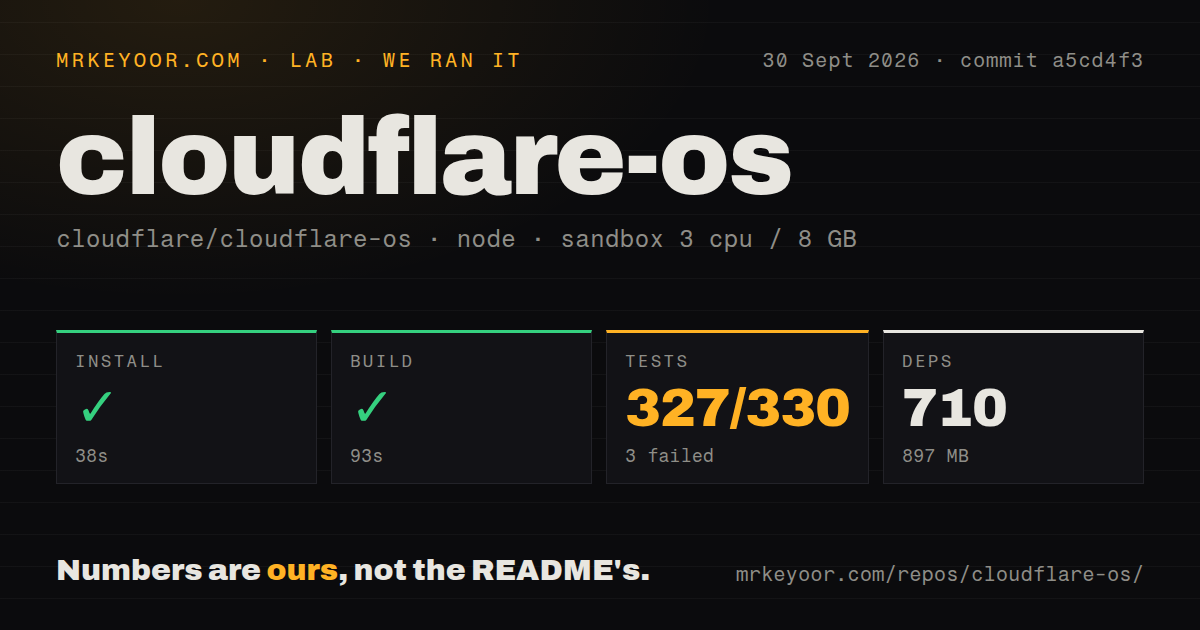
We cloned commit 1dc8442 into an unprivileged fresh Debian container with three CPUs, 8 GB of RAM, Node 22, and no secrets. The repository contained 940 files, roughly 466,855 lines of source, and occupied 19.5 MB when checked out. It is a pnpm monorepo with seven CI workflow files, no Dockerfile, and no top-level tests directory.
Installation succeeded in 26 seconds. It pulled in 688 packages and used 898 MB on disk, substantial for a comparatively small checkout. The build also succeeded, taking 57 seconds.
Testing was less reassuring. The test process timed out after 900 seconds. Our measurement summary recorded 23 passed and zero failed tests at the timeout point, but the last captured Vitest output showed three test files with two passing and one failing, plus 42 passing tests and one failure. The visible failure came from portal-boundaries.test.ts around an expectation that a Jira endpoint would be rejected as a native connector. The log does not establish why it failed. The useful conclusion is narrower: the repository did not produce a clean, complete test result within our 15-minute limit, and the tail contained a concrete failure.
The README's pnpm run-local quick start may be enough to inspect the interface at localhost. Teams evaluating a deployment should still budget time for the monorepo, connector setup, Cloudflare account deployment, authentication, and security review.
Where it is strong
The architecture has a coherent point of view. Private Gadget instances reduce the blast radius between users, while Blueprints preserve a path to sharing useful patterns. The README gives specific things to try, including slides, a collaborative whiteboard, a GitHub issue dashboard, and editing a Google Doc. It labels which examples require configured integrations.
Gatekeepers are the standout feature. Wrapping authorization, resource scoping, audit logs, and approval policy in service-specific Workers is more thoughtful than handing an agent broad credentials. The simulated-action flow is promising for long-running tasks because it separates agent progress from the timing of human review.
The project is candid about its status. The README calls this version 2, describes it as a complete rewrite, and warns that the August 2026 release has many rough edges.
Weaknesses and operational risks
The biggest issue is maturity. There is no listed release, so adopters lack an obvious stable version or documented cadence. A same-day push shows active development, but it also means the ground is moving. The test timeout and captured failure reinforce the early-access label.
The security claims deserve careful validation. Sandboxing and narrow capabilities are good design choices, but calling generated apps totally safe is stronger than the evidence available here. Real deployments still depend on correct Gatekeeper implementations, OAuth scopes, approval semantics, isolation boundaries, logging, and administrative policy. Generated code should remain untrusted until those boundaries have been tested for each service.
Deployment is opinionated. Local execution uses Wrangler and workerd, and Gatekeepers are separate Workers. That suits Cloudflare-native teams, but adds architectural commitment for everyone else. The lack of a Dockerfile removes one familiar deployment route.
Community health and release outlook
At 9,165 GitHub stars, Cloudflare OS has attracted substantial early attention. The repository was pushed on August 25, 2026, the day of our review, so it is plainly active. Its 97 open issues are not automatically a negative, but without a listed release history we cannot judge upgrade discipline or how quickly maintainers close reported problems. The supplied GitHub Trending item indicates interest but provides no detailed user experience.
Where it fits in a real stack
Treat Cloudflare OS as an internal platform layer above Cloudflare Workers, identity, and approved company services. It can provide the employee workspace, agent runtime, Gadget lifecycle, and Gatekeeper controls, while existing systems remain sources of truth. Start with low-risk, read-heavy integrations and a small technical cohort. Define who may publish Blueprints, who reviews Gatekeepers, how logs are retained, and which actions require approval before connecting sensitive systems.
For teams mainly wanting self-hosted AI chat, Open WebUI or LibreChat is a simpler fit. For structured AI workflows and customer-facing applications, Dify may be more direct. Cloudflare OS fits when the goal is broader: letting employees generate personal software while the platform governs what that software can reach. That idea is compelling, but today it carries the engineering burden of an active, early-access rewrite.