
Budibase connects request forms to workflow actions
Budibase is worth considering when an employee's request needs to create a record, reach an approver, and update an internal app. The README puts agents alongside apps and automations, with database and business-system connections beneath them. That makes an approval process a better starting point than an isolated chatbot. The README describes those actions.
Taking ownership of that platform has a visible cost. Our checkout contained 4,510 files and roughly 577,550 source lines, occupying 143.2 MB before dependencies. The contributor guide separates the Svelte builder, browser client, Koa server, and worker. If you only need colleagues to edit a table, that's a lot of application machinery to adopt. Budibase makes more sense when the same data needs screens and repeatable actions.
What happened when we ran it
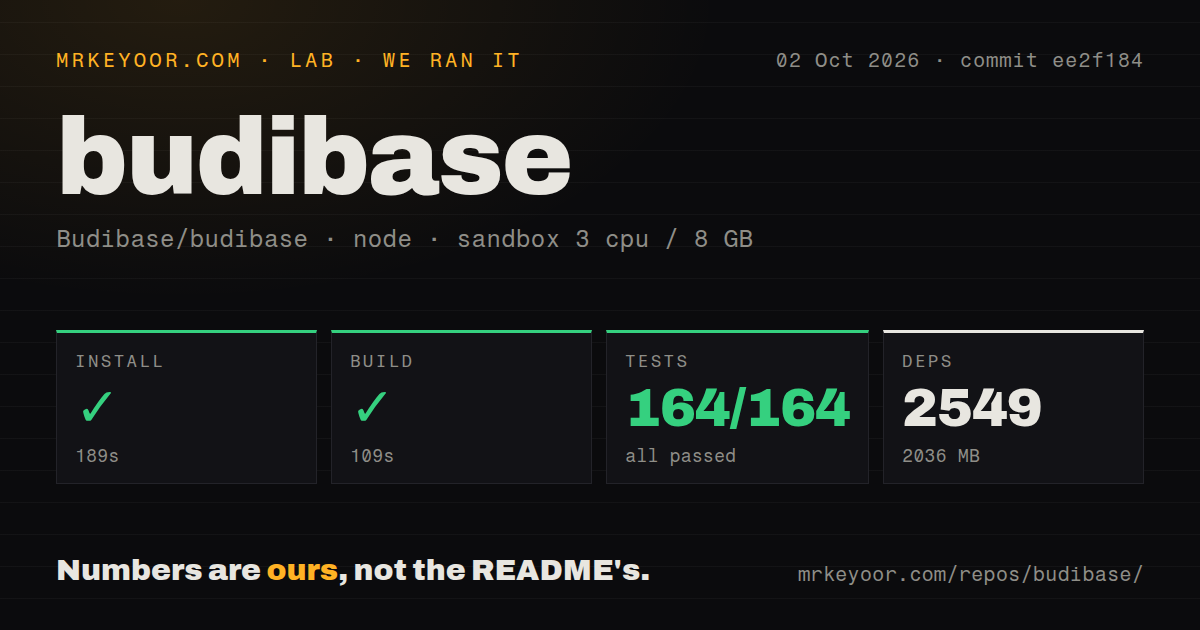
Our run installed Budibase commit ee2f184 in 189 seconds, pulling 2,549 Yarn packages and occupying 2,036 MB on disk. The build succeeded in 109 seconds. We cloned it on October 2, 2026, into a fresh, unprivileged Debian sandbox with 3 CPUs, 8 GB of RAM, the lab-node:22 image, and no secrets. Installation and compilation completed under those conditions.
The test command failed after 15 seconds with exit code 130. The recorded Jest summary shows 164 passed and 0 failed out of 164. The log tail gives more context: shared-core finished 17 suites with 164 passing tests, and string-templates finished 10 suites with 395 passing tests. Those are separate package results. They do not establish that the entire workspace test command completed successfully. The final output names the backend-core test task and repeats Yarn's exit-code error, without explaining why the command stopped. We can't assign that result to missing system packages, memory pressure, or a code defect. The finding is narrower: successful installation and build, passing package suites in the log, and an unsuccessful overall test step. The 15-second result is insufficient evidence for approving the full suite.
Docker packages the platform, while storage remains your job
The single-image Docker guide starts with a persistent /data mount. Its production settings cover session signing, internal API access, Redis, CouchDB, and MinIO credentials. Configure those deliberately and supply credentials for the external systems your apps will touch. SMTP also needs configuration if you use email. A convenient launch command doesn't answer how you'll restore the app's data after a host failure.
The current Compose file separates app and worker services from the proxy, CouchDB, MinIO, Redis, LiteLLM, and its PostgreSQL database. Several stores have persistent volumes. Our 2,036 MB installed footprint describes the source environment, not this running cluster. Likewise, the sandbox's 8 GB of RAM is a measurement condition, not a production sizing recommendation. Choose the deployment route before budgeting the server.
GPL, MPL, and paid-feature licensing need separate decisions
The README identifies GPL v3 for Budibase, MPL for client and component libraries, and the Business Source License for paid features. It says apps you build can use your chosen license. That's useful, but a team requiring permissive licensing throughout the platform should walk away. A team needing a paid capability should confirm its terms before building a workflow around it. Self-hosting doesn't settle that question.
Maintaining a fork is another commitment. The contributor guide requires a CLA and, for external pull requests, an open, triaged issue assigned to the contributor. It limits contributors to one open pull request each. Against the roughly 577,550 source lines we measured, those rules matter if your adoption depends on upstream accepting local changes. Discuss the required change before promising it to your users.
Shared table controls have a reported keyboard-access gap
Issue 19847, opened October 11, 2026, reports that BBUI clickable cells and pagination arrows use non-focusable elements without equivalent keyboard handling. The report concerns shared components and says the proposed Actions interface inherits the limitation. It doesn't establish that every Budibase app is inaccessible. It does give accessibility-sensitive teams a specific interaction to check before choosing the platform.
The 164 passing tests in our recorded summary cannot settle that keyboard question. They belong to shared-core, while the issue concerns BBUI controls. If an employee needs to navigate a table without a mouse, evaluate that actual screen and its pagination in the deployment you intend to use. Treat the issue as a reported limitation requiring verification, rather than evidence that an entire product fails an accessibility standard.
October activity shows maintenance beyond the release tag
GitHub reported 28,334 stars and 270 open issues and PRs, with the last push on October 11, 2026. Release v3.48.0, published October 5, includes approval-flow work, app-navigation changes, and fixes around batch deletion and publishing locks. Together with newly opened component issues, that supports an active-maintenance judgment.
Our scan found 20 CI workflow files and monorepo workspaces, while reporting no Dockerfile or tests directory. That last signal plainly doesn't mean there are no tests: the supplied log contains completed Jest suites. Nor does the scan erase the published Docker hosting route. These are repository-discovery signals with limits. For a release decision, use the actual command outcomes and inspect the affected workflow rather than treating file counts as certification.
A table-only job deserves a narrower candidate
Appsmith is worth comparing when an admin panel or dashboard over existing databases and APIs is the main requirement. NocoDB is the closer candidate when people primarily need spreadsheet-style records, forms, and views. We haven't measured those alternatives here. Choose between them by the work employees must complete, then evaluate the relevant deployment.
I'd trial Budibase with an approval workflow that already causes manual handoffs. Budget for the 2,036 MB source environment if you'll modify the platform, and assign ownership of its persistent stores before employees depend on it. Require a completed test run for your chosen revision. The pilot should end with someone submitting a request and the right person receiving it, with the resulting record available to inspect.