Five data views sit above a database and API
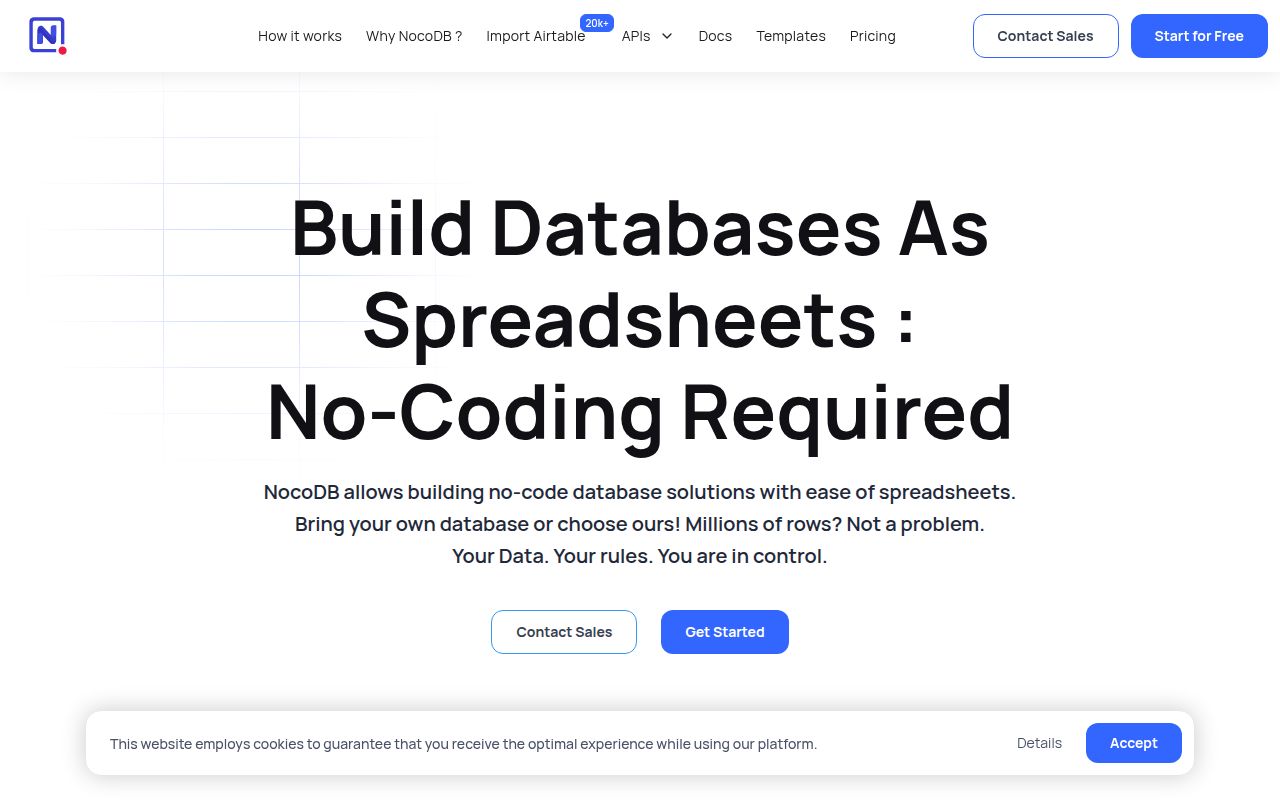
NocoDB gives database records the interaction model of a collaborative spreadsheet. Users can work in grid, gallery, form, Kanban, and calendar views, with filters, grouping, attachments, formulas, lookups, and linked records. Permissions can apply at several levels, while public or password-protected views let a team collect and share selected data. Developers get REST APIs and an SDK instead of relying on manual exports. It fits the space between an office spreadsheet and a custom internal application.
The product has grown well beyond a table editor. Release 2026.08.1 adds realtime presence, folders, and the ability to freeze as many as 3 fields. Paid plans add items such as nested list records and dashboard permissions according to the release matrix. Workflows connect mail, chat, and storage services, while newer documentation has sections for APIs and MCP. That split between community and paid capabilities needs to be mapped against the exact self-hosted edition before a team promises a feature to users.
The quick Docker command hides a 3 GB workspace
A local trial can be one Docker invocation with SQLite and a mounted data directory. The PostgreSQL example adds NC_DB and NC_AUTH_JWT_SECRET. NocoDB also publishes binaries for major desktop and server architectures, but the README labels those binaries as quick local testing only. For production, its auto-upstall script creates a Docker Compose stack with PostgreSQL, Redis, Traefik, SSL, and automatic upgrade behavior. That is convenient if the generated architecture is acceptable.
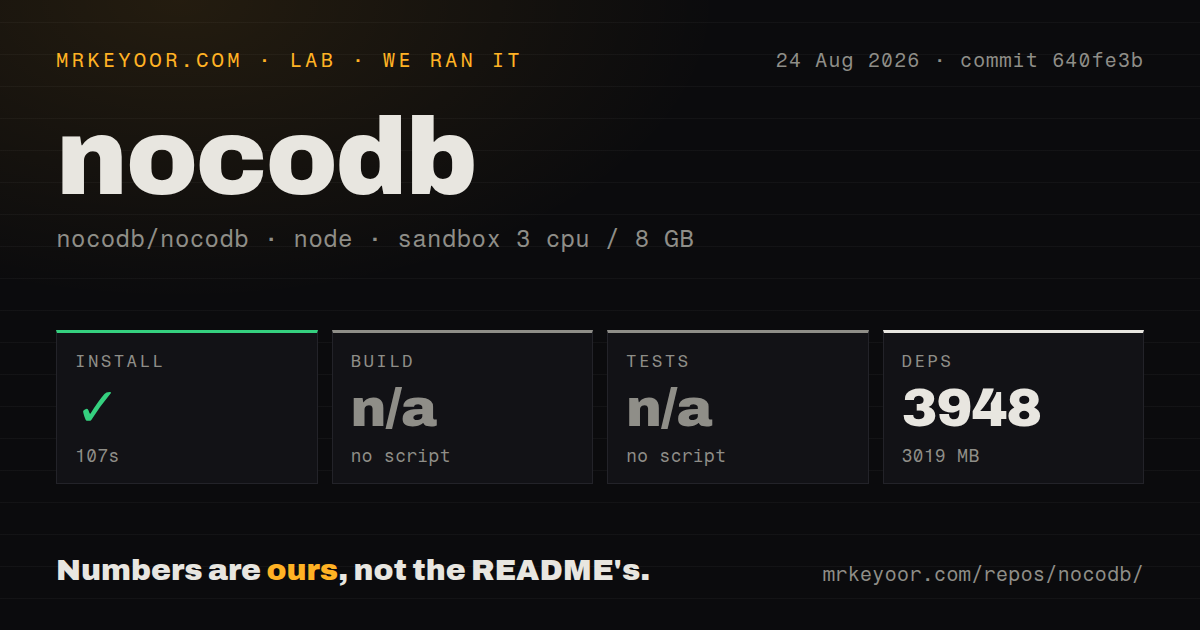
Source work is much heavier. commit 640fe3b contained 4,551 files and roughly 656,606 source lines in a 149 MB checkout. Our pnpm install expanded that to 3,019 MB after adding 3,948 packages. The repository is a workspace monorepo with 10 CI workflow files, no Dockerfile at the scanned location, and no tests directory. Developers planning local changes should identify the relevant package commands and CI jobs before treating a successful dependency install as proof that the product builds.
What happened when we ran it
Our sandbox installed the NocoDB workspace in 107 seconds. It pulled 3,948 packages and occupied 3,019 MB on disk. The harness found no build script or target, so it skipped the build instead of inventing a command. It also found no test script or target and therefore ran no tests. These facts apply to commit 640fe3b in a fresh unprivileged Debian container with 3 CPUs and 8 GB of RAM.
A skipped step is not a pass or a failure. The install proves that pnpm could resolve and place the workspace dependencies on our box. It says nothing about whether the frontend bundles, the API compiles, migrations apply, or product tests pass. The presence of 10 CI workflows shows that upstream automation exists, but a buyer still needs to locate and reproduce the package-specific checks that apply to a proposed change. That missing obvious root contract is the main source-level weakness we found.
The Sustainable Use License limits redistribution
NocoDB's repository metadata does not identify a standard SPDX license because the project uses its own Sustainable Use License. The January 29, 2026 text allows internal business use and non-commercial or personal use. It allows distribution only free of charge for non-commercial purposes, and the license is non-sublicensable and non-transferable. Branches other than master and develop are described as unlicensed.
This may work perfectly for an organization running NocoDB internally. It is a poor assumption for a vendor that wants to bundle the software, provide a modified commercial service, or redistribute it as part of another product. The README calls NocoDB free and self-hostable, which describes access and deployment rather than OSI-approved licensing. Ask counsel about the actual use case before development, especially if customers will receive binaries or access to a modified hosted version.
Current issues reach storage and deployment boundaries
Open issue 14471 reports a version 2026.08.1 timestamp problem with PostgreSQL 16. In that reproduction, regular DateTime values sent with an explicit offset were stored with a fixed 2-hour shift, while the API reversed the shift on read and appeared correct. System CreatedTime and UpdatedTime fields showed another form of the mismatch. It is one report, but direct SQL consumers, exports, and replication are exactly where a hidden raw-value change can hurt. Test timestamps through both the API and database before importing production data.
Reverse-proxy layouts have a separate warning. Issue 13870 reports that a NocoDB 2026.05 deployment below /nocodb/ returned HTML whose Nuxt assets still pointed at root-relative /_nuxt/ paths, producing 404 responses. Issue 13614 describes MariaDB 11.8.6 failing on generated CAST(... AS JSON) SQL after version 0.301.2. Neither issue proves all proxy or MariaDB installations fail. Both are specific enough to add those combinations to an acceptance test rather than trusting a generic Docker health check.
August 2026 development is active and commercially layered
GitHub recorded 64,750 stars and 715 combined open issues and pull requests when fetched. The last push was August 26, 2026. Release 2026.08.1 arrived on August 19 with collaboration features, API changes, interface fixes, and self-hosting notes. The notes warn that old E2B and Exa environment variable names are no longer read, so AI code execution, analysis, and web search can stop after an upgrade until operators rename them.
NocoDB makes sense when the spreadsheet interface is the product requirement, not decorative admin tooling. Its user-facing breadth is real, and the project is current. The 3,019 MB install, absent root verification targets, custom license, and open database-specific reports raise the cost of adopting its source. Trial the exact community or paid edition with a copy of representative data, verify upgrades, and keep deployment at a root hostname unless the chosen release passes a subpath test.