The current README contains 304 project listings
Awesome AI Agents is closer to a small database than a traditional link dump. We counted 304 project headings in the current All Projects section. Each entry can include a repository, category, description, interfaces, capabilities, star count, submitter, maintainer evidence, and repository owner. The opening taxonomy covers agents, development frameworks, long-term memory, evaluation, observability, guardrails, MCP servers, browsing, coding, and other slices.
Our measured commit a32e86f was only 1.1 MB, with 32 files and about 2,814 lines of source. The repository uses Go tools to validate the canonical JSON data, verify forge metadata, assign stable IDs, record contribution credit, and generate the much larger README. That separation is a strength: contributors edit structured records, while readers get a document that remains searchable without running the generator.
Public source and a 6-month commit are the entry floor
A project needs a verifiable public repository on GitHub, GitLab.com, or Codeberg. Its default branch must have at least one substantive, non-automated commit in the 6 months before review. Stars do not qualify a project, and there is no minimum count. The maintainer checks behavior, category fit, duplicates, and presentation after the repository gate passes. Hosted products without their own qualifying repository are excluded.
The license rule needs equal attention: no particular license is required. A public repository may be useful for inspection while still failing your company's redistribution or modification policy. The catalog also labels repository ownership separately from maintainership. When historical evidence has not established a submitter or maintainer, the README says so rather than inferring the role from an organization name. That restraint makes provenance fields worth reading.
What happened when we ran it
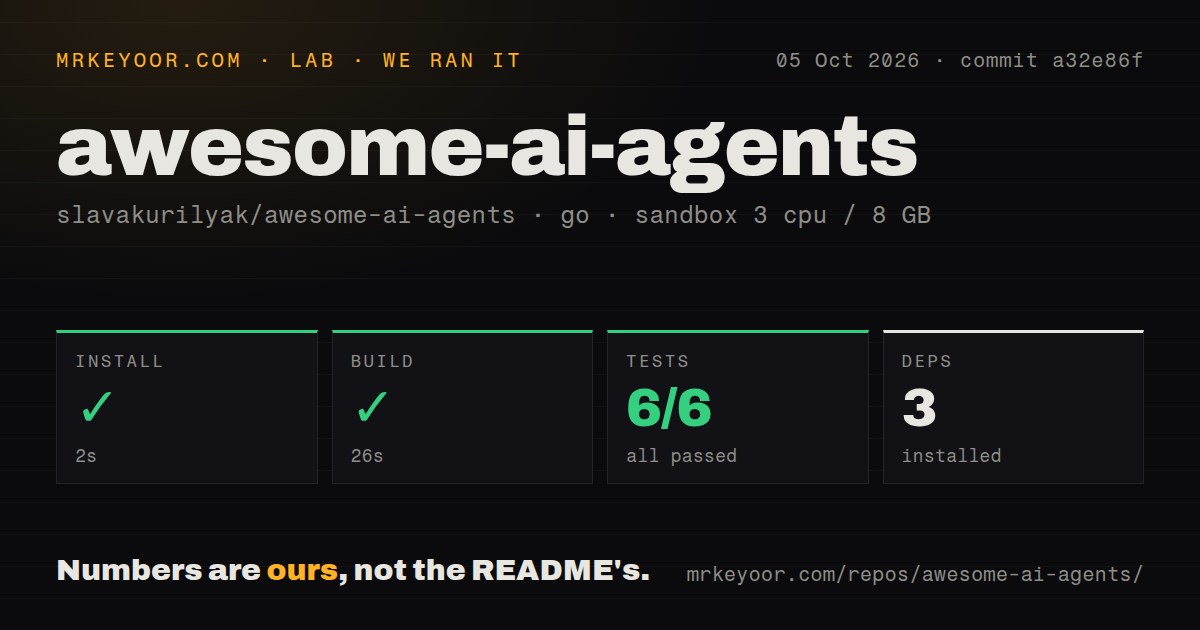
Our sandbox installed 3 packages in 2 seconds and built commit a32e86f in 26 seconds. The test command finished in 5 seconds, with 6 passing tests and 0 failures out of 6. The run used a fresh unprivileged Debian container with 3 CPUs, 8 GB of RAM, Go 1.24, and no secrets. All three measured steps succeeded.
The repository has no Dockerfile, no separate tests directory, and 0 CI workflow files. Go tests can live beside source, so the missing directory does not conflict with the 6 passing tests. The absence of visible workflows matters differently: our run proves the tested commit worked in one clean container, while the repository does not show a GitHub Actions gate that repeats those checks on every proposed change.
Star windows help discovery but cannot rank agent quality
The README publishes daily, 7-day, and 30-day growth views with explicit rules. Growth rankings exclude the top 10 projects by total stars and projects below 100 stars. The current page also admits when a window lacks enough history: its 30-day section says snapshots from September 24 to October 4, 2026, do not provide the needed early-September baseline. That is much better than manufacturing a comparison.
Stars still measure attention, not task success, operating cost, security, or maintenance quality. The directory includes 103 entries under AI Agents, 89 under Development Frameworks, and 21 under MCP Servers, with projects appearing in more than one category. Those counts are useful for browsing. They do not tell you whether an agent completes your tickets, respects a budget, or survives hostile tool output.
Six passing tests cover the catalog, not its 304 projects
The green 5-second suite is evidence for the repository's Go tooling. It does not install, build, or exercise every listed project. That distinction is easy to miss because each entry carries repository and activity metadata. Verification here means the repository exists and the record meets local structure and contribution rules; it does not mean the agent has passed a common safety or performance evaluation.
Use the list as a funnel. Choose a category, open several source repositories, discard entries with incompatible licenses or stale releases, then run the finalists on one representative task. For MCP servers, inspect permissions and tool schemas before connecting them to an agent. For hosted integrations, trace which credentials and data leave your machine. The catalog makes that second-stage work possible; it cannot do it for you.
An October 4 push matters more than the missing release tag
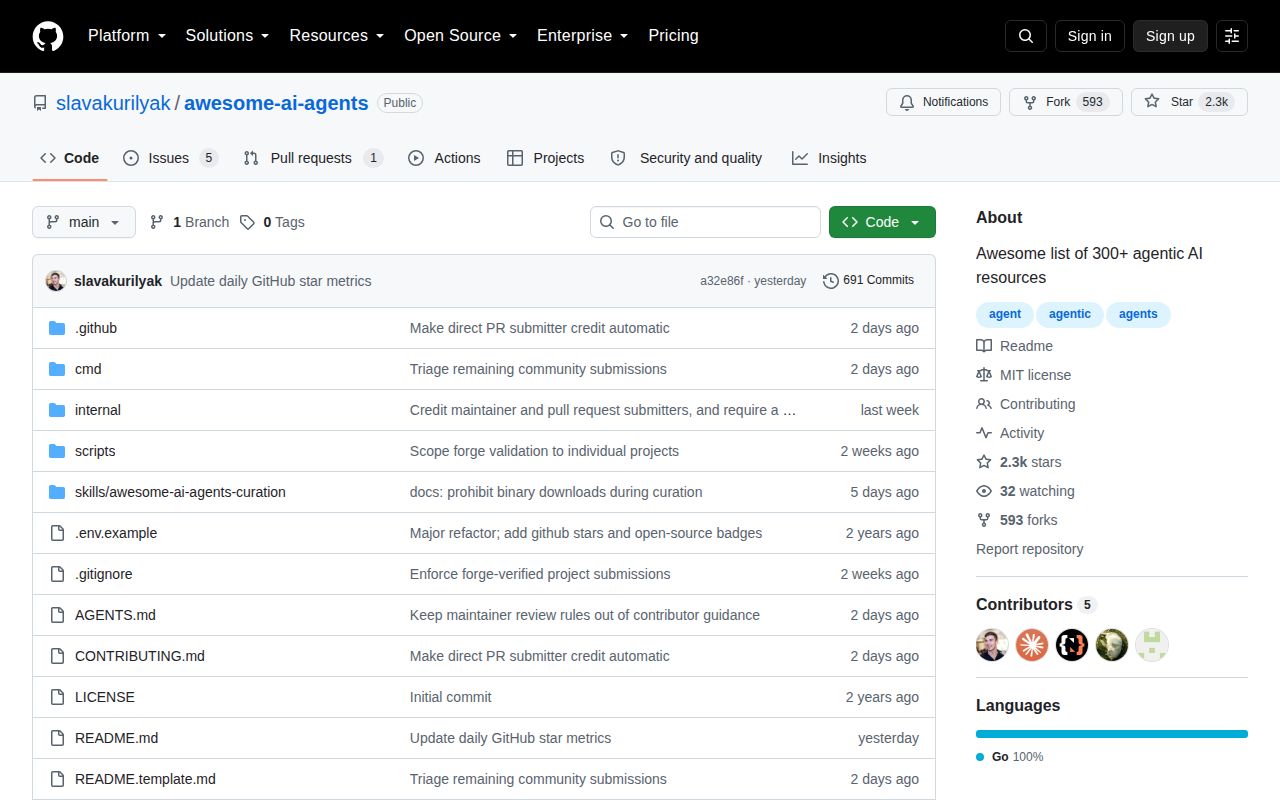
GitHub showed 2,340 stars and 6 combined issues and pull requests on October 5, 2026. API searches split them into 5 open issues and 1 open pull request, most involving project submissions. The repository was pushed on October 4. GitHub's latest-release endpoint returned no release, which is unsurprising for a generated directory and does not outweigh current edits and submission activity.
Awesome AI Agents is a good first stop when you do not yet know which agent category contains the answer. Its 304 listings give broad coverage, and the contribution guide is unusually clear about activity and provenance. Our 6-of-6 result supports the maintenance tooling, not the claims of every listing. Keep that boundary intact and the list saves research time without pretending popularity is due diligence.