The Yellow Pages for AI Agents
In the rapidly expanding universe of AI, large language models are the brains, but they are often trapped in a digital skull, unable to interact with the world. The Model Context Protocol (MCP) aims to be the nervous system, providing a standardized way for these brains to connect to hands, eyes, and ears in the form of external tools, APIs, and data sources. But a standard is useless without implementations. That's where punkpeye/awesome-mcp-servers comes in. This isn't a tool you run; it's the map you consult before you begin your journey. It's an 'awesome list' that has become the de facto directory for discovering MCP servers, solving the crucial problem of finding the right component to give your AI agent its next superpower.
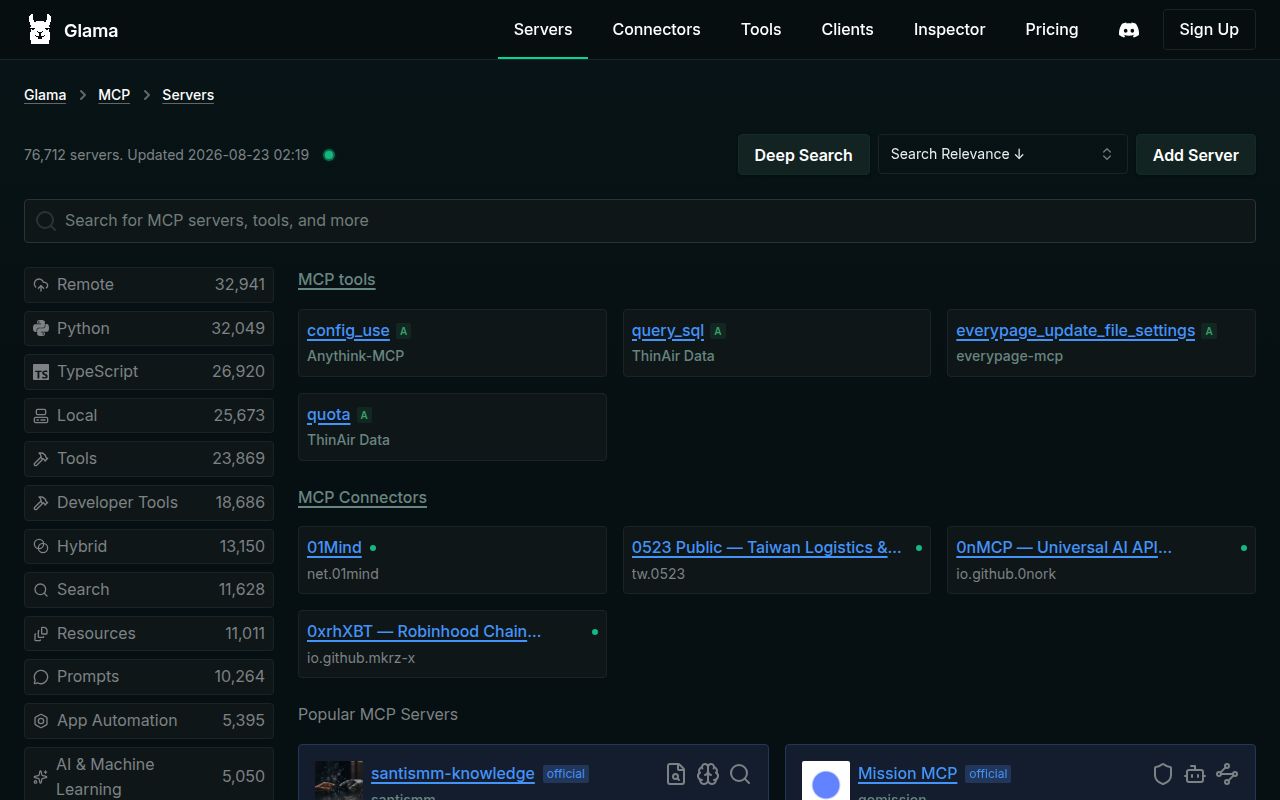
The project's brilliance lies in its structure and comprehensiveness. It doesn't just dump links into a file. The list is meticulously categorized into dozens of logical domains, from File Systems and Databases to Home Automation and Finance & Fintech. This allows a developer to immediately zero in on the exact capability they need. A clever emoji-based legend provides at-a-glance information about each server's programming language, supported operating systems, and scope (local service vs. cloud API). This simple system is remarkably effective, letting you scan for a Python-based, Linux-compatible server for OS Automation in seconds. The addition of a polished web directory at glama.ai/mcp/servers elevates it beyond a simple README, offering a searchable and more user-friendly interface that syncs with the repository.
A Glimpse into the Ecosystem
Digging into the listings reveals the sheer dynamism of the AI agent space. The Aggregators section, for instance, showcases projects aiming to be a universal translator for other tools. Correctover/mcp-server offers self-healing failover for LLM API calls, a sophisticated piece of infrastructure for production systems. Meanwhile, projects like daedalusdevelopmentgroup/ddg-agent-payable-services and forgemeshlabs/coinopai-mcp are pioneering the use of micropayments on crypto networks (USDC on Base) to create pay-per-call tool economies for agents. This is the bleeding edge, where AI, finance, and decentralized systems intersect, and this list is the best place to witness it.
A developer's workflow with this resource is straightforward: you identify a need for your agent, find the relevant category in the list, scan the entries for a match in tech stack and scope, and then click through to the project's own repository to perform due diligence. It serves as the top of the funnel for discovery, saving countless hours that would otherwise be spent searching GitHub or Google for compatible tools.
Overwhelmed by Success
The project's greatest strength, its popularity, is also the source of its most significant weakness. With over 91,000 stars, it has incredible visibility, but this has resulted in a deluge of contributions and requests that the maintainers seemingly cannot keep up with. The over 2,200 open issues are a stark indicator of this strain. While many of these are likely requests to add new servers, the sheer volume means that the list's quality control is a constant challenge. There's no guarantee that a listed project is well-maintained, secure, or even functional. The inclusion of glama.ai quality score badges on some listings is a commendable effort to address this, but it's not universally applied. Users must treat this list as a starting point for their own research, not as an endorsed list of vetted products. The lack of a formal release cycle is normal for an awesome list, but it further emphasizes that its state is fluid and commit-driven, requiring users to check back frequently for updates.
Your Starting Point, Not Your Destination
This repository is not a component in your stack; it's a resource you use to build your stack. It is framework-agnostic, focused on the MCP standard. This contrasts with ecosystems like LangChain or LlamaIndex, which bundle their own curated selections of tool integrations tightly coupled to their framework. If you are building directly with MCP, this list is absolutely essential. If you are using a higher-level framework, it remains an invaluable resource for discovering novel tools that you might then integrate. It provides a broader, more diverse view of the ecosystem than any single framework can offer.
Ultimately, awesome-mcp-servers is a vital public good for the open-source AI community. It brings order to the chaos of a rapidly innovating field. While you should approach its contents with a healthy dose of skepticism and be prepared to vet each tool yourself, there is no better or more comprehensive starting point for finding the building blocks to create truly capable and intelligent agents.