mrkeyoor.com_
Sat 17 Oct 13:32 UTC
Webevaluationupdated 08 Oct 2026

anatomy review

Anatomy, presented in the app as Anatomy Atelier, is a browser-based 3D explorer for nine human organs. It pairs rotatable models and labelled structures with short lessons, quizzes, comparisons, illustrations, and 12 interface languages.

+179stars / 7d
Verdict

Our Anatomy build passed in 30 seconds, but all 2 tests failed and npm audit reported 32 known vulnerabilities, so the attractive viewer is not yet a dependable teaching package. Use it as a small Three.js example or a casual nine-organ explorer after checking its facts yourself. Do not redistribute its models until the maintainer documents their source and license.

We ran it

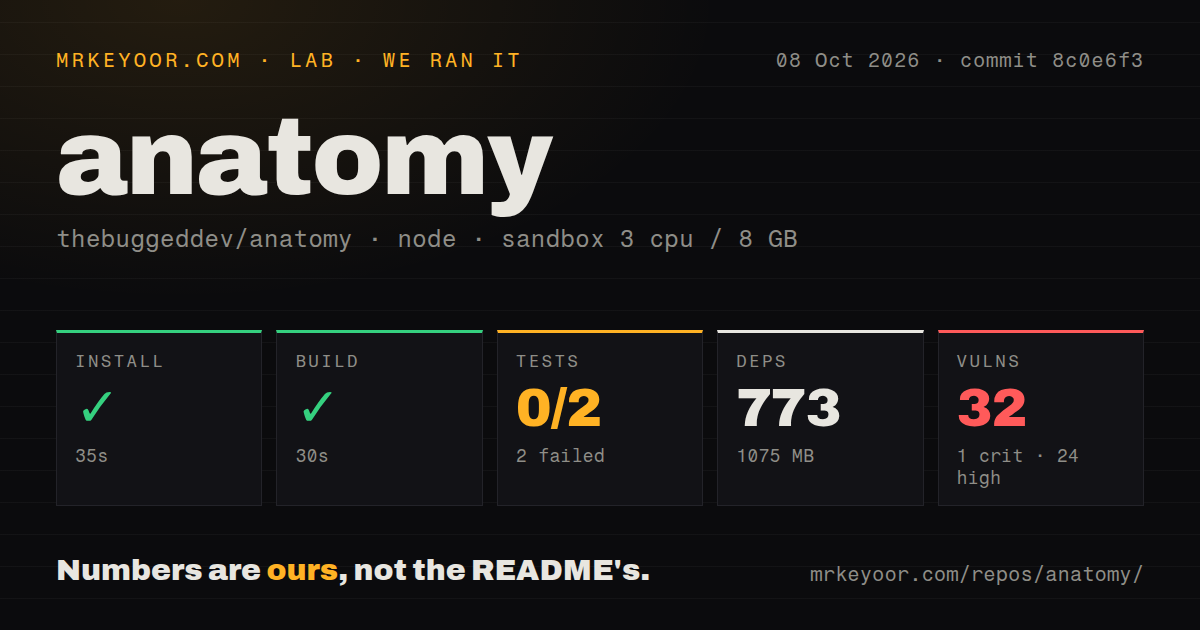
Lab card: what happened when we ran anatomyScreenshot of anatomy (anatomyatelier.vercel.app)
Install✓ · 35s773 packages · 1075 MB
Build✓ · 30s
Tests✗ · 10s0 passed · 2 failed of 2 (node:test)
Known vulns321 critical · 24 high · 6 moderate · 1 low (npm audit)
Repo131 files~6,874 lines of source · 35.3 MB · 0 CI workflows · tests dir

Answers from our run

Does anatomy build from source?

Dependencies installed in 35 seconds (773 packages), and the build succeeded in 30 seconds. We cloned commit 8c0e6f3 into a clean Debian container with 3 CPUs and no project-specific setup.

Do anatomy's tests pass?

No. The project's own test command finished in 10 seconds and reported 0 passed, 2 failed (node:test).

Does anatomy have known vulnerabilities in its dependencies?

npm audit flagged 32 known advisories in the dependency tree, including 1 critical at the time of our run.

Who should not use anatomy?

Medical teaching that requires documented model provenance or reuse rights: the repository has no license, and issues 23 and 24 ask where the GLB assets came from.

What are the alternatives to anatomy?

Human Atlas, BodyParts3D, BioDigital Human. Our Anatomy build passed in 30 seconds, but all 2 tests failed and npm audit reported 32 known vulnerabilities, so the attractive viewer is not yet a dependable teaching package.

Setup3/5The build passes, but 773 packages produce a 1,075 MB install
Docs1/5The README still describes the starter instead of the anatomy app
Community3/53,400-plus stars, but no code push since August 9
Maturity2/5Nine organs work as a concept, while tests and licensing remain open

Who it’s for

Students who want a small visual introduction to nine organs in a web browser.
Three.js developers studying model loading, hotspots, cross sections, and accessible canvas controls.
Teachers willing to review the medical copy and model labels before using it in a lesson.
Designers looking for a compact example of multilingual, right-to-left 3D educational UI.

Who it’s NOT for

Medical teaching that requires documented model provenance or reuse rights: the repository has no license, and issues 23 and 24 ask where the GLB assets came from.
Learners who need a whole-body atlas: the source contains nine organ models, not a complete anatomical system.
Teams requiring a clean dependency baseline: our npm audit found 32 known vulnerabilities, including 1 critical and 24 high severity.
Contributors who need working automated checks: our run finished with 0 passes and 2 failures out of 2 tests.
Users relying on exact hotspot placement: issue 27 reports that labels on the heart model are visibly offset.
Developers expecting the README to explain the product: it still documents a generic vinext starter and optional database scaffolding.

Setup reality

Our sandbox installed 773 npm packages in 35 seconds and used 1,075 MB on disk. The build succeeded in 30 seconds. Node's test runner failed in 10 seconds with 0 passes and 2 failures out of 2; the supplied log tail shows only the totals and does not expose either failed assertion. Npm audit found 32 known vulnerabilities: 1 critical, 24 high, 6 moderate, and 1 low.

Local development requires Node 22.13 or newer and uses vinext, Vite, Next, React, Three.js, GSAP, and Wrangler. The core anatomy viewer has no documented credential requirement. The checked-in Sites configuration declares no D1 or R2 binding, although unused Drizzle and D1 starter files remain.

The browser needs WebGL and must download the GLB models and image sets. There is no root Dockerfile and no CI workflow in the measured commit. The README's three-command quick start builds, but it describes the starter rather than Anatomy Atelier's actual content, interaction, or asset requirements.

Nine GLB organs make a focused explorer, not a full atlas

Anatomy Atelier contains 9 interactive models: heart, brain, lungs, liver, kidneys, eyeball, intestine, pancreas, and skin. Each organ has labelled hotspots with anatomical terms, a written overview, basic measurements, a medical note, and a short fact. Supporting cards show tissue, location, comparison, and organ artwork. That is enough for a guided introduction, but the name can suggest far broader body coverage than the repository provides.

The viewer itself has thoughtful controls. A learner can rotate and zoom the model, isolate structures, toggle a cross section or layers, reset the camera, and enable automatic rotation. Clicking a hotspot opens its label and detail. A quiz asks the learner to find each labelled structure once, then reports a score. These interactions make the models more useful than a passive spin-around object.

Twelve languages are built into the same organ interface

The source defines 12 locales: English, Spanish, Hindi, Chinese, Arabic, Portuguese, French, German, Japanese, Russian, Indonesian, and Korean. Arabic switches the interface to right-to-left layout, while the font loader groups writing systems. Organ facts and interface text have separate dictionaries, which is a sensible structure for translators working on medical labels without touching navigation copy.

Language breadth does not verify scientific accuracy. The application includes measurements, medical notes, conditions, and Latin terminology, yet the repository does not identify an editorial or clinical review process. Treat the text as learning material that needs checking, especially before classroom or patient use. The same caution applies to hotspot positions: issue 27 shows heart labels such as the aorta offset from the displayed structure.

What happened when we ran it

Our sandbox installed commit 8c0e6f3 in 35 seconds. Npm added 773 packages, and the installed environment occupied 1,075 MB. The source checkout contained 131 files, about 6,874 lines, and used 35.3 MB. A vinext build then completed in 30 seconds inside an unprivileged Debian container with 3 CPUs, 8 GB of RAM, Node 22, and no secrets.

The test command failed after 10 seconds. Node's runner reported 2 tests, 0 passes, and 2 failures, with no skipped or cancelled cases. The supplied log tail contains the runner summary and a stack frame from pending subtests, but not the names or assertion messages. We cannot assign a cause from that evidence. The measured commit therefore builds while offering no passing automated test in the command we ran.

Npm audit found 32 known vulnerabilities: 1 critical, 24 high, 6 moderate, and 1 low. The lab also found no CI workflow file and no Dockerfile, though a tests directory exists. A successful 30-second build is useful, but it does not answer whether the viewer behaves correctly across browsers, whether the medical labels are accurate, or whether the dependency findings reach the deployed bundle.

The README documents vinext instead of Anatomy Atelier

The 3,439-character README calls the project vinext-starter. It explains Node 22.13, optional Cloudflare D1 and Drizzle files, workspace identity headers, and ChatGPT sign-in helpers. It never describes the nine anatomy models, the quiz, the 12 languages, the Three.js viewer, or the medical content. A developer can find npm install, npm run dev, and npm run build, but not the product they are about to maintain.

Starter residue remains in the codebase too. The package name is site-creator-vinext-starter, an empty database schema and D1 example are checked in, and the README calls those optional. In the rendered interface, Systems, Library, and Notes appear in the main navigation without click handlers in the component we inspected. The anatomy work is real; the repository packaging has not caught up with it.

Missing model provenance blocks safe reuse

The repository API detects no license, and there is no root license file. Issue 23 asks for reuse terms for the models and illustrations, while issue 24 asks whether the GLB files were created by the author or sourced from another dataset. Neither issue has a documented provenance answer. Publicly readable source is not the same as permission to copy, modify, or sell the bundled assets.

That gap changes the recommendation for developers more than a rough button does. You can inspect the Three.js loading, hotspot, disposal, quiz, and localization code. You should not assume you can carry the 9 models or their illustrations into another product. Human Atlas or the BodyParts3D files are clearer starting points when a documented source dataset is part of the requirement.

An August 9 push and 27 open items signal a young project

GitHub recorded the last code push on August 9, 2026, one week after the repository was created, and listed 27 open issues and pull requests combined. The API returned no latest release. Issue discussion continued into September, including licensing, model provenance, hotspot placement, and a report about a separate custom domain. The project attracted more than 3,400 stars quickly, but its release and maintenance history is still short.

Anatomy Atelier is easy to admire as an interface study. Nine models, 12 languages, label quizzes, and WebGL controls make it unusually complete for a small visual project. The decision changes once accuracy, redistribution, or maintenance enters the room: 2 failed tests, 32 audit findings, no asset license, and an unrelated README leave too much for a school or product team to resolve on its own.

Alternatives

ProjectWhat it isPick it when
Human Atlas gh↗An open browser atlas with thousands of selectable BodyParts3D meshes and system layers.pick this instead when anatomical breadth and separately selectable structures matter more than a curated nine-organ lesson.
BodyParts3DA repository of BodyParts3D and Anatomography model files for building your own anatomy viewer.pick this instead when you need an attributed model dataset rather than a finished learning interface.
BioDigital HumanA commercial web platform for interactive 3D anatomy and health education.pick this instead when reviewed content, broad body coverage, and vendor support matter more than source access.

What people are saying

  1. [github-trending] thebuggeddev/anatomy
  2. [hackernews] Anatomy of a Lean proof for software engineers
  3. [producthunt] PC Anatomy
  4. [hackernews] Anatomy of a Texture
  5. [hackernews] Open-source 3D anatomy explorer: 2,234 selectable BodyParts3D meshes

Sources

  1. Anatomy repository README
  2. Anatomy application component
  3. Anatomy viewer controls
  4. Anatomy model definitions
  5. Model licensing question
  6. Heart label position report
  7. Measured Anatomy commit

More web reviews

dioramas · elpis · deepseek-whale-girl · floorplan-3d · taro · driver.js · the whole board →