AI SDK is strongest where model output meets a web interface
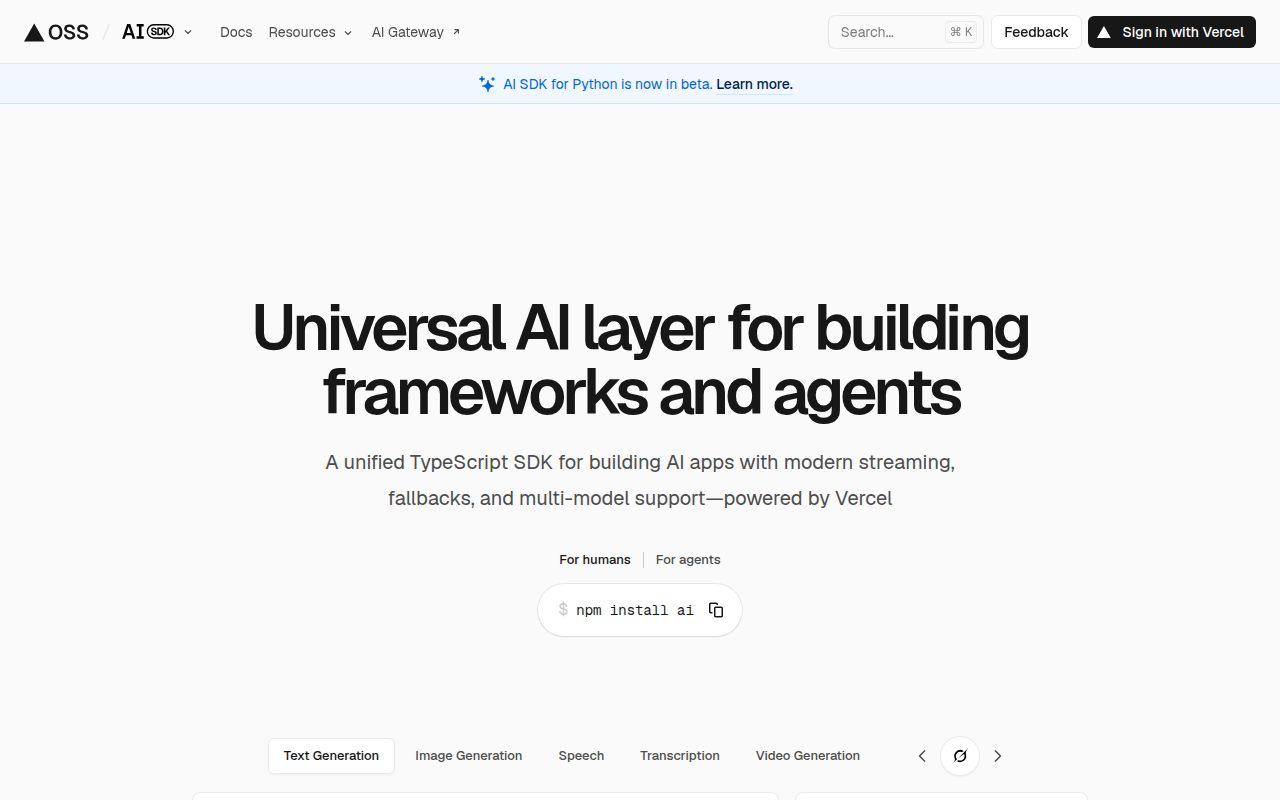
AI SDK wraps text generation, structured output, tool loops, and streamed UI messages in TypeScript APIs. The provider layer can address OpenAI, Anthropic, Google, and other services through Vercel AI Gateway or through separate packages that connect directly. On the client side, framework packages translate streamed model and tool states into messages a React, Svelte, Vue, or Angular application can render. That combined server-and-interface scope is the reason to choose it over a thin vendor client.
Node.js 22 or newer is required by the README. A basic application installs ai; direct connections add packages such as @ai-sdk/openai or @ai-sdk/anthropic, while React UI adds @ai-sdk/react. This modular packaging lets a product stay narrow, even though the source repository covers many providers, frameworks, and examples. The distinction matters because the contributor checkout we measured is far larger than the dependency footprint suggested by the one-line consumer installation.
Provider choice is easier, but provider details still matter
The unified calls are useful. generateText can accept a gateway model string or a provider-created model object. Structured output pairs the generation call with a Zod schema, so the application handles a typed result rather than parsing free text afterward. Agent code can define tools and let ToolLoopAgent continue through model and tool turns. These are common jobs with enough shared shape to justify one application API.
The repository had 1,769 open issues and pull requests combined on August 25, 2026. Same-day work included xAI usage metadata, Moonshot model options, provider file handling, embedding batch limits, and durable video generation. That activity shows the maintenance cost of normalizing providers whose APIs keep moving. It also warns against assuming perfect interchangeability: model names, metadata, multimodal inputs, reasoning controls, and hosted tools can remain specific to one vendor even when the top-level function name stays stable.
Tool execution is your security boundary
The README's agent example gives a model a local-shell tool, but the tool implementation obtains a Vercel Sandbox and runs the command there. AI SDK defines how a model requests a tool and how the result returns to the loop. It does not make an arbitrary command safe. A production team still owns argument validation, isolation, timeouts, permissions, output limits, auditing, and user confirmation for consequential actions.
That example uses one shell tool and a model string, yet it depends on an external model service and a sandbox runtime. Credentials and billing remain outside the library. Direct provider packages can avoid the gateway, while the gateway can centralize provider access. Choose that boundary deliberately. A team with strict data-residency or vendor-contract rules should verify where prompts, attachments, tool results, and telemetry travel before adopting the convenient default.
What happened when we ran it
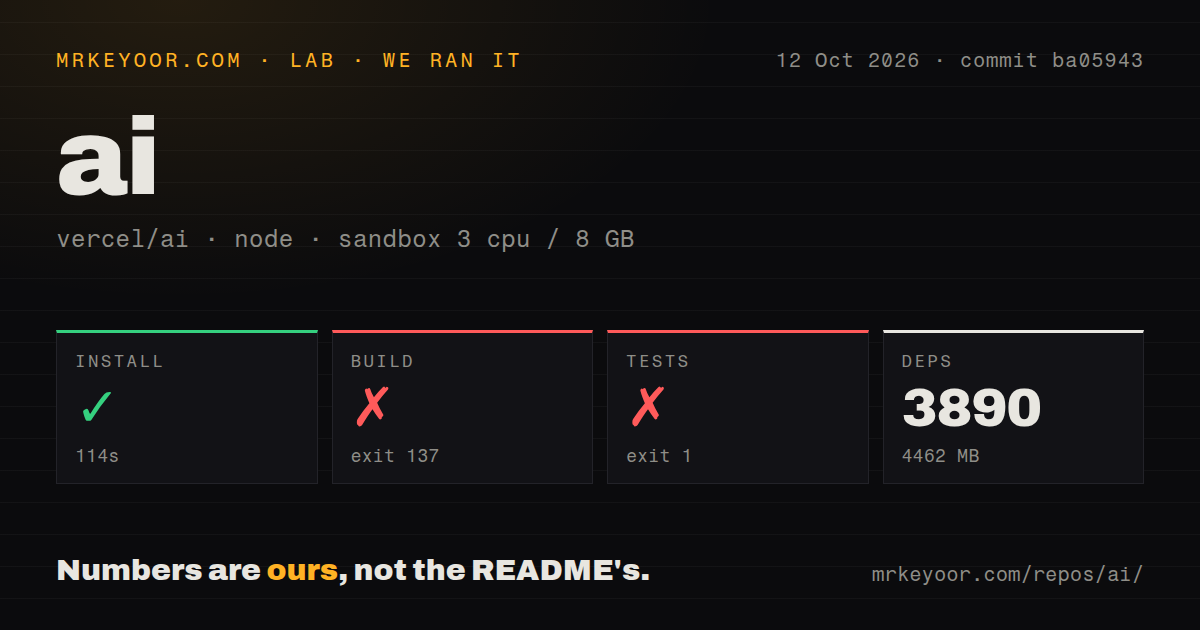
Our fresh Node 22 sandbox cloned commit 6e27135, then installed 3,731 packages in 76 seconds. Dependencies occupied 4,066 MB on disk, compared with a 79.8 MB checkout containing 8,276 files and about 885,841 source lines. Installation succeeded, which confirms that the pinned pnpm workspace resolved without secrets in the unprivileged container. It does not mean every provider or example was ready to execute.
The build failed after 221 seconds. Turbo reported 67 successful tasks out of 91, then named @example/next-openai-pages#build as the failed command. The log tail also showed lifecycle failures for Next.js, FastAPI, agent, SvelteKit, Nuxt, and telemetry examples. Those final lines do not establish one shared cause, so we will not invent one. They show that the repository-wide build did not pass in the stated fresh environment.
Tests failed after 15 seconds. The summary named failures in Replicate, Google, fal, AssemblyAI, Gladia, provider-utils, Voyage, and other packages, ending with exit code 1. The checkout exposed 12 CI workflow files, no root Dockerfile, no conventional tests directory, and pnpm monorepo workspaces. Our run therefore supports a practical split: consuming a focused package is approachable; reproducing the maintainers' complete validation environment takes more context than install alone supplied.
The UI layer saves the most product code
Streaming is where a direct model SDK often leaves substantial work to the application. AI SDK UI models messages as parts, including text and typed tool invocations, and exposes status through hooks such as useChat. The README's image-generation example renders a pending tool state differently from a completed output. That is a concrete pattern for interactive products, where a response is a sequence of state changes rather than one final string.
The source tree spans about 885,841 lines, which explains both the coverage and the cost of moving with it. Framework support broadens the audience, but applications should isolate SDK-specific message shapes behind their own boundary. Pin versions, read migration notes, and test saved conversations plus tool states during upgrades. Same-day provider releases are good evidence of care; they also mean a permissive version bump can touch behavior close to users.
Choose it for TypeScript product work, not abstraction for its own sake
AI SDK fits teams that would otherwise build provider adapters, stream parsers, tool-state models, and chat hooks themselves. Its documentation reaches useful code quickly, and direct provider packages keep the gateway optional. The coding-agent skill can also place current SDK guidance inside Claude Code or Cursor, which is sensible for an API surface that changes often.
A small server that makes one text call may be clearer with the provider's official client. Retrieval-heavy systems may prefer LangChain.js, while workflow-centered agent products should compare Mastra or Genkit. AI SDK wins when provider choice and a responsive TypeScript interface are both core requirements. Our failed 91-task monorepo build should affect contributor expectations, not erase the value of the smaller published packages.