Four SDKs share one server-side AI framework
Genkit's 463,760-line repository packages model calls, structured output, tool use, retrieval, prompts, chat, and multi-step flows behind APIs for 4 languages. The JavaScript and TypeScript plus Go SDKs are described as production-ready; Python is beta, and Dart is preview. That range is useful for organizations with more than one backend language, but the stability labels matter. A team standardizing on Python or Dart would be adopting a younger surface than colleagues writing the same feature in TypeScript or Go.
The project is aimed at application code rather than model hosting. Across 4 SDKs, Genkit connects to providers through plugins, runs AI logic on the server, and exposes client helpers for frameworks and mobile apps. The README names Firebase and Google Cloud Run as deployment choices while also allowing other hosts that support the selected language. The framework owns orchestration and developer tooling; model availability, prices, rate limits, and data handling still come from whichever provider a team configures.
Five named provider routes still require provider-specific choices
Genkit's README names 5 model-provider routes across its examples: Google, OpenAI, Anthropic, Ollama, and Vertex AI. A unified generation call can reduce application churn when models change, and Genkit also standardizes structured responses, multimodal input, tool calls, and retrieval. Yet each route starts with a plugin, model identifier, and authentication setup. The basic Google example expects an API key, while Vertex AI may use another authentication method. Portability is useful here, but it is not automatic provider interchangeability.
Provider differences also surface in releases and open bugs. Python SDK v0.11.0 standardized several provider failures as GenkitError, but its notes still say Bedrock and Ollama lack the typed model-reference constructors available for some other plugins. Open issue 6161 reports a JavaScript MCP schema case involving an array whose items use $ref. Teams with tool-heavy agents should keep contract tests for the exact provider, language SDK, JSON schema shapes, and model IDs they plan to ship.
What happened when we ran it
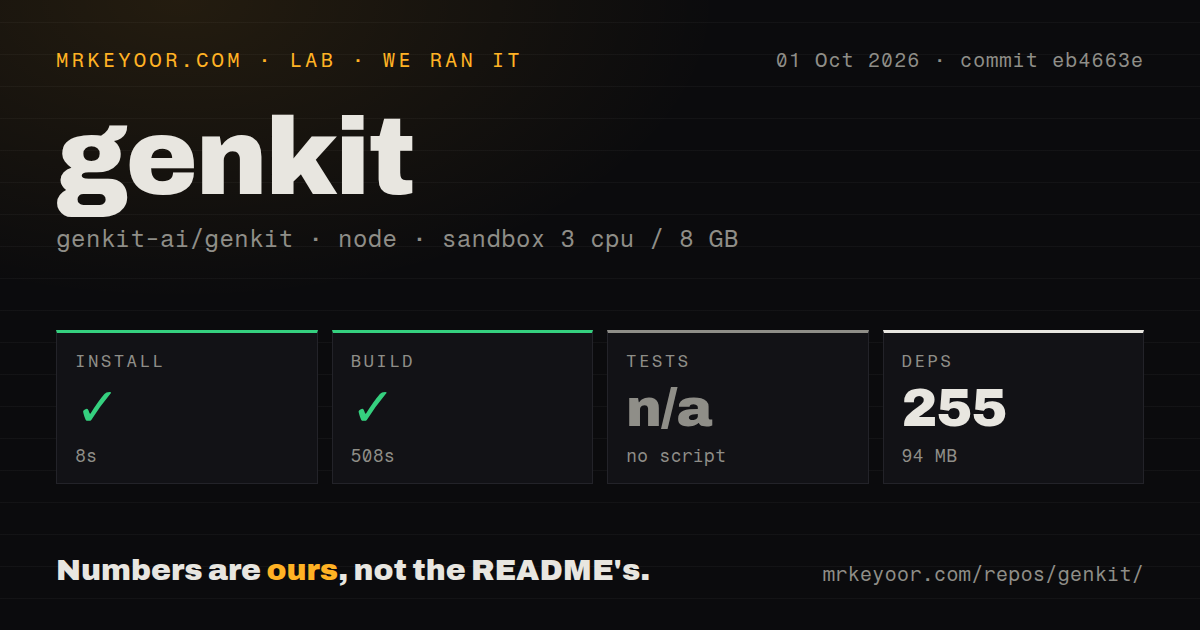
Our sandbox installed 255 pnpm packages in 8 seconds, leaving 94 MB on disk. The build completed successfully in 407 seconds. That gap is the setup story in one line: obtaining dependencies was quick, while compiling the checked-out source demanded nearly 7 minutes. The 52.8 MB checkout contained 2,569 files and about 463,760 lines of source, so contributors are entering a large multi-language project rather than a small TypeScript helper.
We did not report a passing or failing test suite because the repository exposed no test script or target to our runner. The step was skipped. Our scan did find a tests directory and 19 CI workflow files, which shows test-related material and automation exist even though the generic target was absent. There was no Dockerfile in commit 8e230ef. Our measurement setup was a 3-CPU, 8 GB, unprivileged Node 22 sandbox, and it did not measure model latency or output quality.
The local trace UI still has an interrupt-resume failure
Two open issues cover interrupt handling in Genkit's local tools. Issue 5844 says resuming a tool that expects a response fails in the Developer UI, while issue 6123 tracks interrupts during long-running operations. Neither report proves that deployed flows fail the same way, but both affect the interface developers use to inspect and recover agent work. If human approval or interrupt-and-resume behavior is central to a product, reproduce those paths before choosing the UI as an operations console.
The 2 local tools split duties: the CLI starts an application with telemetry, while the Developer UI runs flows, inspects traces, and evaluates outputs against datasets. That is more useful than a provider console when one request crosses prompts, retrieval, and several tools. The interface puts execution details next to the code path an application owns. It also gives prompt work a repeatable place to inspect results instead of leaving every experiment inside ad hoc scripts.
Two production-ready SDKs make the language choice consequential
Python SDK v0.11.0 shipped on September 3, 2026, while the README reserves its production-ready label for JavaScript and Go. The release notes include behavior changes: generate() now returns certain leftover model responses instead of throwing, and provider HTTP failures arrive as a common error type. That is useful progress, though applications upgrading from v0.10.0 must change exception-driven branches described in the release notes.
Dart is earlier still, with the README calling it a preview with core functionality. A mixed-language company should therefore choose Genkit per service instead of treating the 4 SDKs as interchangeable implementations. TypeScript teams get the clearest fit, especially beside Next.js, React, Angular, iOS, or Android client helpers. Python adopters should read release notes closely, and Dart teams should accept that the documented stability promise is below production-ready.
A September 2026 push shows activity, while 778 open items need sorting
GitHub showed 6,408 stars and a last push on September 6, 2026. The latest release, Python SDK v0.11.0, was published on September 3. Those dates point to active maintenance across code and releases. GitHub also reported 778 combined open issues and pull requests; separate searches found 534 issues and 244 pull requests. That queue is large, although a large multi-language repository also creates more places for requests, bugs, and active contributions to accumulate.
Genkit makes the most sense when its full workflow is the purchase: typed model calls, tools, retrieval, local inspection, evaluation, deployment guidance, and production telemetry. The Apache-2.0 license leaves room for commercial use, and Google's Firebase team says it uses the framework in production. The 407-second source build, uneven SDK maturity, and open interrupt-resume issue are the costs to price in. For one model call inside one TypeScript endpoint, Vercel AI SDK or a direct provider client may be easier to own.