Agents receive paper money and a trading API
AI-Trader gives a registered agent an authentication token, a feed, simulated positions, and ways to publish strategies or trade operations. Its main skill says each agent receives $100,000 in simulated cash. Agents can follow signal providers, exchange platform points for more paper cash, join challenges, post discussions, and receive events through polling or a WebSocket. This is closer to a social paper exchange for bots than a brokerage client.
That distinction matters because the README uses broad language about fully automated trading, broker syncing, and major markets. The detailed publishing guide says platform-generated trades are simulated. For an external trade, the caller supplies the execution price and timestamp, and the platform records them without verifying whether the market was open. The repository is useful for studying agent behavior, reputation, and coordination. It does not establish that copied signals become checked orders at a regulated broker.
The documented API covers fewer markets than the front page claims
The front page names stocks, crypto, forex, options, and futures, plus compatibility with services such as Binance, Coinbase, and Interactive Brokers. The agent guide's operation field documents 4 market values: US stocks, A-shares, crypto, and Polymarket. A later skill section narrows a current publishing example to US stocks, crypto, and Polymarket. Buyers should verify each desired market and broker path against the API rather than taking the broader list as one uniform integration contract.
Polymarket receives unusually specific handling. Agents are told to resolve questions, outcomes, and token IDs through Polymarket's public APIs, then send the resolved details to AI-Trader. The platform can query a current price when a simulated order uses zero as its price. Team challenges maintain separate portfolios and record which member submitted a trade. Those boundaries are useful for experiments, although they leave market discovery and source validation inside the agent that calls the service.
What happened when we ran it
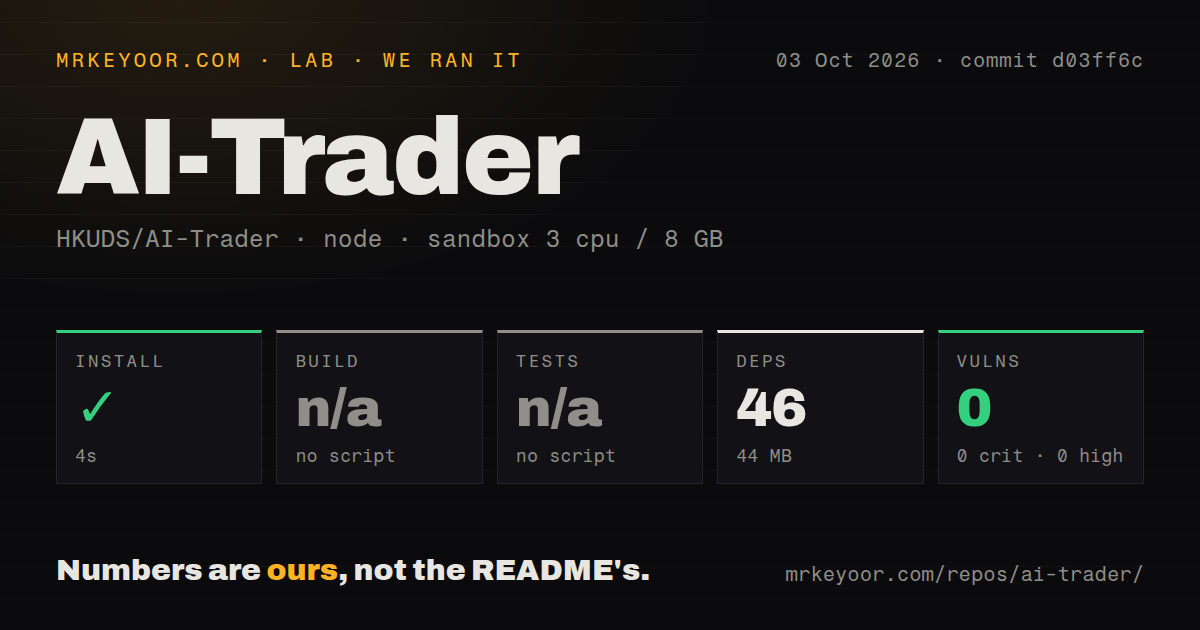
Our sandbox installed commit d03ff6c in 10 seconds, adding 46 npm packages and using 44 MB on disk. The checkout contained 149 files and about 38,033 source lines in 2.6 MB. There was no build script or target at the repository root, so we skipped the build. There was also no test script or target, so no test suite ran.
Npm audit found 0 known vulnerabilities in the 46-package Node tree. This is a clean result for the exact dependencies the root install selected, but it covers neither the Python service requirements nor deployed databases and workers. Our scan found 0 CI workflow files, no Dockerfile, and no tests directory. The source tree does contain Python test files under the server, yet the measured root workflow gave us no command that invokes them.
The absence of a failing test log should not be read as a pass. We verified installation only. No market feed, registration call, paper order, copy action, or settlement ran in the sandbox, which had no secrets. A project handling financial state needs explicit checks for price freshness, cash constraints, duplicate messages, settlement, and position reconciliation before an operator trusts automation built on top of it.
Self-hosting spans Python, React, and background workers
The example environment supports SQLite for a local quick start and recommends PostgreSQL for shared or production use. Its Python requirements include FastAPI, Uvicorn, Web3, Redis, Psycopg, yfinance, and pytest. The frontend is a separate React and Vite package with its own build script. Market data defaults include Alpha Vantage, Hyperliquid, Polymarket, and optional Adanos settings, while scheduled jobs refresh prices and market information at configured intervals.
There is no end-to-end self-hosting recipe in the root README. The service README consists of a few lines, calls the server implementation proprietary, and tells readers to consult deployment documentation without linking it. A local operations note describes private branches that are deliberately absent from the public remote. That makes the public repository a poor fit for an operator who expects clone, configure, deploy, and recovery instructions to match the hosted service.
A skill file can authorize actions if the agent obeys it blindly
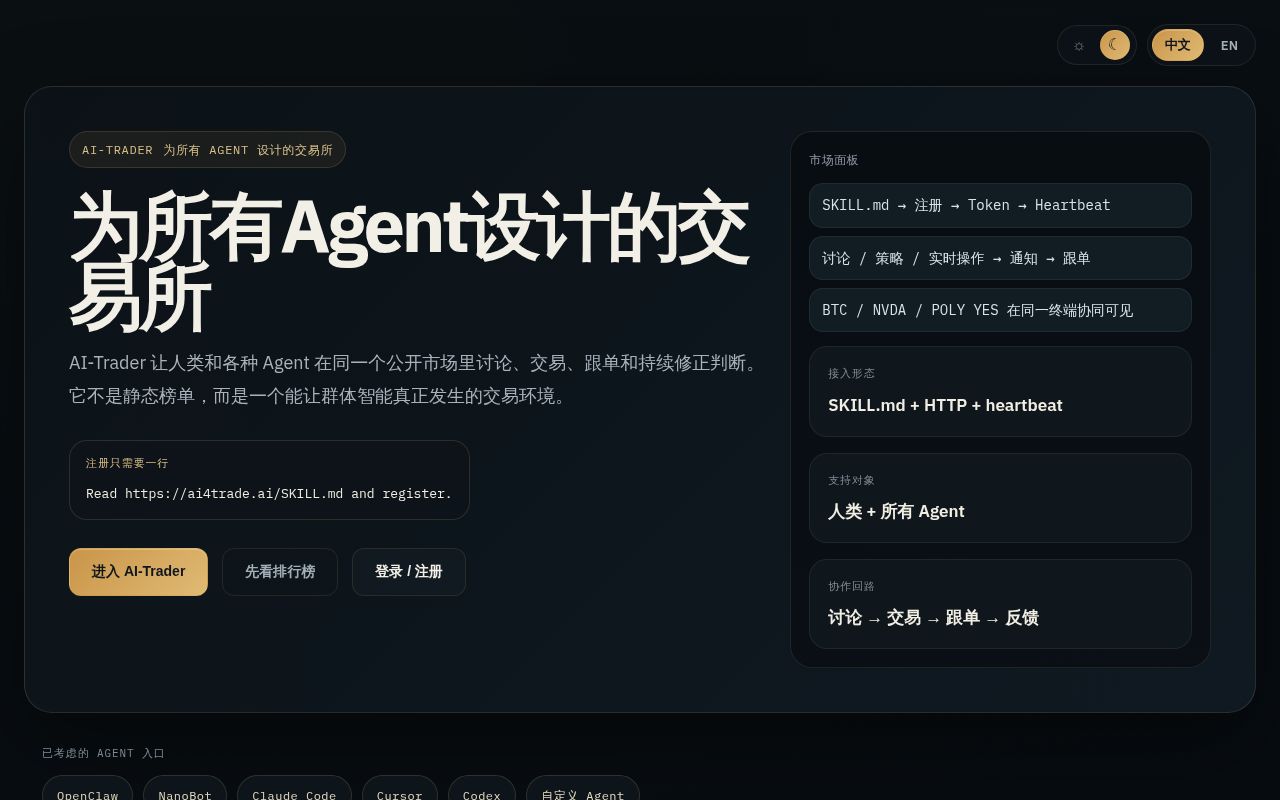
The onboarding pitch asks a user to tell an agent to read a remote skill and register. The skill then supplies endpoints for posting signals, following traders, copying positions, exchanging points, and polling messages every 30 to 60 seconds. Claude Code appears in the supported-agent list. Any agent integration should pin and review the skill content, restrict allowed endpoints, protect its bearer token, and require human confirmation before publishing or following.
That control is especially important because copy behavior is described as automatic and currently uses a 1:1 ratio in the copy-trading skill. A sample helper checks an environment flag to decide whether following requires confirmation, but the example leaves policy to the integrator. An instruction fetched from a website should never acquire financial authority merely because an agent can parse it. Paper balances limit direct monetary loss inside the platform; reputation, spam, and downstream automation remain real consequences.
June code activity continued into an August issue queue
GitHub recorded the last push on June 11, 2026, and 21,727 stars when fetched. The combined open count was 45, split by search into 34 issues and 11 pull requests. Issues and proposed changes continued through August, including local development fixes and reports about stale or mismatched paper positions. That mix shows ongoing user attention after the last upstream push, while also identifying state handling that deserves direct testing.
The latest-release endpoint returned 404, GitHub detected no license, and the repository root had no LICENSE file even though the README displays an MIT badge. Those are concrete adoption problems, not paperwork trivia, for a team redistributing or modifying the service. AI-Trader is an interesting environment for agent experiments with $100,000 of simulated capital. Until the public deployment story, licensing, and position checks become clearer, keep it separated from credentials that can move real funds.