One provider layer feeds Python, CLI, REST, Excel, and MCP
OpenBB calls its open-source core the Open Data Platform. A provider extension maps an outside financial source into common routes, so the same data can reach Python code, the terminal, a FastAPI service, Excel, Workspace, or an MCP client. The attraction is organizational: one integration can serve analysts, quants, dashboards, and agents without every consumer learning the provider's request format.
The smallest Python example imports obb, requests historical prices, and converts the result to a DataFrame. The CLI wraps the same platform and adds interactive navigation plus routine scripts for automated collection. A local API can listen on 127.0.0.1:6900, then connect to OpenBB Workspace. Those surfaces share an extension catalog, but they remain separate runtimes with their own deployment and access-control choices.
What happened when we ran it
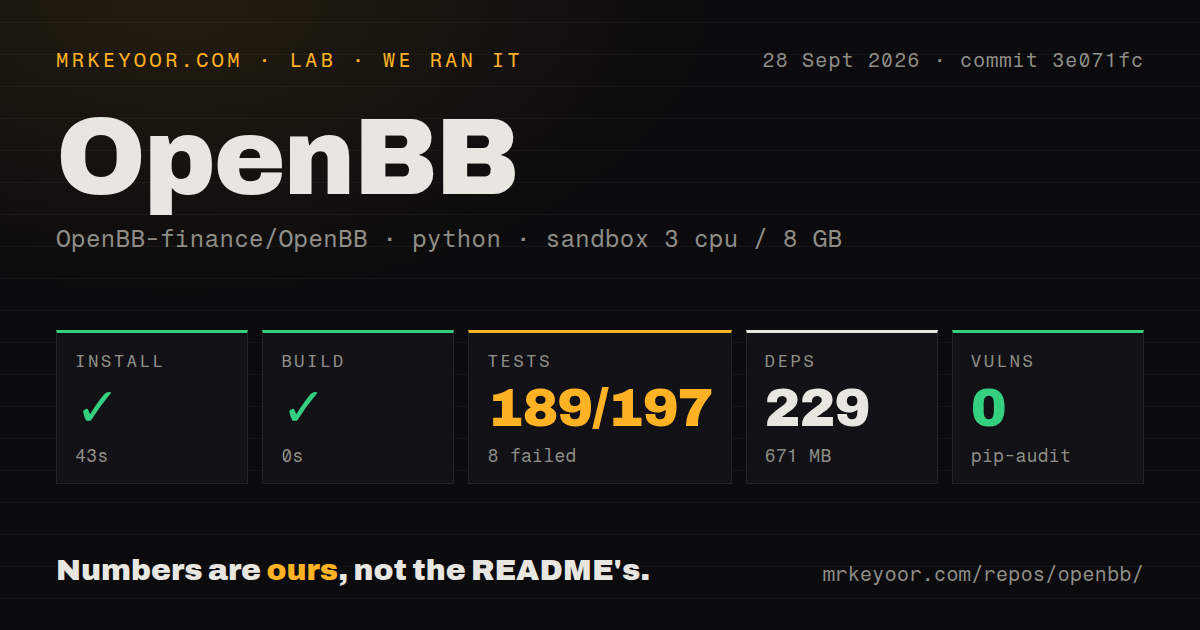
Our sandbox installed commit 3e071fc from the ./cli/ project in 43 seconds. It pulled 229 packages and used 671 MB on disk. The build step succeeded immediately and recorded 0 seconds. The checkout itself held 2,190 files, roughly 289,320 lines of source, and occupied 239.4 MB. We found 16 CI workflow files and a tests directory, but no Dockerfile.
Pytest ran for 33 seconds and exited with status 1. It reported 189 passed and 8 failed out of 197. Pip-audit found 0 known vulnerabilities in the installed environment. That audit result is useful and narrow: it does not verify provider data, license compliance, credential handling, or every service in the monorepo. The test result also means the measured CLI checkout did not clear a full fresh-container gate.
Eight integration commands exited before returning data
All 8 failures came from integration/test_commands.py::test_launch_with_cli_input. The cases covered equity history through FMP, yfinance, and Polygon; crypto, currency, futures, and ETF history through FMP; plus /economy. Each ended with SystemExit: -1. The supplied log tail does not include the earlier exception or response that led to those exits, so it does not prove a credential problem, network problem, or application defect.
The breadth of that list still matters. One passing unit suite cannot stand in for live checks across every provider and asset class. Before adoption, choose the exact routes you need and run them with the production credential set, account tier, symbols, date ranges, and rate limits. Record the raw provider response beside OpenBB's normalized object. Our 189 passing tests support the codebase; the 8 exits leave those end-to-end CLI paths unresolved.
Provider credentials remain separate contracts
OpenBB connects public, licensed, and proprietary sources. A common call shape reduces application code, but each provider keeps its own key, entitlement, quota, coverage, and redistribution terms. Issue 7628 documented that a standard OpenBB 4.7.2 install leaves most provider credentials unset. Before its September closure, a missing EIA key returned HTTP 500 and caused Workspace widget validation to reject an otherwise healthy local backend.
That report was closed on September 17, so it should not be presented as an unfixed current bug. Its setup lesson remains useful: install only the providers the team can operate, store keys outside notebooks and shell history, and test the missing-key response. The CLI's all-extensions install is convenient for exploration. A production API deserves a smaller declared provider set, explicit secrets, and monitoring that distinguishes missing access from an upstream outage.
Normalized fields still need source-level checks
The README says OpenBB data is not necessarily accurate and warns against relying on it for trading decisions. Open issue 7634 gives that warning a concrete shape in openbb-sec 1.6.7. The reporter found missing debt tag mappings for several issuers and an operating-income rollup equal to total revenue when no expense subtotal existed. Those are material field errors, even though the interface returned a structured result.
For research, retain provider names, retrieval timestamps, raw identifiers, and the transformation version beside each dataset. Reconcile a sample against filings or the licensed source before a metric reaches a screen, report, model, or agent. An MCP client makes financial data easier to ask about; it also makes an incorrect normalized number easier to repeat. OpenBB reduces integration work. The buyer still owns provenance and validation.
September activity matters more than the moving release pointer
GitHub showed 73,602 stars, 51 open issues, and 43 open pull requests on September 29, 2026. The repository was pushed on September 28. The releases/latest endpoint points to a moving ODP Desktop tag describing v1.0.2 from April 25, which does not capture current package work. On September 28, the project tagged openbb-cli-v2.0.1 after merging its release pull request into the v5 branch.
The default develop branch still declares CLI package version 1.4.2 with openbb 4.7.2, while the v5 branch has moved the CLI line to 2.0.1. That is active development, not abandonment, and it is also a migration boundary. Pin the branch, package versions, provider extensions, and generated interfaces together. Test upgrades against saved commands before changing an analyst workstation or shared API.
Use OpenBB to consolidate providers, then verify the output
OpenBB makes sense when the alternative is maintaining the same provider plumbing for 3 or more consumers. Its extension model, Python objects, CLI, API, and MCP route give a data team one place to own that work. The cost is visible in our run: 229 packages, 671 MB, and 8 failed integration cases even though 189 tests passed. This is infrastructure, not a lightweight quote lookup.
A one-provider notebook should start with yfinance or pandas-datareader. A backtesting and execution team should compare LEAN. Choose OpenBB when the provider catalog and common schema remove duplicated engineering across a real organization. Keep the recommendation conditional on field-level checks, pinned extensions, and a credential inventory. The project can unify access, but only your acceptance data can establish whether a normalized number is fit for a financial decision.