
The repository is a Chinese learning map, not an AI framework
ai-guide collects explanations and tutorials rather than shipping a model, agent, or developer SDK. The main Vibe Coding course starts with basic concepts, then moves through tool choice, small projects, prompting, context management, code quality, product design, monetization, SEO, and further programming study. Separate folders cover DeepSeek, AI use cases, technical analysis, project tutorials, industry news, and an OpenClaw guide. The online site reorganizes this material for browsing.
That breadth is the main attraction. A beginner can discover Cursor, Codex, Claude Code, MCP, local deployment, prompt writing, no-code tools, Spring AI, and LangChain without assembling a reading list first. GitHub showed 19,192 stars and only 2 combined open issues and pull requests when fetched. The repository was pushed on August 21, 2026, so it is not a forgotten link dump, though the small issue queue gives little public evidence about editorial corrections.
English readers receive one translated course, not the full library
Chinese is the default README, file structure, navigation language, and voice. An English link is visible near the top, which is better than making international readers discover translations by accident. The actual translations/en directory contains the Vibe Coding beginner tutorial subtree. It does not mirror every top-level area shown in the Chinese repository, such as the full AI directory, OpenClaw guide, author material, and product-service pages.
That makes the project reasonable for an English reader interested specifically in Vibe Coding, but weak as a full English AI reference. The Chinese copy also carries a distinct personal style, with emphatic claims, jokes, community invitations, and the author's own services. Translation should preserve useful technical meaning without being mistaken for independent evaluation. English-only teams will get a more consistent path from Microsoft's lesson repositories.
What happened when we ran it
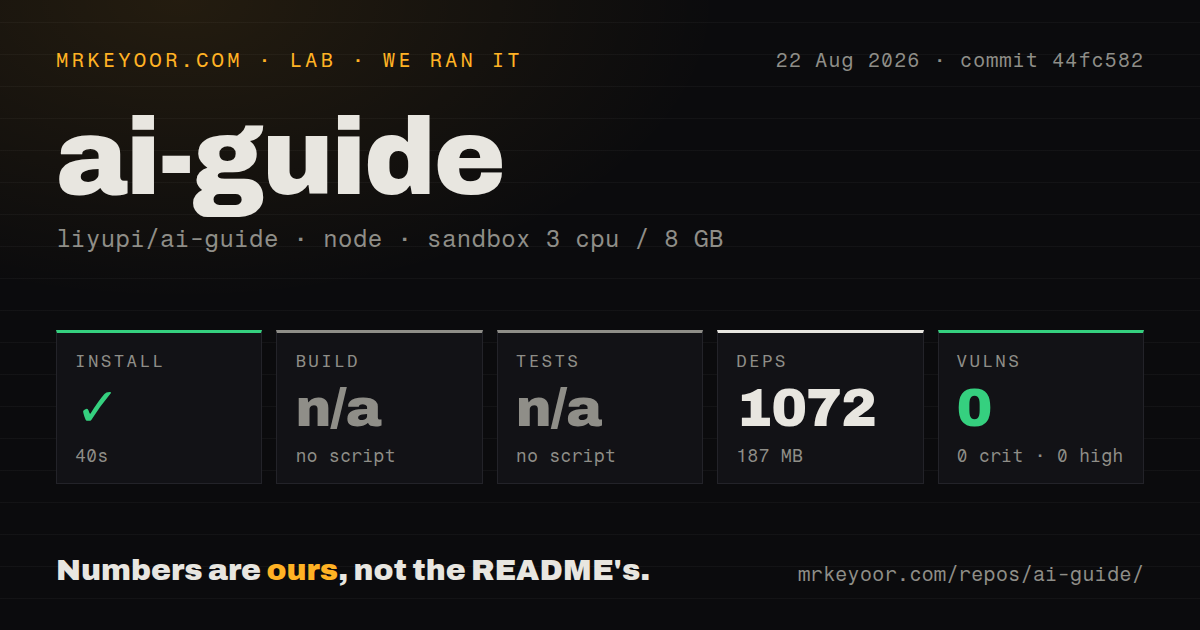
Our sandbox installed commit 44fc582 in 40 seconds on 3 CPUs with 8 GB of RAM. npm added 1,072 packages and used 187 MB on disk. The checked-out repository itself was 8 MB, with 585 files and about 4,222 source lines. Those figures describe the documentation tooling and source checkout, not the size of all remote images, hosted pages, or videos linked from the material.
The harness found no standard build script or target, so it skipped the build. It also found no standard test script or target and ran no tests. npm audit reported 0 known vulnerabilities across the installed dependency set. The scan found 2 CI workflow files, no Dockerfile, and no tests directory. A clean install is still useful evidence that contributors can obtain dependencies, but it does not prove the site renders or that internal and external links resolve.
Practical projects come before computer-science depth
The curriculum is built around making something quickly. The README promises a first Vibe Coding result in 10 minutes, then suggests simple projects during the first 1 to 2 weeks. Later sections address full-stack applications, mini programs, product requirements, architecture, revenue models, search visibility, and content operations. That sequence is motivating for a non-programmer who needs a visible outcome before committing to deeper study.
It is less suitable for someone asking how transformers work, how to evaluate retrieval, how to secure an agent, or how to operate a model service. The repository links to model principles and development frameworks, but its center of gravity remains tool use and product creation. Microsoft's AI for Beginners offers a broader conceptual foundation, while Datawhale's LLM Universe is a better Chinese alternative when RAG and application engineering are the central goals.
Tool reviews need a date check before they guide spending
The navigation includes reviews and tutorials for fast-changing products and models. Headlines cover GPT, Claude, Cursor, Gemini, OpenCode, Gemini CLI, and other services. A reader should treat each article as a dated snapshot. Model availability, free tiers, usage limits, interface behavior, and subscription terms can change faster than a tutorial collection can revise screenshots and recommendations.
The repository has no GitHub release history, so there is no tagged edition that freezes a curriculum state. Health is better judged from the August 21 push and the current content tree than from releases. For a decision involving money or production architecture, follow the linked lesson with official documentation and a fresh trial. The guide is strongest at discovery and orientation, where one imperfect map is still more useful than dozens of unexplained product names.
Reuse rights need clarification beyond package metadata
GitHub's repository endpoint returned no detected license, and the root listing did not show a LICENSE file. The package manifest labels the project MIT, but package metadata alone is an unclear basis for reusing a large body of prose and images. Reading and contributing through the repository is straightforward. Republishing, translating outside the project, or bundling the material commercially deserves permission or legal review first.
For its intended Chinese beginner audience, ai-guide is easy to recommend as a starting shelf. It is free to read, recently updated, and unusually broad. The 1,072-package install with no executed build or tests means local contributors should confirm the documentation site themselves. Readers should pair its enthusiasm with dated source checks and move to a focused engineering course once a chosen project grows beyond a first prototype.