The course covers app building before model internals
Microsoft presents this as a 21-lesson course for people starting to build generative AI applications. The early material explains language models, model selection, responsible use, and prompting. Later lessons move into text generation, chat, vector search, image generation, function calling, UX, security, RAG, agents, fine-tuning, small models, Mistral, and Meta models. That is broad coverage for a first survey.
The emphasis is application work rather than training a foundation model. Build lessons include Python and TypeScript examples when possible, while learn lessons are mostly explanatory. Each lesson has its own README and further-reading section, and many have a short video. Someone who wants transformer mathematics, distributed training, or serious evaluation design will need another course after this one.
Provider choice is the first setup decision
The README names Azure OpenAI, Microsoft Foundry Models, the OpenAI API, and Foundry Local as execution paths. The setup lesson recommends Codespaces and shows an OPENAI_API_KEY secret, then documents Foundry endpoint and credential variables. Foundry Local offers the stated offline route. These paths are alternatives, not one interchangeable button across every code sample.
Choose one provider before installing extras or editing notebooks. A classroom using 20 learner accounts should settle access, quotas, billing, and secret handling in advance. The README says GitHub Models was retiring at the end of July 2026 and directs readers to Microsoft Foundry Models instead. Because we fetched the course on August 27, that migration note is immediately relevant to older forks and tutorials.
What happened when we ran it
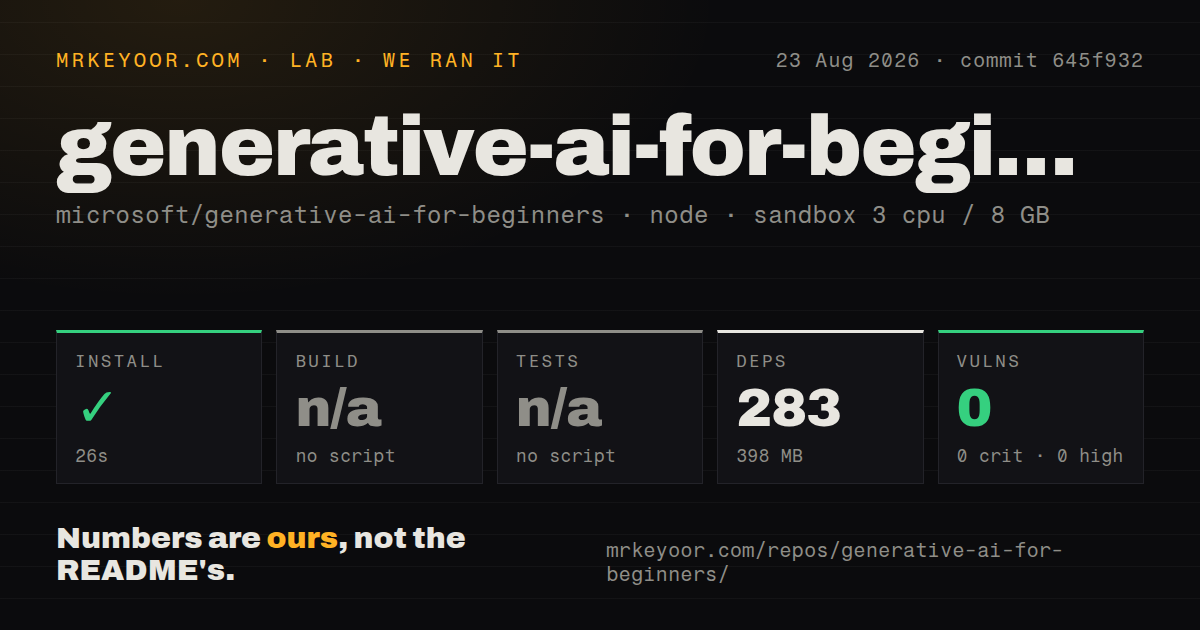
Our sandbox installed 283 npm packages in 26 seconds and used 398 MB on disk. Npm audit reported 0 known vulnerabilities: 0 critical, 0 high, 0 moderate, and 0 low. The run used commit 645f932 in an unprivileged Debian container with 3 CPUs and 8 GB of RAM. Seven CI workflow files and a tests directory were present.
No build script or target was exposed, so our harness skipped the build. No test script or target was exposed, so it skipped tests as well. We did not call a model provider, execute all notebooks, compare generated answers, or validate every Python and TypeScript sample. The successful 26-second install applies only to the npm dependency step, not to the advertised course exercises.
The repository held 12,160 files, about 3,540 lines classified as source, and occupied 941.8 MB at checkout. That unusual ratio makes sense after reading the README: the tree contains more than 50 automated language translations and translated images. Microsoft provides sparse-checkout commands that exclude both directories, which is the sensible clone method if you only need English.
Twenty-one advertised lessons trade depth for range
A learner can start with concepts and finish with working patterns across chat, search, images, tools, RAG, and agents. That sequence helps people learn the vocabulary used in current SDK documentation. Security, responsible use, lifecycle work, and UX have dedicated lessons, so the curriculum does not present prompt writing as the entire discipline.
Range creates discontinuity. Different lessons may use different providers, languages, or notebooks, and each folder carries its own instructions. The repository is better approached as a shelf of guided modules than a single project that grows lesson by lesson. Keep a small notes file recording the provider, model, environment variables, and package versions used for each exercise, especially when jumping directly to lesson 15 or 17.
Fifty-plus translations help readers and inflate the clone
The source README is English, with automated translations linked for more than 50 languages. That makes the material accessible to a much wider class, though automated translation can mishandle technical terms or drift behind a recent English edit. Contributors are told not to submit machine translations themselves and to work only in languages they know, even though the existing translation pipeline is automated.
For English-only study, downloading 941.8 MB is needless. The documented sparse clone filters blobs and omits both translations and translated_images. Instructors using a local mirror can make the same choice, then link learners to the hosted translations when needed. A translated lesson should still be checked against the English code block when an environment variable, SDK name, or retirement date looks inconsistent.
Current source activity is strong, with no GitHub release object
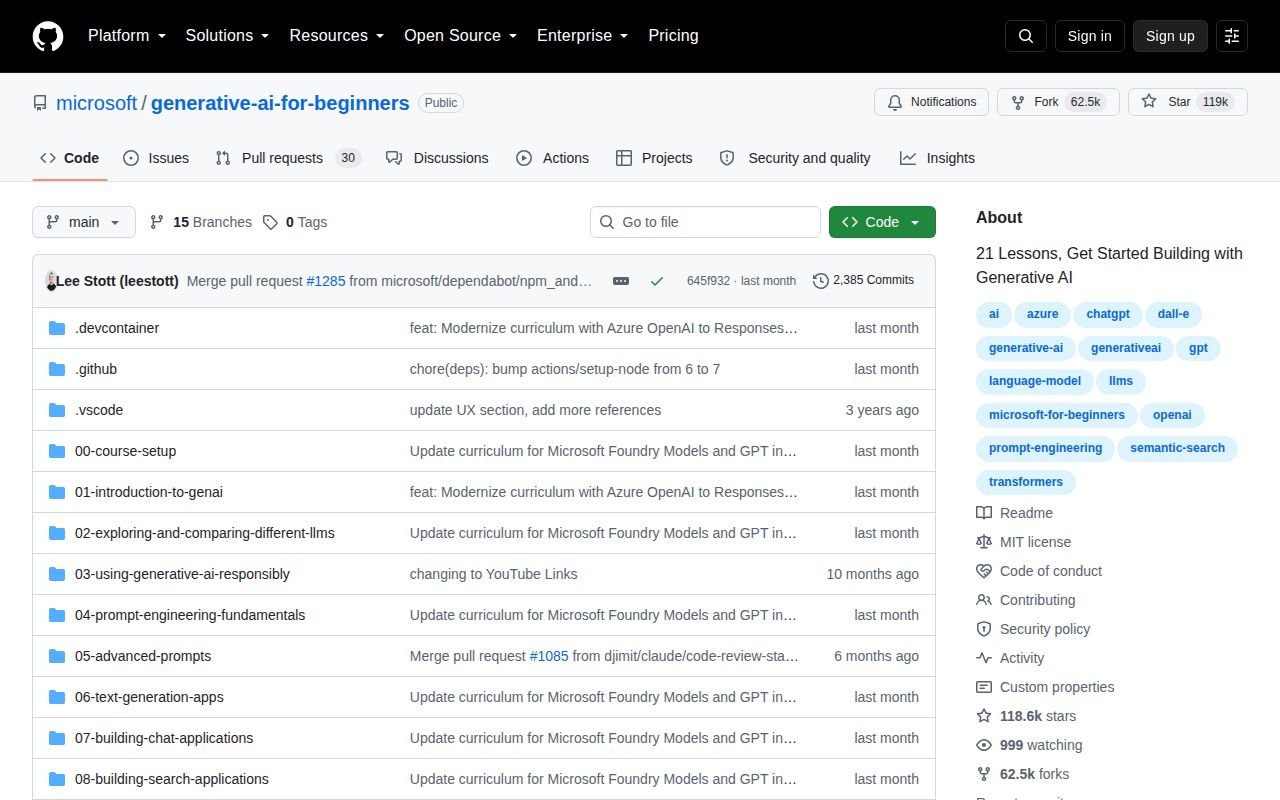
GitHub showed 118,620 stars and 30 combined issues and pull requests when fetched. The last push was August 27, 2026. The latest-release API returned no GitHub release object, but that is not evidence of abandonment: this is a course repository labeled Version 3 in its README, and its source changed on the day of review. Course maintenance is visible in commits and lesson edits rather than packaged releases.
The right expectation is a maintained curriculum, not a supported software distribution. Our run found a clean npm audit and a quick dependency install, yet no root test command capable of proving 21 lessons across multiple providers. Read the explanations, run the exercises you care about, and challenge their outputs. For a beginner who already codes, that is a useful path; for production architecture or model research, it is only the first pass.